
Ulnar Neuropathy: Causes, Symptoms, and Effective Therapies for Nerve Entrapment
 Jan, 27 2026
When your ring and little fingers go numb while driving, holding a phone, or sleeping, it’s not just a random tingling. It could be your ulnar nerve being squeezed - a condition called ulnar neuropathy. This isn’t rare. In fact, it’s the second most common nerve compression problem in the arm, after carpal tunnel syndrome. And if ignored, it can lead to permanent muscle loss in your hand, weak grip, and even a claw-like deformity of your fingers.
What Exactly Is Ulnar Neuropathy?
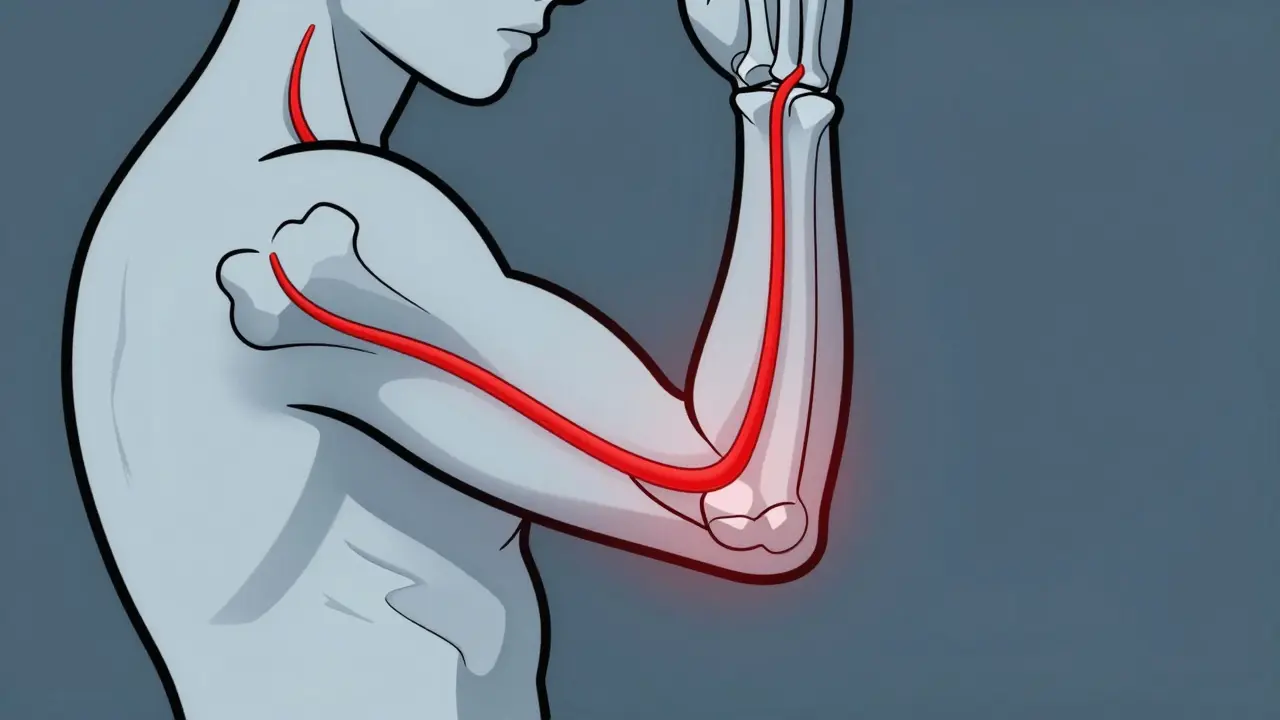
The ulnar nerve runs from your neck down to your hand. It’s responsible for feeling in your pinky and half of your ring finger, plus the muscles that let you pinch and grip things. It’s not protected by much muscle or fat - especially where it bends around the inside of your elbow. That’s the cubital tunnel, a tight space made of bone and ligaments. When you bend your elbow for long periods, the nerve gets pinched against the bone. There are two main spots where this happens:- Cubital tunnel syndrome - at the elbow. This is the most common, making up about 90% of cases.
- Guyon’s canal syndrome - at the wrist. Less common, but often caused by cysts, trauma, or repetitive pressure from tools or handlebars.
How Do You Know It’s Ulnar Neuropathy?
Symptoms don’t come out of nowhere. They creep in slowly. At first, you might notice:- Intermittent numbness or tingling in your pinky and ring finger - especially when your elbow is bent.
- A strange sensation when you lean on your elbow, like when resting it on a car door or desk.
- Waking up at night with your hand “asleep,” needing to shake it out.
- Constant numbness - even when you’re not bending your elbow.
- Weakness when gripping or pinching. You might drop things more often.
- Claw hand - your ring and little fingers curl inward because the muscles that straighten them have weakened.
- Visible muscle loss in your palm, near the base of your pinky.
What Makes It Worse?
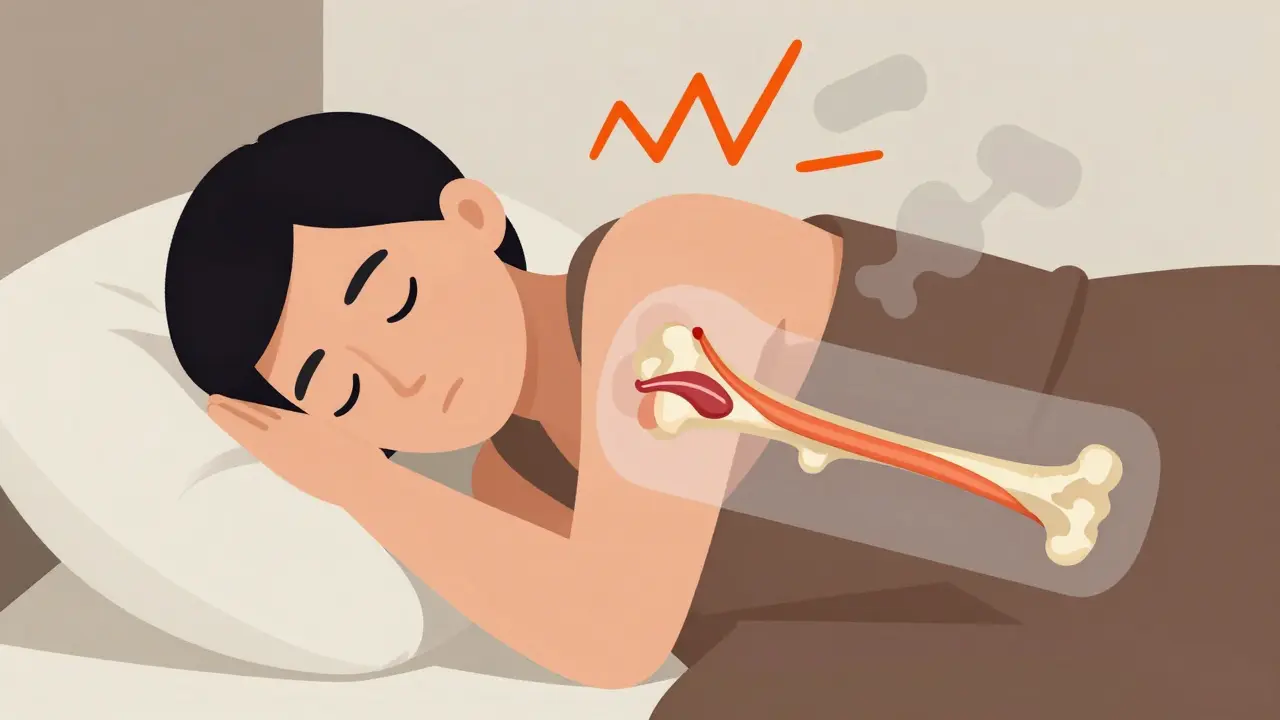
Certain habits and jobs make ulnar neuropathy more likely:- Sleeping with your elbow bent under your head or pillow.
- Driving for long hours with your arm resting on the window.
- Working at a desk with your elbow propped on the armrest.
- Repetitive motions - like swinging a golf club, hammering, or using vibrating tools.
- Jobs in plumbing, auto repair, or customer service where you hold a phone to your ear for hours.
Conservative Treatment: What Works Before Surgery
If you catch it early - before muscle loss - you have a strong chance of fixing it without surgery. About 50% of all patients improve with non-invasive methods. For mild cases, that number jumps to 90%. Here’s what doctors recommend first:1. Avoid Pressure on the Elbow
Stop leaning on your elbows. Use a pillow to support your arm while sleeping. Don’t rest your arm on car doors or desk edges. Simple changes like these can stop the nerve from getting worse.2. Nighttime Splinting
Wearing a soft elbow splint at night keeps your arm straight. This prevents the nerve from being stretched or compressed during sleep. Most patients wear it for 4-6 weeks. Many report major improvement within days.3. NSAIDs and Medications
Over-the-counter pain relievers like ibuprofen or naproxen help reduce swelling around the nerve. For nerve pain, doctors sometimes prescribe gabapentin or pregabalin. These don’t fix the compression, but they calm the pain signals.4. Physical Therapy
A certified hand therapist will teach you nerve gliding exercises. These aren’t stretches - they’re gentle movements that help the nerve slide smoothly through its tunnel. Do them 3-4 times a day. You’ll also get exercises to strengthen weak hand muscles and improve flexibility.5. Corticosteroid Injections
If swelling is the main issue, a doctor may inject corticosteroids near the nerve. This reduces inflammation and can give you months of relief. It’s not a cure, but it can buy time to avoid surgery.6. Emerging Options
Newer treatments like ultrasound-guided hydrodissection are showing promise. A thin needle injects fluid around the nerve to gently separate it from surrounding tissue. It’s minimally invasive and works well for some patients who don’t respond to other methods. Platelet-rich plasma (PRP) is being studied too, but evidence is still limited.When Surgery Becomes Necessary
If you have muscle wasting, constant numbness, or weakness that doesn’t improve after 2-3 months of conservative care, surgery is the next step. About 38% of moderate cases don’t respond to non-surgical treatment. Delaying surgery increases the risk of permanent damage. There are three main procedures:- Simple decompression - the surgeon cuts the ligament over the nerve to give it more space. It’s the least invasive, with a 6-12 week recovery.
- Anterior transposition - the nerve is moved from behind the elbow to the front. This prevents it from getting caught when you bend your arm. Recovery takes 3-6 months.
- Medial epicondylectomy - the bony bump on the inside of your elbow is partially removed to give the nerve more room.
What to Expect Long-Term
With proper treatment, 85-90% of people recover good hand function. But recovery depends on timing. If you’ve had muscle loss for over a year, full strength may never return. That’s why early diagnosis matters. Doctors now use tools like the QuickDASH questionnaire to track progress. It measures how much the condition affects daily tasks - from opening jars to typing. This helps decide if treatment is working.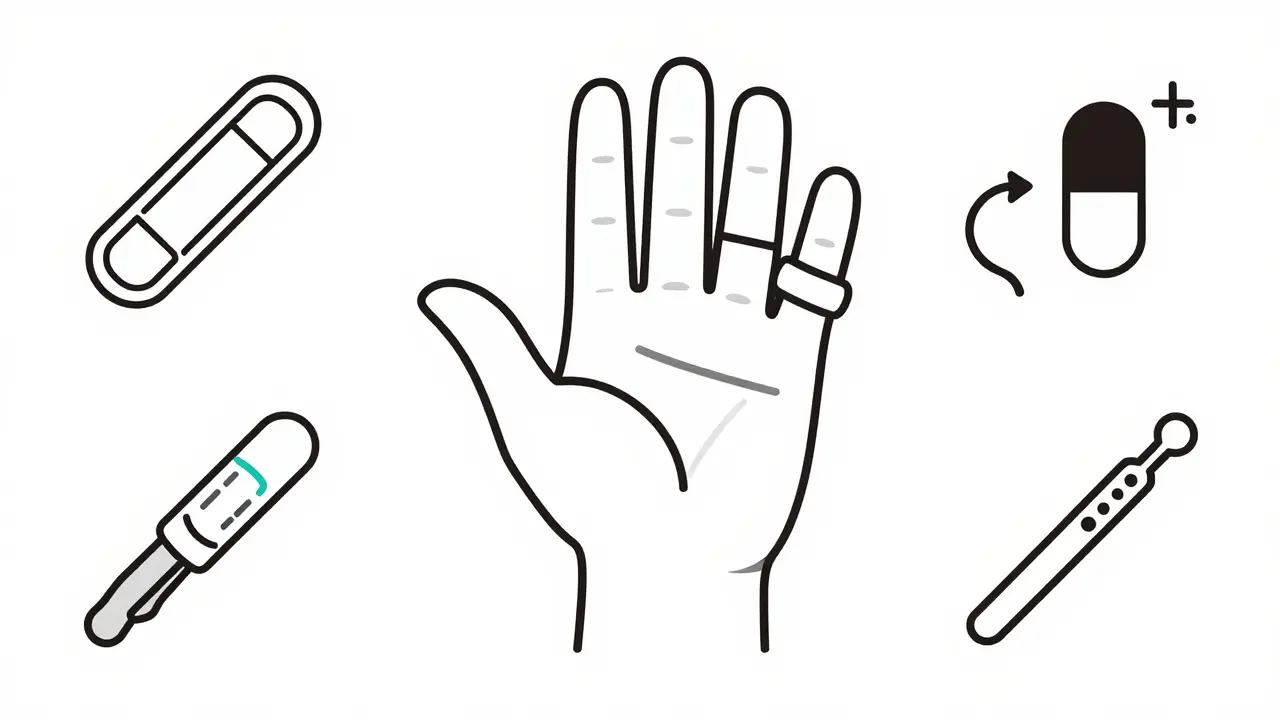
Cost and Practical Considerations
Conservative care - splints, therapy, and meds - usually costs $200-$500. Surgery runs $5,000-$15,000, depending on location and complexity. Insurance typically covers both, but check your plan. Workplace changes can make a big difference. Ergonomic adjustments - like raising your chair, using a headset, or switching tools - can prevent recurrence. Many patients return to work without symptoms after these changes.How to Know If You’re Getting Better
Track your symptoms:- Are you waking up less often with numb hands?
- Can you hold a coffee cup without dropping it?
- Does your pinky still curl inward when you make a fist?
Can ulnar neuropathy go away on its own?
Sometimes, yes - if it’s mild and you stop the activities causing pressure on the nerve. But if symptoms last more than a few weeks or include muscle weakness, it won’t fix itself. Waiting too long can lead to permanent damage.
Is ulnar neuropathy the same as carpal tunnel?
No. Carpal tunnel affects the median nerve at the wrist, causing numbness in the thumb, index, and middle fingers. Ulnar neuropathy affects the ulnar nerve at the elbow or wrist, impacting the ring and little fingers. They’re different nerves, different locations, different symptoms.
Can I still play sports with ulnar neuropathy?
Avoid activities that bend your elbow for long periods or put pressure on it - like golf, tennis, or cycling. Once symptoms improve, you can return with modifications: use padded gloves, adjust your grip, or switch to low-impact alternatives. Always listen to your body.
How long does it take to recover from surgery?
Simple decompression: 6-12 weeks. Transposition or epicondylectomy: 3-6 months. Full strength and sensation may take longer. Hand therapy is critical - skipping it increases the risk of poor outcomes.
Are there any home remedies that help?
Yes - but they’re supportive, not cures. Use ice packs to reduce swelling, avoid leaning on elbows, sleep with your arm straight, and do gentle nerve glides daily. Over-the-counter pain relievers can help with discomfort. But if symptoms persist, see a specialist.
Can ulnar neuropathy come back after treatment?
Yes, especially if the root cause isn’t addressed. People who return to repetitive elbow-bending jobs or habits without changes often see symptoms return. That’s why lifestyle adjustments and ergonomic changes are just as important as medical treatment.
Next Steps If You Suspect Ulnar Neuropathy
If you’re experiencing numbness or weakness in your ring and little fingers:- Stop activities that bend your elbow for long periods.
- Start wearing a soft elbow splint at night.
- Take an NSAID for 7-10 days if swelling is suspected.
- See a doctor or hand specialist within 2-4 weeks.
- Get an EMG/NCS test - it’s the gold standard for diagnosing nerve compression.
matthew martin
January 27, 2026 AT 18:35Man, I thought my numb pinky was just from sleeping wrong. Turns out I’ve been propping my elbow on the car door for years like some kind of lazy caveman. That splint idea? Genius. Ordered one last night - woke up with my arm straight for the first time in a decade. Feels weird. Like my elbow finally got a hug.
Also, the nerve gliding exercises? I did them while watching Netflix. No joke, after three days my ring finger stopped feeling like it was wrapped in plastic wrap. Who knew your nerves needed yoga too?
Chris Urdilas
January 29, 2026 AT 12:30So let me get this straight - we’re paying $15K to move a nerve around like it’s a bad roommate? Meanwhile, my cousin just glued a tennis ball to his elbow and called it ‘ergonomic.’ He’s back on his motorcycle. I’m not saying it works, but… I’m not not saying it doesn’t.
Also, why is every medical article written like a TED Talk? Just tell me what to stop doing. I’m not signing up for a nerve spa retreat.
Jeffrey Carroll
January 31, 2026 AT 04:28It is imperative to underscore the significance of early intervention in cases of ulnar neuropathy. The literature consistently demonstrates that irreversible motor deficits become statistically significant after prolonged compression exceeding twelve months. Conservative modalities, including nocturnal splinting and targeted physical therapy, remain the cornerstone of initial management.
Furthermore, the utilization of EMG/NCS remains the diagnostic gold standard, as clinical correlation alone is insufficient to rule out coexisting pathologies. I strongly encourage patients to consult a certified hand therapist prior to considering surgical options.
Phil Davis
February 1, 2026 AT 01:31Yep. The elbow’s the worst. It’s like nature’s way of saying ‘you’re not allowed to be comfortable.’
Also, why is the cubital tunnel always the one that gets the short end of the stick? No fat, no cushion, just bone and spite. I once rested my elbow on a granite countertop for five minutes and spent the next hour convinced I’d lost my hand. Turns out, I just had a nerve tantrum.
Irebami Soyinka
February 2, 2026 AT 18:05USA doctors think they invented medicine? In Nigeria, we cure this with bitter leaf tea and a slap on the elbow - works better than your fancy splints. You think your nerve is ‘compressed’? Try living without electricity for three months then tell me about nerve glides.
Also, your ‘surgery’ costs more than my entire village’s monthly income. You’re not healing people - you’re selling dreams. 🤡
And yes, I still lift goats. My pinky doesn’t care about your cubital tunnel.
doug b
February 3, 2026 AT 03:30Stop leaning on your elbow. That’s it. That’s the whole fix. No splint? Fine. Just don’t rest your arm on the window. No therapy? Okay. Just don’t sleep like a fetal shrimp.
I had this for six months. Did zero of the stuff in the article. Just stopped propping my elbow. Two weeks later - gone. Your body’s not broken. You’re just using it wrong.
Mel MJPS
February 3, 2026 AT 03:45I’ve been doing the night splint for three weeks and I can’t believe how much better I feel. I used to wake up every night thinking my hand was dead. Now I just roll over and go back to sleep. It’s not magic - it’s just… not hurting anymore.
Also, I started using a headset at work. No more phone-on-shoulder. That alone cut my tingling in half. Small changes, big wins. You got this 💪
Jess Bevis
February 3, 2026 AT 13:35Elbow = nerve trap. Stop bending it. Splint at night. Done.
Rose Palmer
February 4, 2026 AT 00:12It is of paramount importance to recognize that the efficacy of conservative interventions is directly proportional to patient adherence. Noncompliance with nocturnal splinting protocols, coupled with continued occupational or recreational mechanical stressors, significantly diminishes therapeutic outcomes. Furthermore, the integration of evidence-based hand therapy regimens has demonstrated statistically significant improvements in functional outcomes, as measured by the QuickDASH instrument. Surgical intervention should be considered only after a minimum of twelve weeks of structured, supervised nonoperative management.
Mindee Coulter
February 5, 2026 AT 13:50My cousin got surgery and now he can’t even hold a beer without his fingers doing that weird claw thing again. I told him he should’ve just stopped leaning on his arm at the bar. He said I didn’t understand. I said I did. I’ve got the same numb pinky. I just don’t care enough to get a splint.
Also, I use my elbow as a pillow. I’m not changing. 😘
Brittany Fiddes
February 6, 2026 AT 21:19Oh, so this is what happens when Americans treat their bodies like disposable IKEA furniture - bend it, break it, then pay $15,000 to fix it with a ‘transposition.’ How quaint. In London, we simply stop being sloths. No splints. No injections. Just posture. And a bit of disdain for those who mistake ergonomic advice for medical intervention.
Also, ‘nerve gliding’? That’s not a therapy - it’s a yoga trend that got a lab coat. I once saw a man do it while holding a latte. I nearly cried. For England.