
Risk Perception: How Patients Judge the Safety of Generic Drugs
 Jan, 20 2026
When your doctor hands you a prescription and says, "This is the same medicine, just cheaper," do you believe them? For millions of people, the answer is no. Even though generic drugs are required by law to work exactly like their brand-name versions, many patients still worry they’re getting something weaker, less safe, or even fake. This isn’t about ignorance-it’s about risk perception. And it’s costing the system billions.
Why Do People Think Generics Are Riskier?
The word "generic" carries baggage. It sounds like "cheap," "plain," or "second-rate." That’s not how the FDA sees it-they require generics to match brand-name drugs in active ingredients, strength, dosage form, and how fast they work. But patients don’t read regulatory documents. They see the pill looks different. They hear a story about someone who felt worse after switching. And suddenly, science doesn’t matter as much as feeling. A 2012 CDC survey found that 20 to 40% of patients weren’t sure if generics were as safe or effective. One in five outright believed they were less safe. That’s not a small number. That’s millions of people filling prescriptions with doubt in their chest. Here’s what they’re afraid of:- Generics don’t work as well
- They take longer to kick in
- They cause more side effects
- They’re made in sketchy factories
When Real Life Contradicts the Science
Science says generics are bioequivalent-meaning they deliver the same amount of medicine into your bloodstream within a tight range (80-125% of the brand). But biology isn’t a lab. It’s your body, your nerves, your sleep, your diet, your stress. Take sertraline. One Reddit user wrote: "Switched to generic sertraline and had terrible withdrawal symptoms. Went back to brand-problems stopped." That’s not rare. On PatientsLikeMe, nearly 40% of users who switched to generic antidepressants reported different side effects. A 2012 FDA safety alert even flagged certain generic versions of bupropion XL for inconsistent absorption. These aren’t isolated cases. They’re real experiences that override statistical averages. When your blood pressure spikes after switching to a generic, or your anxiety flares up, you don’t think, "Hmm, maybe the bioequivalence range is wide." You think, "This generic isn’t the same." And here’s the cruel twist: the brand-name version isn’t always better. In fact, the same company that makes the brand often sells the exact same pill under a generic label. These are called "authorized generics." But patients don’t know that. And when they find out, it makes them more confused-not less suspicious.Who’s Most Likely to Doubt Generics?
Not everyone feels the same way. Risk perception isn’t random. It’s shaped by who you are.- Older adults (60+): 31.9% worry about side effects, compared to 24.7% of younger people.
- People with lower education: They’re nearly twice as likely to believe generics are dangerous.
- Black and Hispanic patients: 1.8 times more likely to express safety concerns than white patients.
- Unemployed or retired people: More accepting of generics-probably because cost matters more.
- Rural patients: Often think generics are weaker and need higher doses, which they link to more side effects.
Doctors and Pharmacists Are the Missing Link
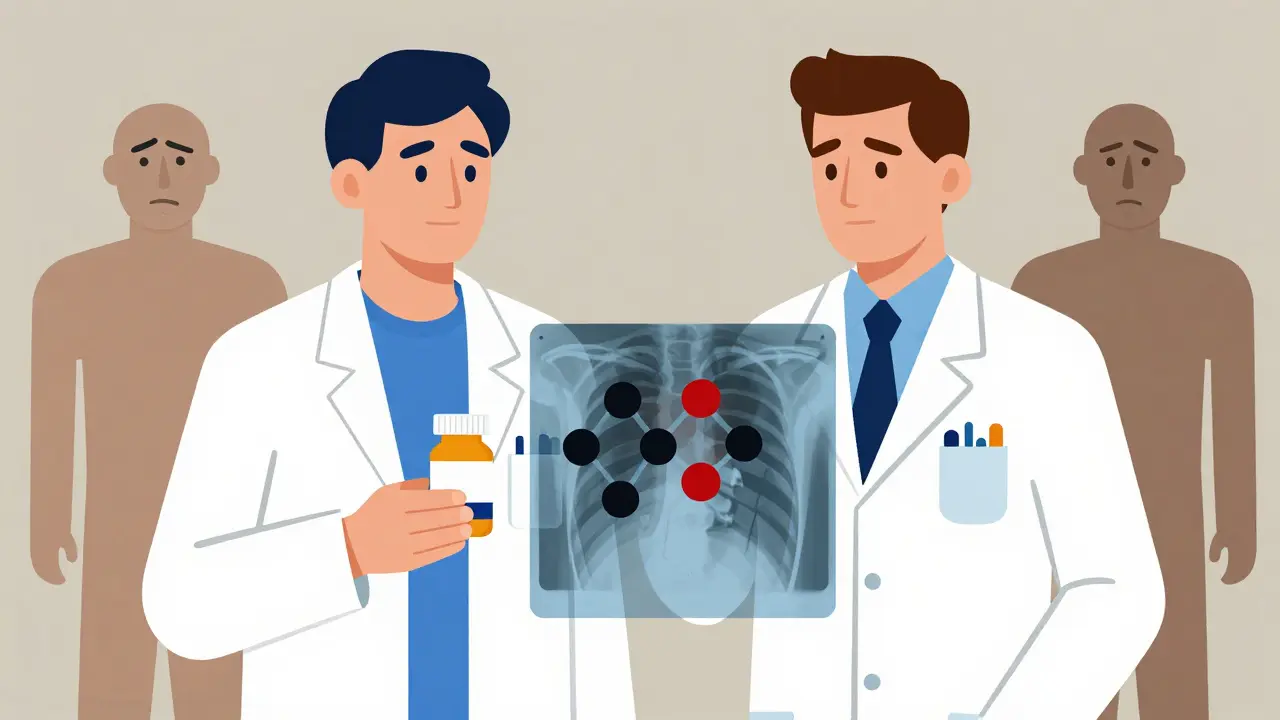
The biggest factor in whether someone accepts a generic? What their provider says. A 2011 study found patients who got a simple explanation about bioequivalence from their doctor were 3.2 times more likely to take the generic. Not a pamphlet. Not a website link. A two-sentence conversation: "This pill has the same active ingredient, same dose, same effect. The only difference is the color and the price." Pharmacists can help too. Patients who got counseling from their pharmacist about generics had 37% higher adherence. But here’s the problem: the average pharmacist-patient chat about a generic switch lasts 47 seconds. That’s less time than it takes to microwave a bag of popcorn. And the materials they’re given? The FDA’s own FAQ on generics got a 3.2 out of 5 clarity score from health literacy experts. Meanwhile, AARP’s guide scored 4.5. That’s not a small gap. That’s a chasm.How to Fix This
You can’t fix perception with data alone. You need trust, timing, and clarity.- Introduce generics at the moment of prescription. That’s when patients are most open. Waiting until the pharmacy counter is too late.
- Use simple, visual language. Instead of "bioequivalent," say "same medicine, same effect, cheaper."
- Train providers to talk about it. Not as a cost-saving tactic, but as a safety and quality choice.
- Target high-risk groups. If you know someone is older, has low health literacy, or belongs to a group with higher skepticism, give them extra time and resources.
- Make the savings visible. Medicare plans that offer $0 copays for generics saw 18% higher use. When money is no barrier, fear loses power.
The Real Cost of Doubt
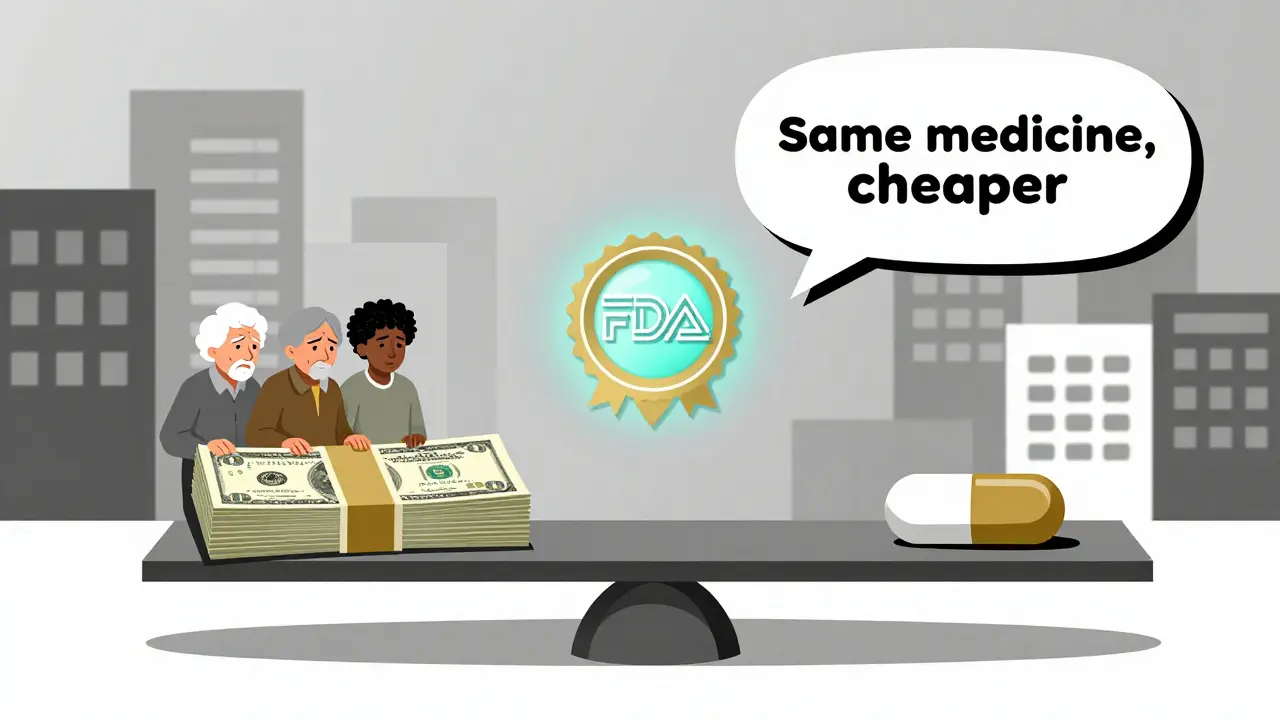
Generics make up 90% of all prescriptions in the U.S. But they only cost 23% of the total drug bill. That’s $370 billion saved every year. Yet, because of fear, patients still ask for brand-name drugs. The Congressional Budget Office estimates that unnecessary brand prescriptions cost the system $8 billion a year. And if we could close the trust gap entirely, we could save another $185 billion over the next decade. This isn’t just about money. It’s about access. It’s about fairness. It’s about making sure people aren’t paying more-or taking less-because they don’t trust the system.What You Can Do
If you’re taking a generic drug and you’re worried:- Ask your doctor: "Is this the same as the brand?" Don’t be embarrassed. Most doctors expect this question.
- Ask your pharmacist: "Can you explain how this works?" They’re trained to answer this.
- Don’t assume a change in how you feel is the drug’s fault. Stress, diet, sleep, and other meds can shift your response.
- If you do feel worse after switching, don’t just quit. Talk to your provider. There might be a batch issue-or something else going on.
Are generic drugs really the same as brand-name drugs?
Yes. The FDA requires generic drugs to have the same active ingredient, strength, dosage form, and route of administration as the brand-name version. They must also be bioequivalent, meaning they deliver the same amount of medicine into your bloodstream within a very tight range (80-125%). The only differences are inactive ingredients like color, shape, or filler-which don’t affect how the drug works.
Why do some people feel worse after switching to a generic?
It’s not always the drug. Many factors can change how you feel: stress, sleep, diet, other medications, or even the placebo effect. Some people notice differences because they expect to. But in rare cases, certain generic versions-especially for complex drugs like extended-release pills or inhalers-can have slight variations in how they’re absorbed. If you feel worse, don’t assume it’s the generic. Talk to your doctor. They can check if it’s a known issue or if you need to switch back.
Can I ask for the brand-name drug instead?
Yes. You have the right to ask your doctor for the brand-name version. But be aware: your insurance may require you to pay more-or even refuse to cover it. Some doctors will only prescribe the brand if there’s a medical reason, like a documented adverse reaction to a specific generic. If cost is a concern, ask your pharmacist about authorized generics-they’re made by the brand company but sold as generics, so they’re identical.
Are generics made in worse factories?
No. The FDA inspects all drug manufacturing facilities-brand and generic-using the same standards. Many generic drugs are made in the same factories as brand-name drugs. In fact, brand companies often produce their own generics under different labels. The FDA also monitors quality through random testing and has increased inspections since 2012. If a facility fails, it’s shut down-regardless of whether it makes brand or generic drugs.
Why do some generics look different from the brand?
By law, generic drugs can’t look exactly like the brand. That’s to avoid trademark infringement. So the color, shape, or markings may be different. But the active ingredient and how it works in your body are identical. Think of it like two different brands of aspirin-they look different, but they both contain acetylsalicylic acid and do the same thing.
Do generics take longer to work?
No. Generic drugs must work at the same rate as the brand-name version. The FDA tests how quickly the medicine enters your bloodstream. If it’s too slow or too fast, it won’t be approved. Any difference in how fast you feel relief is likely due to your body’s condition, not the drug itself.
How can I tell if my generic is safe?
Check the label. All approved generics in the U.S. must list the active ingredient and be sold by licensed pharmacies. You can also look up the drug on the FDA’s website (Orange Book) to confirm it’s approved. If you’re unsure, ask your pharmacist to verify it’s FDA-approved. Avoid buying generics from unlicensed online sellers-those aren’t regulated and can be dangerous.
Jerry Rodrigues
January 21, 2026 AT 18:19Been on generics for years. Never had an issue. My blood pressure med? Same as the brand. My anxiety pill? Same. The only difference is my wallet doesn’t cry.
MARILYN ONEILL
January 22, 2026 AT 08:41Wow. So you’re telling me my body’s just being dramatic? Like I’m not supposed to notice when I feel like crap after switching? That’s rich. I’m not dumb. I feel it. You can’t just say ‘it’s placebo’ and call it a day.
Coral Bosley
January 23, 2026 AT 19:36I switched to generic sertraline and my soul collapsed. I didn’t just feel off-I felt like someone replaced my brain with wet cardboard. I went back to the brand. My therapist said I was ‘overreacting.’ But my body knew better. Science doesn’t live in my nervous system. My panic attacks do.
And now they want me to trust a pill that looks like a toy from a vending machine? No. Not after what happened.
Uju Megafu
January 25, 2026 AT 04:53THIS is why America is falling apart. People trust Big Pharma more than their own bodies. Generics are made in China and India by people who don’t even wash their hands before packaging. You think the FDA checks every batch? LOL. My cousin’s uncle’s neighbor’s daughter died from a fake generic. It was in the news. You just ignore it because it’s inconvenient.
And now you want us to swallow it? Literally? With a smile?
Melanie Pearson
January 25, 2026 AT 07:00Let me be clear: the FDA is a corrupt bureaucratic shell. The ‘bioequivalence’ range of 80-125% is a joke. That’s a 45% variance. One pill could be half as strong, another could be 25% stronger. That’s not medicine-that’s Russian roulette with your neurotransmitters.
And don’t even get me started on the ‘authorized generics.’ That’s not transparency. That’s corporate manipulation disguised as honesty. The same company that charges $500 for the brand sells you the identical pill for $5 and calls it ‘savings.’ It’s a scam dressed in white coats.
And you want me to trust this system? After the opioid crisis? After the Vioxx cover-ups? After every single pharmaceutical scandal since 1998? No. I will not be a lab rat for profit-driven pseudoscience.
My doctor says it’s ‘the same.’ But my body doesn’t lie. And my body remembers the difference.
So no. I won’t take the generic. And if you think I’m irrational, you’re the one who’s been conditioned to accept exploitation as ‘efficiency.’
lokesh prasanth
January 25, 2026 AT 18:42body feels difference. science says no. who to believe? maybe both are right. maybe the pill is same but the mind is not. maybe the mind is the drug.
Steve Hesketh
January 27, 2026 AT 09:57I get why people are scared. I used to be one of them. I switched to a generic for my thyroid med and felt like I was drowning in slow motion. I went back to brand. Felt normal again. But then I found out the generic was made by the same company as the brand-just sold under a different name. I was furious. Then I tried it again. Same pill. Same results. Turns out my stress about switching was making me feel worse. Not the drug. My fear.
That doesn’t mean it’s not real for you. But sometimes the enemy isn’t the pill. It’s the story we tell ourselves about it.
Sangeeta Isaac
January 28, 2026 AT 11:38So let me get this straight. The FDA says generics are fine, but people feel worse, so we should just give them the expensive version? That’s not science, that’s appeasement. And what about the people who can’t afford the brand? Do they just suffer silently? Or worse-skip doses because they’re scared the cheap one will kill them?
Also, the fact that pharmacists get 47 seconds to explain this? That’s criminal. I’ve seen pharmacists hand over a pill like it’s a lottery ticket and say ‘here you go’ without even making eye contact. No wonder people are terrified.
And don’t even get me started on how doctors don’t talk about this until it’s too late. I had to beg mine to explain why my new generic looked like a neon jellybean. She sighed and said ‘it’s just the dye.’ Like that fixes everything.
Fix the system. Train the providers. Stop treating patients like idiots. And stop pretending that money isn’t the real reason we’re pushing generics.
MAHENDRA MEGHWAL
January 29, 2026 AT 20:59It is not merely a matter of bioequivalence. It is a matter of human dignity. When a patient is told, ‘This is the same,’ and yet experiences a change in well-being, the response must be compassion, not condescension. The scientific data is not the whole truth. The lived experience is equally valid. To dismiss it is to abandon the very foundation of medical ethics.
Therefore, the solution lies not in persuasion, but in partnership. The provider must listen. The system must accommodate. The patient must be seen.
Dee Monroe
January 30, 2026 AT 16:08I think we’re missing the deeper point. It’s not about whether the pill works the same. It’s about control. When you’re sick, you feel powerless. You’re handed a prescription and told to trust strangers in labs you’ve never seen. Then you’re told to trust a pill that looks different, costs less, and has no story behind it. No brand legacy. No marketing. No emotional weight. Just… a tablet.
People don’t just want medicine. They want meaning. They want to believe they’re getting the best. The brand isn’t just a drug-it’s a symbol of care, of investment, of worth. When you replace it with a generic, you’re not just changing the pill. You’re changing the narrative of their healing.
And that’s why we need more than data. We need ritual. We need reassurance. We need to tell people, ‘I see you. I hear you. This matters to me too.’
That’s the real cure. Not the active ingredient. The attention.
Maybe we should start prescribing empathy instead of pills.
Alex Carletti Gouvea
January 30, 2026 AT 21:01Generics are a socialist plot to destroy American healthcare. You think China and India are making safe pills? They don’t even have clean water. This is why our veterans are dying. This is why our kids are getting sick. Stop pushing foreign-made junk on hardworking Americans. If you want cheap, go buy a knockoff iPhone. But don’t poison your body for a few bucks.
Kevin Narvaes
January 31, 2026 AT 19:58the real issue? we trust corporations more than our own bodies. the brand name? that’s a lie. the generic? that’s a lie too. the truth? you’re just a number in a spreadsheet. and the pill? it’s just a chemical that makes you feel something. maybe better. maybe worse. doesn’t matter. as long as the profit margin stays above 12%. we’re all just lab rats with insurance cards.