
Pulmonary Embolism: Sudden Shortness of Breath and How It's Diagnosed
 Nov, 29 2025
One minute you’re walking up the stairs, the next you can’t catch your breath. No fever. No cough. No asthma inhaler helps. Just this crushing, unexplained gasping for air - and your heart is racing. If this sounds familiar, you’re not alone. Thousands of people every year experience exactly this: a sudden, terrifying loss of breath that turns out to be a pulmonary embolism - a blood clot blocking an artery in the lung.
Most people don’t realize how common this is. In the U.S. alone, about 100,000 people die from it each year. Many more survive, but only because they got lucky - or because someone finally listened. The problem isn’t the clot itself. It’s that the symptoms look like everything else: anxiety, a pulled muscle, bronchitis, even a heart attack. And because it’s not always obvious, diagnosis is often delayed. By the time it’s caught, it’s too late for some.
Why Sudden Shortness of Breath Is the Biggest Red Flag
When a clot travels from the leg (or sometimes the arm) and lodges in the lung, it doesn’t just cause pain. It stops blood from flowing properly through the lungs. That means oxygen can’t get into your bloodstream. Your body panics. Your breathing gets faster. Your heart pounds. You feel like you’re suffocating - even when you’re sitting still.
Research from the National Institutes of Health shows that 85% of people with pulmonary embolism have sudden shortness of breath as their first and most obvious symptom. That number jumps to 92% if the clot is large and blocks a major artery. It doesn’t matter if you’re young, fit, or have never had a blood clot before. If your breathing changes out of nowhere - especially if it’s worse when you lie down or move - it’s a warning sign.
What makes this even trickier is that the severity doesn’t always match the danger. Some people with small clots feel like they just ran a mile. Others with massive clots feel fine until they faint. That’s why dismissing breathlessness as “just stress” or “getting out of shape” can be deadly.
Other Symptoms You Can’t Ignore
Shortness of breath rarely comes alone. Look for these other signs, especially if they happen together:
- Chest pain - sharp, stabbing, and worse when you breathe in or cough. It’s often mistaken for a heart attack, but it’s not coming from your heart. It’s from the lung tissue being irritated by the clot.
- Leg swelling - usually in one leg, often the calf. About 44% of PE patients have this. It’s not just a swollen ankle. It’s a full, tender, warm swelling that doesn’t go away with rest.
- Coughing up blood - happens in about 1 in 5 cases. Even a small amount of pink or bloody sputum is a major red flag.
- Fast heartbeat - over 100 beats per minute, without exercise or caffeine.
- Dizziness or fainting - this means the clot is big enough to drop your blood pressure. It’s a medical emergency.
One patient from Melbourne, Sarah, thought she had anxiety. She’d been short of breath for three weeks, climbing stairs or even walking to the mailbox. Her doctor told her to breathe deeply and cut back on coffee. It wasn’t until she collapsed at home that a CT scan found a clot blocking half her lung. She survived - but barely.
How Doctors Diagnose a Pulmonary Embolism
There’s no single test that catches every clot. Diagnosis is a step-by-step process, and it starts with asking the right questions.
First, doctors use tools like the Wells Criteria or the Geneva Score. These aren’t magic formulas - they’re checklists. Points are added for things like: recent surgery, leg swelling, heart rate over 100, or a history of blood clots. If the score is low, the chance of PE is under 10%. If it’s high, the chance jumps to over 50%.
Then comes the D-dimer test. This blood test looks for a protein fragment released when clots break down. A negative result means no clot is likely - but only if you’re low-risk. If you’re over 50, the test becomes less reliable. That’s because older bodies naturally have higher D-dimer levels, even without clots. So for people over 50, doctors don’t rely on D-dimer alone. They go straight to imaging.
The Gold Standard: CTPA Scan
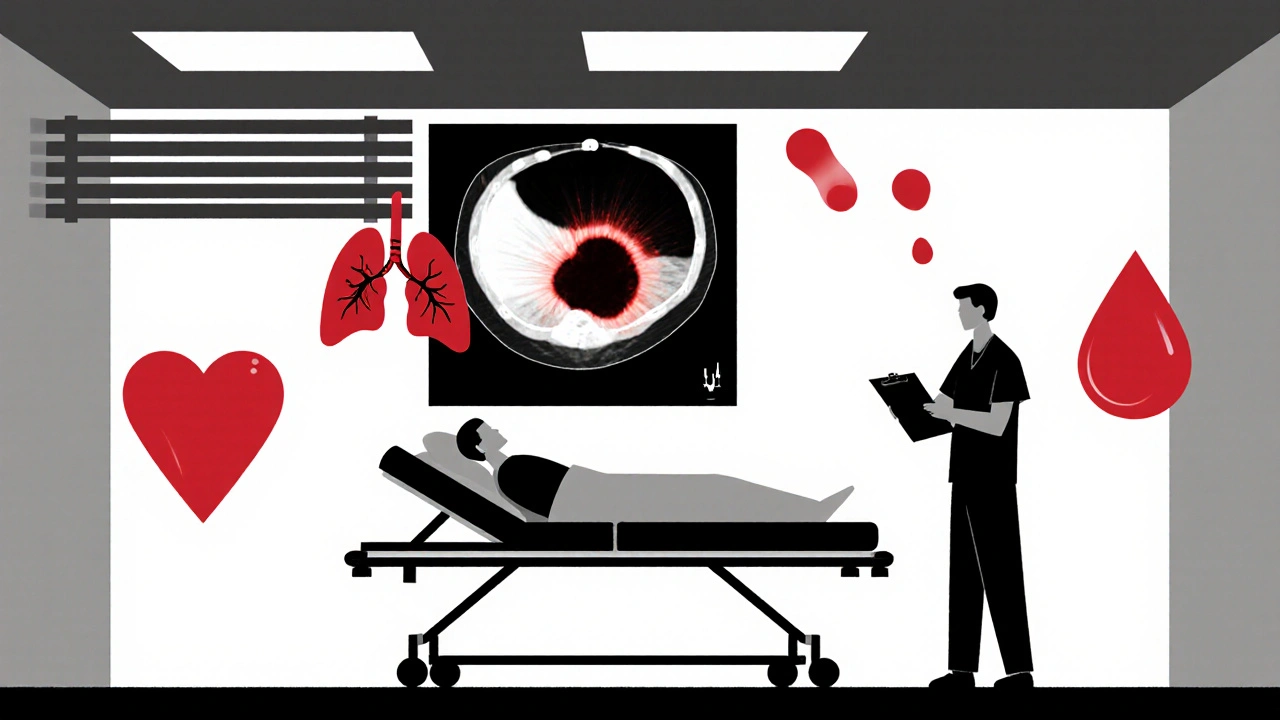
If the D-dimer is positive or you’re high-risk, the next step is a CT pulmonary angiogram - or CTPA. This is the most accurate test for PE. You get a contrast dye injected into your arm, then a CT scanner takes detailed pictures of your lung arteries. The dye makes the blood vessels light up on the screen. If there’s a clot, it shows up as a dark gap in the flow.
CTPA catches 95% of pulmonary embolisms. It’s fast - usually done in under 10 minutes. But it’s not perfect. You need to be able to hold your breath. You need good kidney function to process the dye. And it exposes you to radiation - about the same as 2 years of natural background exposure.
For people who can’t have contrast dye - like those with severe kidney disease or allergies - doctors turn to a V/Q scan. This test looks at airflow and blood flow in the lungs. It’s less common because it needs special nuclear medicine equipment, and not every hospital has it. But when it’s available, it’s just as accurate as CTPA for ruling out PE.
Ultrasound: The Hidden Key
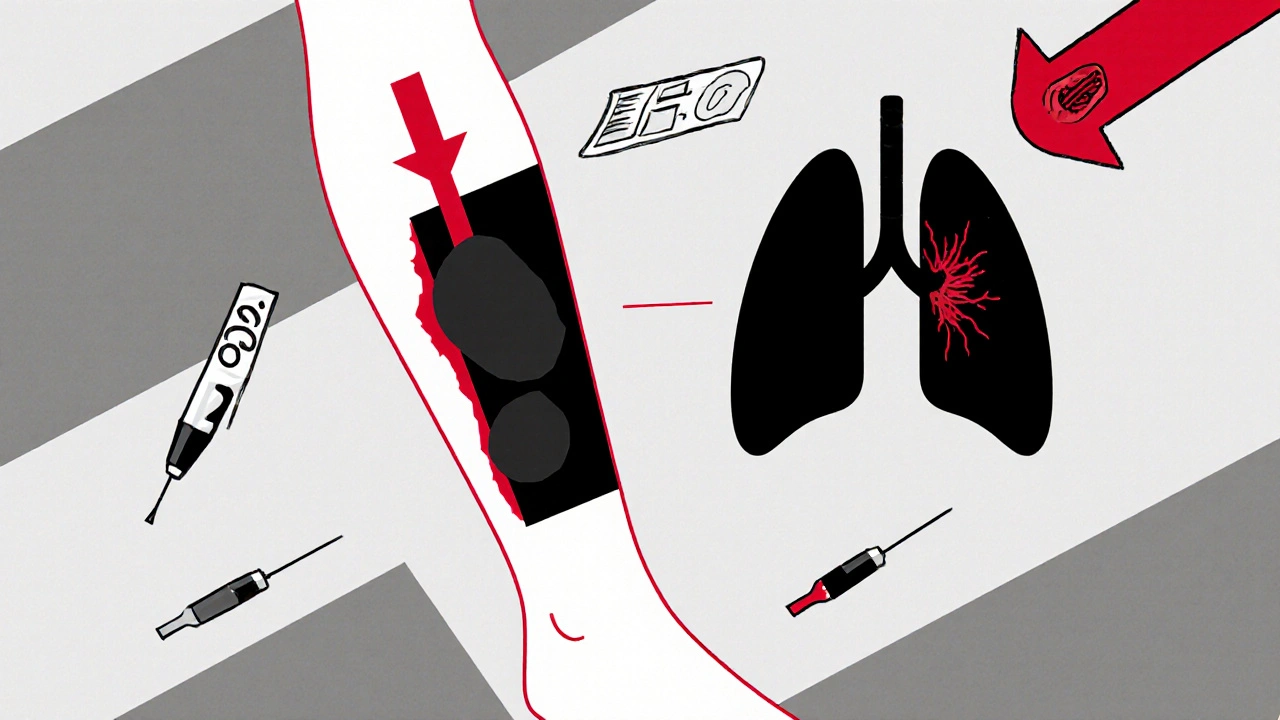
Most clots in the lungs start in the legs. That’s why doctors often check for deep vein thrombosis (DVT) with a compression ultrasound. It’s painless. No radiation. Just a probe pressed against your calf and thigh. If they find a clot in your leg, and you have shortness of breath, the diagnosis is almost certain. In fact, when a leg clot and breathing trouble show up together, the chance of PE is over 96%.
This is why many emergency rooms now do a leg ultrasound before ordering a CT scan - especially if the patient is stable. It’s faster, cheaper, and safer. And it gives doctors a clear answer without exposing you to more radiation or contrast.
When Time Is Critical: What Happens in the ER
If you show up with sudden breathlessness, low blood pressure, and a racing heart - you’re not waiting for test results. You’re in a massive PE. Doctors don’t wait for scans. They go straight to an echocardiogram - an ultrasound of the heart. If the right side of the heart is swollen and struggling, it means the clot is blocking major vessels. That’s life-threatening.
In these cases, treatment starts immediately: clot-busting drugs, high-dose blood thinners, or even emergency surgery to remove the clot. The faster they act, the better your chance. Studies show that hospitals with dedicated Pulmonary Embolism Response Teams (PERT) cut death rates by over 4%.
Why Diagnosis Gets Delayed - And How to Avoid It
A 2022 survey in Australia found that 68% of PE patients visited a doctor at least twice before getting the right diagnosis. Many were told they had asthma, pneumonia, or anxiety. One man in Sydney was prescribed an inhaler for three weeks before collapsing. His wife insisted on a CT scan. The clot was the size of a walnut.
Here’s what you can do:
- If you have sudden breathlessness - especially with leg swelling or chest pain - ask: “Could this be a blood clot?”
- If you’ve had a clot before, are on birth control, recently had surgery, or have cancer - your risk is higher. Don’t downplay new symptoms.
- If you’re over 50, don’t assume a negative D-dimer means you’re safe. Push for imaging if symptoms persist.
- If you’re in the ER and your breathing doesn’t improve, insist on a CTPA or ultrasound. Don’t accept “it’s probably nothing.”
What’s New in PE Diagnosis
Technology is getting smarter. New AI tools can now analyze CTPA scans faster and more accurately than some radiologists. One algorithm, called PE-Flow, caught 93.7% of clots in a trial of over 3,000 scans.
Doctors are also using age-adjusted D-dimer levels. Instead of using the same cutoff for everyone, they now raise the threshold for older patients. For someone 75, a D-dimer under 750 ng/mL might be normal. This reduces unnecessary CT scans by over a third - without missing clots.
Future tests may include blood markers beyond D-dimer - like thrombomodulin or plasmin-antiplasmin - that give a clearer picture of clotting activity. These aren’t routine yet, but they’re coming fast.
What Happens After Diagnosis
Once PE is confirmed, you’ll start on blood thinners - usually for at least 3 months. Some people need them for life, especially if they have cancer, genetic clotting disorders, or repeated clots. About 1 in 3 people with a history of PE will have another one within 10 years.
Recovery isn’t just about medicine. You’ll need to move. Sitting still for long periods is the biggest risk. Walking, even short distances, helps prevent new clots. Compression stockings can help if you had leg swelling. And you’ll need follow-up scans to make sure the clot is dissolving.
Most people go back to normal life. But it takes time. Some feel breathless for months. That’s normal. The lungs heal slowly. Don’t compare yourself to how you were before. Give your body space to recover.
Can you have a pulmonary embolism without knowing it?
Yes - but it’s rare. Small clots in the outer parts of the lungs may cause no symptoms at all. These are often found by accident during scans for other reasons. But if you have any signs - even mild shortness of breath or a fast heartbeat - don’t assume it’s nothing. Most serious cases show clear symptoms.
Is a pulmonary embolism the same as a heart attack?
No. A heart attack happens when blood flow to the heart muscle is blocked. A pulmonary embolism is a clot in the lung arteries. The chest pain can feel similar, but the causes, tests, and treatments are completely different. One affects the heart; the other affects the lungs.
Can birth control cause pulmonary embolism?
Yes. Combined hormonal contraceptives - especially those with estrogen - increase the risk of blood clots. The absolute risk is still low for healthy young women, but it’s 3 to 4 times higher than for women not using them. If you smoke, are over 35, or have a family history of clots, your risk rises even more.
How long does it take for a pulmonary embolism to dissolve?
It depends on the size of the clot and your treatment. Small clots can dissolve in weeks. Larger ones may take months. Blood thinners don’t dissolve clots - they stop them from growing while your body breaks them down naturally. Most people feel better within a few weeks, but full recovery can take 6 months or longer.
Can you prevent pulmonary embolism?
Yes. Stay active. Avoid sitting for long periods - especially on flights or after surgery. Drink water. Wear compression socks if you’re at risk. If you’ve had a clot before, your doctor may recommend long-term blood thinners. For high-risk patients, like those with cancer, preventive shots of anticoagulants are common.
Final Thoughts: Don’t Wait for the Worst
Sudden shortness of breath isn’t just inconvenient - it’s a signal your body is screaming for help. Pulmonary embolism doesn’t care if you’re young, fit, or healthy. It strikes without warning. And the longer you wait, the higher the chance it will kill you.
If you’ve ever felt like you couldn’t breathe - and no one could explain why - ask for a D-dimer test or ultrasound. Push back if you’re told it’s “just anxiety.” You know your body better than anyone. Trust that feeling. And if you’ve had a clot before - be extra careful. Recurrence is real.
The good news? With faster diagnosis and better tools, more people are surviving than ever before. But survival depends on one thing: catching it early. Don’t wait for the fainting. Don’t wait for the collapse. If your breath is gone - get checked. Now.
gerardo beaudoin
December 1, 2025 AT 11:05Sudden shortness of breath? Yeah, I thought it was just out of shape until I passed out on the stairs. Turned out to be a clot. No warning. No cough. Just gasping like I’d run a marathon in a vacuum. Docs didn’t even think to test me until my wife screamed at them. Don’t wait for the collapse. Ask for the D-dimer. Now.
tushar makwana
December 2, 2025 AT 19:18i read this and thought of my cousin in delhi. she was told she had anxiety for 2 months. then one day she just fell. turns out big clot in her lung. they saved her but she’s on blood thinners now. why do doctors always say ‘just breathe deep’? it’s not stress. it’s your body screaming. 🙏
Richard Thomas
December 3, 2025 AT 02:55The clinical utility of the Wells Criteria, when applied with appropriate weighting of risk factors such as recent immobilization, malignancy, and elevated heart rate, remains statistically superior to empirical diagnostic approaches. The overreliance on D-dimer in populations over fifty, without stratification for age-adjusted thresholds, constitutes a significant diagnostic vulnerability that perpetuates both false negatives and unnecessary imaging. The integration of age-specific D-dimer cutoffs, as recently validated in the PROTECT trial, should be considered standard of care.
Sara Shumaker
December 4, 2025 AT 20:54It’s wild how often we dismiss our bodies because we don’t want to believe something bad is happening. I used to think if I wasn’t dying right then, it wasn’t serious. But this post made me realize: sometimes the body doesn’t scream loud enough until it’s too late. I’m going to start asking ‘could this be a clot?’ every time someone says they’re just ‘out of breath.’ We need to normalize that question.
And if you’re on birth control, especially with other risk factors - please, just get checked. It’s not fearmongering. It’s science.
Scott Collard
December 6, 2025 AT 12:59CTPA is overused. Ultrasound first. Always. If you’re stable, no need for radiation or dye. You’re not a lab rat.
Robert Bashaw
December 6, 2025 AT 20:02My aunt had this. She was fine one day - then next thing you know, she’s in the ER with tubes everywhere, screaming like a banshee. They said the clot was the size of a golf ball. She’s alive now, but she won’t sit still for more than five minutes. I swear, if I ever feel like I’m drowning in air, I’m calling 911 before I even finish my sentence. No more ‘maybe it’s nothing.’ That’s how people die quietly.
Monica Lindsey
December 7, 2025 AT 20:56People who ignore symptoms because they’re ‘too young’ or ‘too healthy’ are the reason this kills so many. You’re not invincible. You’re just lucky so far.
jamie sigler
December 8, 2025 AT 10:00Why are we still using D-dimer? It’s garbage. I’ve seen healthy people with levels through the roof and zero clots. And people with massive clots and normal levels. It’s a coin flip.
Bernie Terrien
December 9, 2025 AT 02:07CTPA’s radiation? Please. You’re more likely to die from a missed PE than from a CT scan. The real risk is doctors being lazy. They’d rather say ‘anxiety’ than admit they don’t know.
Jennifer Wang
December 10, 2025 AT 16:18It is imperative to emphasize that the diagnosis of pulmonary embolism remains a clinical emergency requiring a multimodal diagnostic approach. While CTPA serves as the diagnostic gold standard, the integration of clinical probability assessment tools, such as the revised Geneva score, alongside age-adjusted D-dimer thresholds, significantly improves diagnostic specificity and reduces unnecessary radiation exposure. Furthermore, lower extremity compression ultrasonography, when positive in the context of compatible symptoms, provides a high pretest probability for PE and may obviate the need for immediate imaging in hemodynamically stable patients.
stephen idiado
December 11, 2025 AT 07:17Pharma pushed CTPA. D-dimer is unreliable. Ultrasound is cheaper. But hospitals won’t do it because they make money off scans. This isn’t medicine. It’s profit-driven.
Subhash Singh
December 12, 2025 AT 03:13Could you please elaborate on the sensitivity and specificity of the V/Q scan compared to CTPA in patients with renal insufficiency? Are there any recent meta-analyses validating the diagnostic accuracy in this subgroup?
Geoff Heredia
December 12, 2025 AT 14:01They’re hiding something. Why do they always say ‘it’s anxiety’? Because they don’t want to admit they don’t know. I’ve seen it. They’re covering up the truth. PE is being misdiagnosed on purpose to avoid liability. The system is rigged.
Tina Dinh
December 12, 2025 AT 14:38OMG this is so important!! 🚨 I just told my sister to get checked after she said she was ‘just winded’ - she had a clot!! You’re not crazy if you feel it. Trust your gut. 💪❤️ #SpeakUp #PEAwareness
Andrew Keh
December 13, 2025 AT 05:26Thank you for this comprehensive overview. It is crucial that public awareness regarding the presentation of pulmonary embolism be elevated, particularly among populations who may not perceive themselves as being at risk. The emphasis on early intervention and diagnostic diligence cannot be overstated.