
Presbyopia: Why You Can't Read Small Print Anymore and What You Can Do About It
 Dec, 3 2025
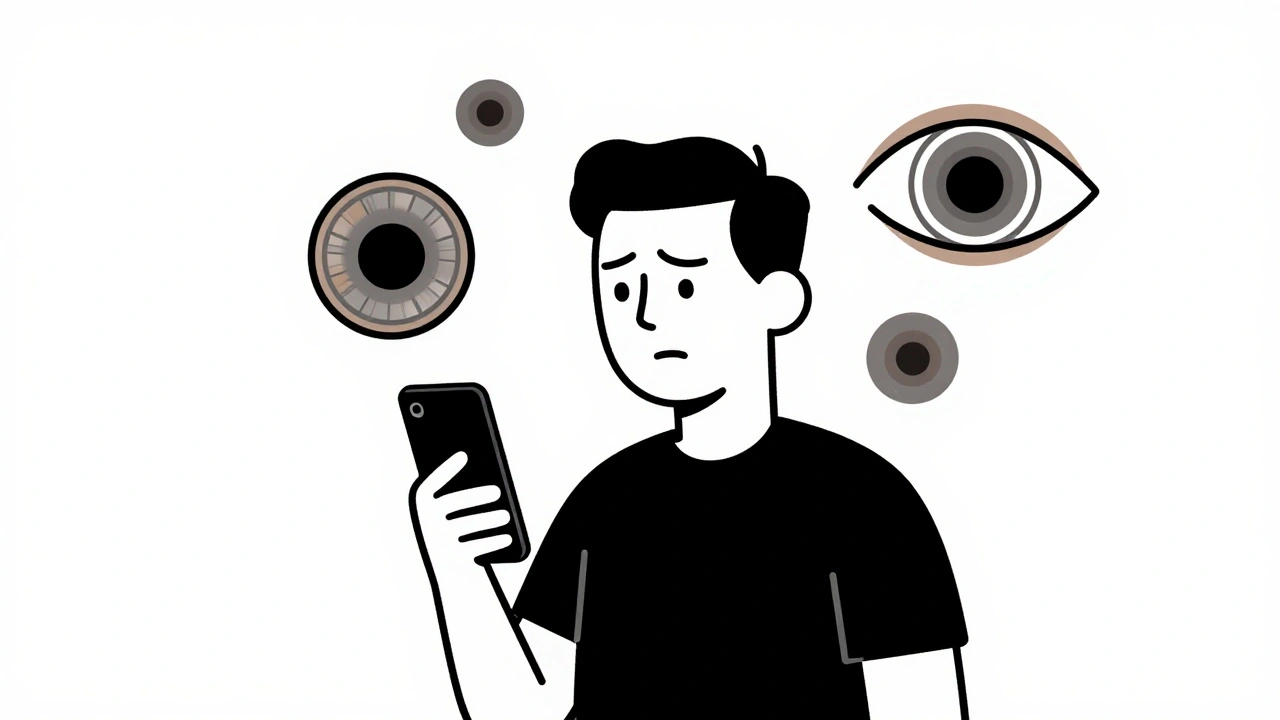
By your mid-40s, you might notice something strange: holding your phone farther away to read the text. Or squinting at the menu in a dimly lit restaurant. You’re not going crazy. You’re not failing at life. You’re just experiencing presbyopia - the natural, universal aging of your eyes that makes focusing on close-up things harder. It’s not a disease. It’s not your fault. And it happens to everyone. If you’re reading this and you’re over 40, you’re either already dealing with it, or you will be soon.
What Exactly Is Presbyopia?
Presbyopia is when your eye’s natural lens loses its flexibility. Think of it like an old rubber band - it used to stretch easily to focus on things up close, but now it’s stiff. This isn’t caused by screen time, poor lighting, or bad habits. It’s biology. Your lens keeps growing throughout your life, adding layer after layer like an onion. By the time you hit 40 to 45, it’s simply too thick and too rigid to change shape quickly enough to bring near objects into focus.At age 10, your eyes can focus on something as close as 7 centimeters. By 60, that distance stretches to over 100 centimeters - almost a meter. That’s why you’re reaching for your coffee mug just to read the label. The result? Blurry text, tired eyes, headaches after reading for more than a few minutes.
This isn’t the same as being farsighted. Farsightedness comes from the shape of your eyeball. Presbyopia comes from your lens getting old. And unlike other vision problems, you can’t prevent it. No eye exercises, no special diet, no supplements will stop it. As Dr. Emily Chew from the National Eye Institute says, ‘It’s as inevitable as gray hair.’
How Strong Do Your Reading Glasses Need to Be?
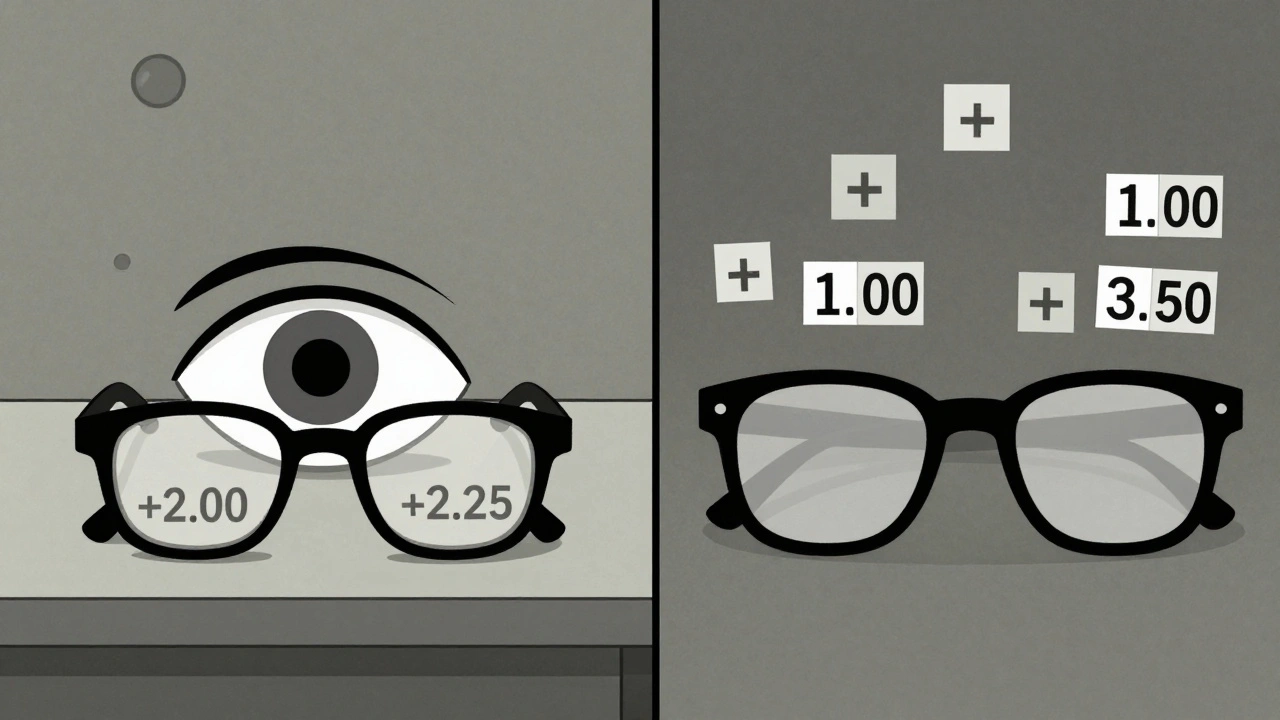
The strength you need isn’t random. It follows a predictable pattern based on age. Around 45, most people need +1.00 diopters. By 50, that jumps to +1.50. By 60, you’re likely in the +2.50 to +3.00 range. By 65, many need +3.50 - the strongest commonly available over-the-counter strength.Over-the-counter reading glasses at Walmart, Target, or online retailers like Zenni come in 0.25-diopter increments, from +0.75 to +3.50. They cost between $6 and $20. They’re fine for occasional use - picking up a book, checking your watch, reading a recipe. But they’re not customized. If your left eye needs +2.00 and your right needs +2.25, buying a pair that’s +2.00 in both lenses will make one eye work harder. That leads to eye strain, headaches, and fatigue.
Prescription reading glasses fix that. They’re made to match your exact needs, including any existing nearsightedness or astigmatism. They cost $150 to $400, depending on the frame and lens material. But if you’re reading, working on a computer, or doing detailed tasks for hours, the extra cost is worth it.
Progressive Lenses: The Seamless Alternative
If you already wear glasses for distance vision, reading glasses become a hassle. You’re constantly taking them off and putting them back on. That’s where progressive lenses come in.Progressive lenses are single lenses that give you clear vision at all distances - near, intermediate (like computer screens), and far - without visible lines. No more bifocals with that awkward ‘line across your glasses’ look. The transition is smooth, like a ramp instead of a step.
But they’re not magic. They have a learning curve. About 25% of first-time wearers experience peripheral distortion - things on the sides look wavy or blurry. It takes 2 to 4 weeks to adapt. You learn to move your head, not just your eyes, to find the right viewing zone. Some people never fully adjust. Others swear by them.
Modern progressives like Essilor’s Eyezen 2.0, launched in 2023, have wider near-vision zones based on real-world usage data from 10,000 wearers. That means less head movement and more comfort when reading or using a tablet. They’re priced between $250 and $450, depending on the brand and features.

What About Contact Lenses or Surgery?
If you hate wearing glasses, contact lenses are an option. Monovision contacts correct one eye for distance and the other for near vision. About 80% of people adapt well. But 15% lose depth perception - making tasks like pouring coffee or walking down stairs feel off. It’s not ideal for drivers or athletes.Surgical options exist, but they’re more serious. LASIK monovision reshapes the cornea to create the same one-eye-for-distance, one-for-near setup. It costs $2,000 to $4,000 per eye. Satisfaction rates are around 85%, but 10-15% of people need a retreatment within five years. Dry eyes are common - affecting 35% of patients.
Refractive lens exchange replaces your natural lens with an artificial multifocal one - the same procedure used for cataracts. It’s permanent. It costs $3,500 to $5,000 per eye. You’ll likely see better than ever, but some report halos around lights at night (25% of cases) or reduced contrast sensitivity (15%). There’s also a tiny risk of infection - about 0.04% - but it’s serious if it happens.
A newer option is the Presbia Flexivue Microlens, a tiny implant placed in the cornea. Approved in Europe in 2022, it improves near vision without removing your natural lens. It’s not yet FDA-approved in the U.S., but Phase 3 trials show 78% of users achieve 20/25 near vision after a year.
Why Eye Exams at 40 Are Non-Negotiable
The American Academy of Ophthalmology says everyone should get a full eye exam at age 40. Not because you’re having trouble reading - but because presbyopia is just one of many age-related changes. Glaucoma, macular degeneration, and diabetic retinopathy often show no symptoms until damage is done.A comprehensive exam includes cycloplegic refraction - drops that temporarily paralyze your focusing muscles. Without them, your optometrist might underestimate your needed correction by 0.25 to 0.50 diopters. That might sound small, but it’s the difference between comfortable reading and constant eye strain.
Don’t wait until you’re squinting at your phone. Get checked. Even if you think you don’t need glasses yet, knowing your baseline helps track changes over time.
What Works Best for You?
There’s no one-size-fits-all solution. It depends on your lifestyle.- If you only read occasionally - a book, a label, a receipt - over-the-counter readers are fine. Just make sure you’re not straining. If your eyes tire quickly, upgrade to prescription.
- If you already wear distance glasses and read a lot, progressives are the most convenient. Give them at least 3 weeks to adapt. Don’t quit after a few days.
- If you’re active, dislike glasses, and have good distance vision, monovision contacts might work. But test them first with trial lenses.
- If you’re over 55 and already considering cataract surgery, a multifocal lens implant might be the best long-term choice. Talk to your eye doctor about timing.
One graphic designer in Melbourne told me he switched to occupational progressives with a 14mm corridor length. He could see his computer screen clearly without tilting his head, and still read a book at arm’s length. No more switching glasses. No more headaches. That’s the goal.
The Bigger Picture: Why This Matters
By 2030, 2.1 billion people worldwide will have presbyopia. That’s more than the population of the entire European Union. The global market for corrective lenses is growing at 7.2% per year. Online retailers like Warby Parker now offer ‘progressive trial kits’ so you can test them at home before buying.It’s not just about reading. It’s about independence. Being able to see your medication labels, your grandchildren’s drawings, your smartphone notifications, your car’s dashboard. Presbyopia doesn’t stop you from living - but untreated, it can make daily life frustrating and even risky.
And here’s the good news: we’ve got solutions. They’re affordable, effective, and constantly improving. Johnson & Johnson’s Acuvue Oasys Multifocal, approved in 2023, gives 89% of users clear near vision. New topical eye drops are in early trials that could temporarily restore focusing ability for several hours.
You’re not losing your vision. You’re just aging - and science has kept up.
Is presbyopia the same as farsightedness?
No. Farsightedness (hyperopia) is caused by the shape of your eyeball being too short, making it hard to focus on close objects even when young. Presbyopia is caused by your lens losing flexibility as you age. You can be farsighted and develop presbyopia - they’re separate issues that can happen together.
Can I use reading glasses for computer work?
Standard reading glasses are designed for about 40cm away - perfect for books and phones. Computer screens are usually 50-70cm away. That’s where progressive lenses or computer-specific glasses (with a lower add power) work better. Using regular readers for long computer sessions can cause neck strain and eye fatigue.
Why do my reading glasses give me headaches?
Headaches usually mean the prescription is too strong, too weak, or mismatched between your eyes. Over-the-counter readers are a one-size-fits-all solution. If you’re getting headaches after 10-15 minutes of reading, you likely need a custom prescription. Also, cheap lenses can have optical distortions that strain your eyes.
Do I need to get new glasses every few years?
Yes, typically every 2-3 years between ages 45 and 65. Your lens keeps stiffening, so your needed correction increases. By 65, it usually stabilizes. If your glasses feel less effective or you’re holding things farther away, it’s time for a new exam.
Are expensive progressive lenses worth it?
If you wear glasses daily and want seamless vision, yes. Higher-end progressives have wider viewing zones, less distortion, and better adaptation. Cheaper ones may save money upfront but cause more eye strain and longer adjustment times. Look for brands like Essilor, Zeiss, or Hoya - they’ve invested in real-world testing and design.
Can eye exercises prevent or reverse presbyopia?
No. Despite claims online, no eye exercises, yoga, or supplements can restore lens flexibility. The hardening of the lens is a physical, age-related change. The National Eye Institute confirms this: presbyopia cannot be prevented. Focus on getting the right correction, not on unproven methods.
What’s the best way to choose reading glasses?
Try them on. Hold a book or phone at your normal reading distance. If the text is clear without squinting, the strength is right. If it’s blurry or you feel strain, go up or down by 0.25 diopters. Don’t just pick the strongest pair - you don’t need more power than necessary. And if you have different strengths in each eye, get prescription glasses.
What to Do Next
If you’re over 40 and noticing trouble with close-up vision, don’t ignore it. Schedule a comprehensive eye exam. Don’t just buy readers off the shelf. Get your prescription right. Your eyes will thank you.If you’re already wearing glasses, consider upgrading to progressives if you’re tired of switching between pairs. If you’re active and hate glasses, talk to your optometrist about monovision contacts. If you’re over 55 and thinking about cataract surgery, ask if a multifocal lens is right for you.
Presbyopia isn’t a crisis. It’s a milestone - like needing bifocals, or having your first gray hair. It’s part of getting older. But with the right tools, it doesn’t have to slow you down.
Elizabeth Crutchfield
December 4, 2025 AT 02:44Chad Handy
December 5, 2025 AT 05:08michael booth
December 5, 2025 AT 12:10Martyn Stuart
December 6, 2025 AT 07:36Karl Barrett
December 7, 2025 AT 17:03Jake Deeds
December 8, 2025 AT 01:59val kendra
December 9, 2025 AT 15:43Isabelle Bujold
December 10, 2025 AT 18:52George Graham
December 12, 2025 AT 04:38Joe Lam
December 12, 2025 AT 15:04Jenny Rogers
December 13, 2025 AT 00:56Dematteo Lasonya
December 13, 2025 AT 20:42Gillian Watson
December 14, 2025 AT 11:00Pavan Kankala
December 16, 2025 AT 09:10Ollie Newland
December 17, 2025 AT 04:41