
International Travel on Anticoagulants: How to Stay Safe and Prevent Blood Clots
 Dec, 19 2025
Anticoagulant Travel Risk Assessment
How Safe Is Your Travel?
Answer these questions to get personalized risk assessment and travel recommendations.
Traveling internationally while on blood thinners doesn’t have to be scary-but it does need planning. If you’re taking warfarin, rivaroxaban, apixaban, or any other anticoagulant, your risk of a dangerous blood clot during long flights or car rides is higher than most people realize. But here’s the good news: anticoagulants are designed to protect you, and with the right steps, you can travel safely. The key isn’t avoiding travel-it’s managing your meds, moving your body, and knowing what to watch for.
Why Travel Increases Your Clot Risk
Sitting still for hours, especially on flights longer than four hours, slows blood flow in your legs. That’s when clots can form in the deep veins-a condition called deep vein thrombosis (DVT). If part of that clot breaks loose, it can travel to your lungs and cause a pulmonary embolism (PE). Together, these are called venous thromboembolism (VTE). It’s not about economy class. It’s about immobility. The CDC says the overall risk of a travel-related clot is low-about 1 in 4,656 flights-for healthy people. But if you’re on anticoagulants, you’re already at higher risk because of an underlying condition: maybe you had a previous clot, you have cancer, you’re over 40, or you’re overweight. For those with multiple risk factors, the chance jumps to about 1 in 1,000. That’s why skipping your meds or staying seated for 10 hours straight isn’t worth the gamble.When You’re at Highest Risk
Not everyone on blood thinners needs extra precautions. But if you have any of these, you’re in the high-risk group:- Had surgery or a major injury in the last 3 months
- Have active cancer
- Been diagnosed with a blood clot before (especially if it was unprovoked)
- Are pregnant or within 3 months postpartum
- Take estrogen-based birth control or hormone therapy
- Have heart failure (NYHA class III or IV) or COPD
- Have a genetic clotting disorder like Factor V Leiden
- BMI of 30 or higher
- Have a leg in a cast or a central line
Don’t Stop or Skip Your Medication
This is the biggest mistake people make. You think, “I’m on blood thinners, so I’m protected.” But if you miss a dose-or worse, stop taking them-you’re in danger. Your blood doesn’t just go back to normal. It gets stickier. Dr. Susan Coogan, a vascular surgeon, puts it plainly: “If you skip doses or stop taking them for a period of time, your blood can actually become MORE sticky.” That’s because anticoagulants work continuously. Stopping them-even for a day-creates a rebound effect where your body overcompensates, increasing clot risk. For warfarin users, timing matters. If you’re crossing time zones, take your dose at the same clock time, not the same circadian time. So if you usually take it at 7 p.m. Melbourne time and you fly to New York (15-hour time difference), take it at 7 p.m. New York time the next day. Don’t try to adjust to local time immediately. Your INR can swing dangerously if you do.DOACs vs. Warfarin: Which Is Better for Travel?
If you’re on a Direct Oral Anticoagulant (DOAC) like rivaroxaban, apixaban, or dabigatran, you’re already ahead of the game. DOACs work faster-within 2 hours-and don’t need regular blood tests. Warfarin, on the other hand, takes days to reach full effect and requires monitoring with INR tests. For long trips, DOACs are easier. No fridge needed. No needles. Just a pill. But they’re expensive. Rivaroxaban costs about $575 for a 30-day supply in the U.S. Warfarin? Around $4. That’s a huge difference. If you’re on warfarin and traveling for more than two weeks, consider getting a personal INR monitor like the Roche CoaguChek® Mobile. It costs about $299 upfront, plus $7.49 per test strip. For people with unstable INRs or complex medical histories, it’s worth it. You can check your levels in your hotel room and adjust your dose if needed, with your doctor’s guidance.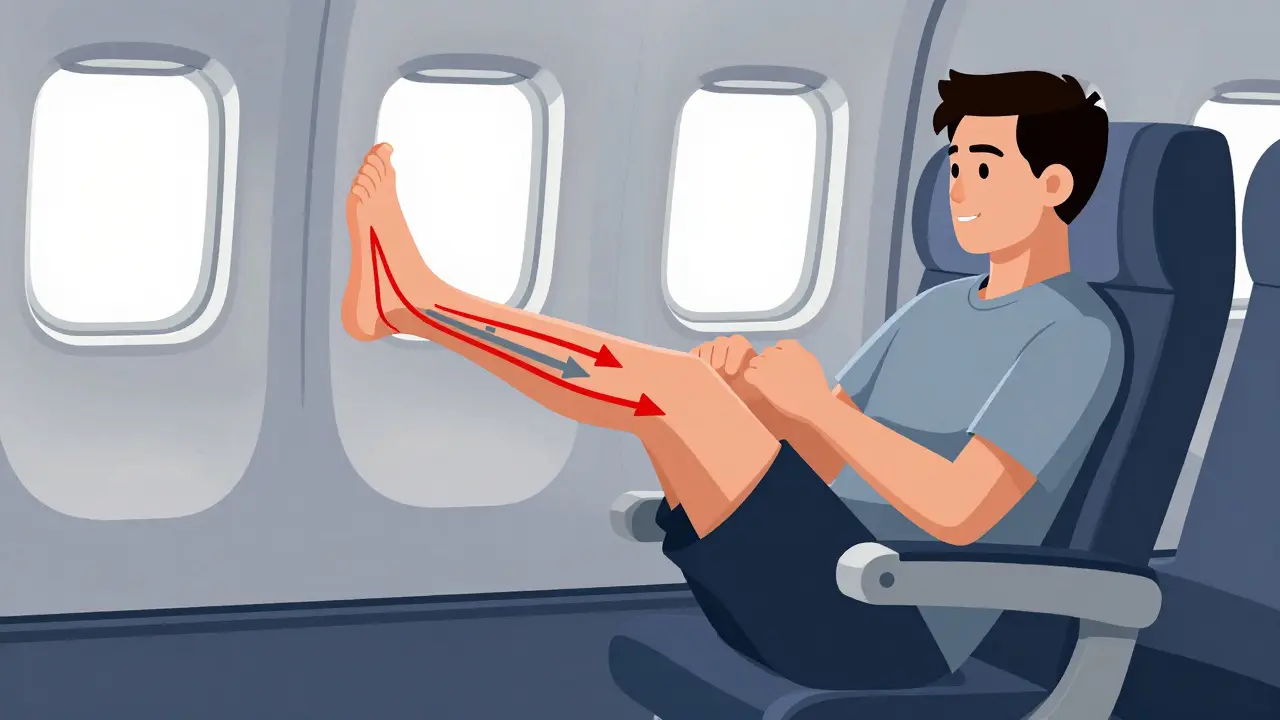
Compression Stockings: Do They Really Work?
Yes. But only if they’re the right kind. Not all “compression socks” are equal. You need below-knee graduated compression stockings that provide 15-30 mmHg of pressure at the ankle. Anything less won’t help. Anything more can cut off circulation. The ACCP recommends them for high-risk travelers-even if you’re on anticoagulants. Why? Because they’re a physical barrier to clot formation. They squeeze your calves, pushing blood back toward your heart. They’re not a replacement for meds, but they’re a powerful backup. Wear them from the moment you leave home until you reach your destination. Don’t wait until you’re on the plane. Put them on before you even get in the car.Move-Even If You’re Tired
The best thing you can do during travel is move. Every 2 to 3 hours, get up and walk. If you’re on a plane, walk the aisle. In a car, stop every 2 hours. At a train station, stretch your legs. If you can’t get up, do seated exercises every 30 minutes:- Flex your feet up and down 10 times
- Rotate your ankles in circles-5 each way
- Press your heels into the floor while lifting your toes
- Squeeze your calf muscles tightly for 5 seconds, then release
Hydration, Alcohol, and What to Drink
Dehydration thickens your blood. That’s a recipe for clots. Airplane cabins are dry-humidity levels can drop below 20%. That’s drier than a desert. Drink water. Constantly. Aim for at least 250 mL (8 oz) every hour. Avoid alcohol and sugary drinks. They dehydrate you faster. Caffeine in moderation is fine, but don’t rely on coffee to keep you awake. Water is your best friend.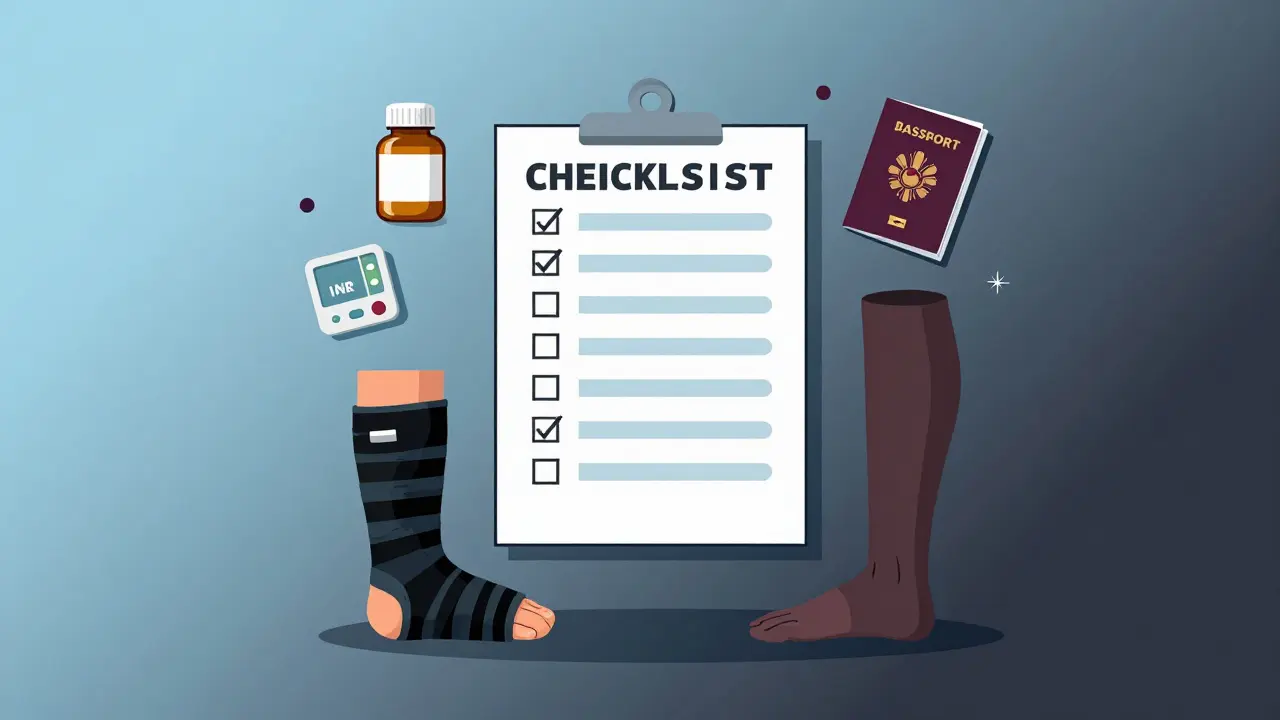
What to Pack Before You Go
Don’t wing it. Here’s your travel checklist:- Extra supply of anticoagulants (at least 2 weeks more than your trip length)
- Original prescription labels with your name and doctor’s info
- Copy of your most recent INR result (if on warfarin)
- Personal INR monitor (if recommended by your doctor)
- Compression stockings (15-30 mmHg)
- Medication list: drug names, doses, and prescribing doctor’s contact info
- Emergency contact card with local hospital info at your destination
- Travel insurance that covers medical evacuation and pre-existing conditions
Warning Signs: Know When to Act
Clots don’t always show up during travel. They can develop up to eight weeks after you return. That’s why you need to know the signs:- Swelling, pain, or warmth in one leg (72% of DVT cases show this)
- Chest pain that gets worse when you breathe deeply
- Sudden shortness of breath
- Coughing up blood
- Unusual bruising or bleeding that won’t stop
- Bloody or black stools
- Red or pink urine
Can You Fly After a Recent Blood Clot?
Yes-but only if you’re stable. The International Air Transport Association (IATA) says you can fly once you’re asymptomatic and on anticoagulants. But that’s vague. Most doctors recommend waiting at least 2 to 4 weeks after a DVT or PE diagnosis. The Cambridge University Hospitals advise against long trips within four weeks of diagnosis. If you had a recent clot, talk to your hematologist. They’ll check your clot stability, your INR (if on warfarin), and your overall health before giving the green light.What’s Coming Next
Research is still catching up. The MARVEL trial, expected to finish in late 2024, is testing whether a low dose of rivaroxaban (10 mg) taken before long flights can safely prevent clots in high-risk travelers already on anticoagulants. Right now, we don’t have clear guidelines for adding extra meds. The ACCP says no-because bleeding risk outweighs any benefit. But if the MARVEL trial shows safety and effectiveness, that could change. For now, stick to the basics: take your meds, move often, wear compression socks, drink water, and know the warning signs. You don’t need to cancel your trip. You just need to be smart about it.Can I still travel if I’ve had a blood clot before?
Yes, as long as you’re stable on anticoagulant therapy and symptom-free. Most doctors recommend waiting at least 2 to 4 weeks after a DVT or PE before taking long trips. Always get clearance from your hematologist or primary care provider. They’ll check your INR, assess your risk, and confirm your meds are on track.
Should I take aspirin before my flight if I’m on blood thinners?
No. Aspirin doesn’t help prevent clots in people already on therapeutic anticoagulants. It only increases your risk of bleeding without any proven benefit. The American College of Chest Physicians explicitly advises against it. Stick to your prescribed medication and non-drug measures like movement and compression stockings.
Do I need to get my INR checked before traveling?
If you’re on warfarin, yes. Get an INR test 1 to 2 weeks before departure. Target levels are usually 2.0-3.0 for atrial fibrillation and 2.5-3.5 for mechanical heart valves. If your INR is too low, you’re at risk for clots. Too high, and you risk bleeding. If your INR is unstable or you’re traveling longer than two weeks, consider bringing a portable INR monitor.
Can I bring my anticoagulants through airport security?
Yes. Keep your medications in their original bottles with your name and prescription label. Bring a copy of your prescription or a doctor’s note, especially for liquid forms or large quantities. You don’t need to declare them unless asked, but having documentation helps avoid delays. Never pack them in checked luggage-always carry them in your hand luggage.
What if I have a bleeding emergency abroad?
Carry a card with your medication list, doctor’s contact info, and emergency contacts. Know the location of the nearest hospital at your destination. If you experience uncontrolled bleeding-like nosebleeds that won’t stop, vomiting blood, or large bruises-go to the ER immediately. Bring your medication bottles with you so doctors know what you’re taking. Some hospitals may have reversal agents like vitamin K for warfarin or andexanet alfa for DOACs.
Is it safe to travel to high-altitude destinations while on blood thinners?
Generally, yes. High altitude doesn’t directly increase clot risk for people on anticoagulants. But it can cause dehydration and make you feel more tired, which might reduce movement. Stay hydrated, move often, and avoid alcohol. If you have heart or lung disease, check with your doctor first. Altitude sickness can worsen symptoms of underlying conditions.
Hussien SLeiman
December 20, 2025 AT 16:20Look, I’ve been on warfarin for eight years and flown to Tokyo, Buenos Aires, and Reykjavik-none of which required a visa for my blood clot history, but all of which required me to carry a notarized letter from my hematologist stating I’m not a walking thrombosis factory. People act like this is new information, but if you’ve ever had a DVT, you know the real enemy isn’t the airplane seat-it’s the medical system that treats you like a liability instead of a patient. Compression socks? Sure. But what about insurance that doesn’t exclude you? What about pharmacies in Bali that don’t stock rivaroxaban? This article reads like a brochure for pharma reps who’ve never been stuck in a terminal with a 14-hour layover and a leaking IV bag.
And don’t get me started on the ‘drink water’ advice. I’ve been dehydrated in the Sahara and still had a lower INR than some nurses who think ‘hydration’ means gulping Gatorade on a flight. The real issue? Nobody talks about the cost of bleeding out in a foreign ER with no translation app and a doctor who thinks ‘anticoagulant’ is a type of cheese.
So yes, move your legs. But also demand better systems. Because if your life depends on a pill and a pair of socks, we’ve already lost.
Also, aspirin? Please. That’s like bringing a toothpick to a gunfight and calling it self-defense.
Nancy Kou
December 22, 2025 AT 00:30This is exactly the kind of practical, no-nonsense guide people need before they book that dream trip. I’m a nurse and I’ve seen too many patients panic because they thought ‘I’m on blood thinners, so I’m fine’-until they didn’t move for 10 hours and woke up with a swollen leg. The checklist at the end? Gold. Bring extra meds. Carry your prescription. Know the signs. These aren’t suggestions-they’re survival tactics.
And for the love of all that’s holy, stop skipping doses. I had a patient once who stopped warfarin for a ‘weekend getaway’ and ended up in ICU with a PE. Don’t be that person. You’ve got this. Just be smart.
Henry Marcus
December 22, 2025 AT 08:31Wait… so you’re telling me the government, airlines, and Big Pharma are all hiding the truth? That the real reason they push DOACs is because they’re profitable, not because they’re safer? That the CDC’s ‘1 in 4,656’ stat is cooked to make you feel safe while they quietly profit off your fear? And compression socks? They’re just a distraction-like seatbelts in a car that’s rigged to crash. I’ve seen the documents. The MARVEL trial? It’s a sham. Rivaroxaban was tested on people who were already sedentary in climate-controlled rooms-not on real travelers who get up, walk, and breathe real air.
And don’t even get me started on the ‘INR monitor’-that’s a tracking device. They’re monitoring your blood to see if you’re compliant. If your INR dips too low, they’ll flag you. If it spikes? You’re a liability. You think they care if you live? No. They care if you’re profitable. Stay home. Or at least, fly private. Or better yet-don’t fly at all. The system is rigged.
Also, why do they never mention that airplane air is laced with fluoride? To ‘thin’ the blood? Or to make you docile? I’m not saying it’s true… but I’m not saying it’s not either.
Frank Drewery
December 23, 2025 AT 17:30Really appreciate this breakdown. I’ve been on apixaban for AFib and was terrified to travel after my last clot. This made me feel like I could actually do it without losing my mind. The seated exercises are genius-I’ve been doing them on every flight since I read this. And the hydration tip? Game changer. I used to drink coffee like it was water. Now I’ve got a 1L bottle next to me the whole time. Small changes, big difference.
Also, I brought my own compression socks and wore them from the moment I left my house. No one looked at me weird. I just smiled and said ‘I’m a walking medical experiment.’ They laughed. I didn’t care. I made it home safe.
Thanks for the clarity. This is what the internet should be.
jessica .
December 24, 2025 AT 22:29So let me get this straight-Americans are getting killed by clotting because they’re too lazy to move or drink water? And now we’re supposed to pay $600 for a pill that’s not even available in most of the world? Meanwhile, real Americans who work two jobs can’t even afford insulin, but we’re handing out DOACs like candy to people who can afford to fly to Europe?
This isn’t about health. This is about privilege. You want to travel? Fine. But don’t act like your blood thinner is a magic wand. You’re lucky you have a doctor. Most people don’t. And you think your INR monitor is gonna save you when you’re stuck in a rural clinic in Peru with no power and no translator? Get real.
Also, why are we letting Big Pharma dictate our medical choices? Who even wrote this? A rep for Janssen? Because it reads like a sales pitch with a side of guilt.
Ryan van Leent
December 26, 2025 AT 12:58Sajith Shams
December 28, 2025 AT 03:08Let me be blunt. This article is 70% common sense and 30% marketing fluff. The real issue isn’t the flight-it’s the lack of global standardization in anticoagulant care. In India, where I’m from, most patients on warfarin don’t even know what INR means. They get a prescription, take it for a month, and stop when they feel ‘fine.’ No monitoring. No education. No access to DOACs. And yet, they still fly. They still travel. They still survive.
So don’t treat this like a luxury problem. For most of the world, ‘traveling on anticoagulants’ means carrying pills in a plastic bag with no label, hoping the pharmacy in Kathmandu has the same batch as the one in Delhi.
Compression socks? Sure. But what about education? What about training nurses in rural clinics to recognize DVT? What about affordable reversal agents? This article reads like a guide for wealthy Westerners who think ‘risk’ means missing a flight. For the rest of us, risk means dying because no one knows what rivaroxaban is.
And yes-I’ve had a PE. I’m still here. Not because of socks. Because I was lucky.
Ashley Bliss
December 28, 2025 AT 06:38There’s something deeply tragic about how we’ve turned survival into a checklist. We don’t just want to live-we want to live *perfectly*. We need the right socks, the right pill, the right monitor, the right hydration schedule, the right emergency card, the right insurance, the right doctor’s note, the right time zone adjustment…
But what about the soul? What about the person who just wants to see the ocean without feeling like they’re carrying a bomb in their veins? What about the grief of being told you can’t just *be*? That every breath, every step, every sip of water must be calculated?
I’m not saying ignore the advice. I’m saying-don’t let it steal your joy. You’re not a medical case study. You’re a human being who wants to see the world. And if you take your pill, move your legs, and drink water… you’ve done more than enough.
Let the rest go. Let the fear go. Let the guilt go.
You’re allowed to be afraid. But you’re also allowed to go.
Elaine Douglass
December 29, 2025 AT 04:38Takeysha Turnquest
December 29, 2025 AT 06:43They say knowledge is power. But what if the knowledge is designed to make you feel powerless? What if the checklist isn’t protection-it’s a cage? We’ve turned life into a series of protocols. Don’t skip the pill. Wear the socks. Drink the water. Check the INR. Carry the card. Know the signs. What’s left of you?
Who decided that your right to travel depends on your compliance? Who decided that your body must be monitored, measured, and managed like a machine?
I don’t want to survive travel. I want to feel alive in it. To feel the wind. To taste the food. To sit in silence and watch the clouds.
Maybe the real clot isn’t in your veins.
Maybe it’s in the system that told you you needed this many rules to be worthy of joy.