
How to Read Directions for Extended-Release Medications on Labels
 Dec, 16 2025
Every year, thousands of people end up in the emergency room because they didn’t understand what extended-release meant on their medication label. It’s not just about taking a pill - it’s about knowing how that pill works inside your body, and what happens if you break it, crush it, or take it at the wrong time.
What Does Extended-Release Actually Mean?
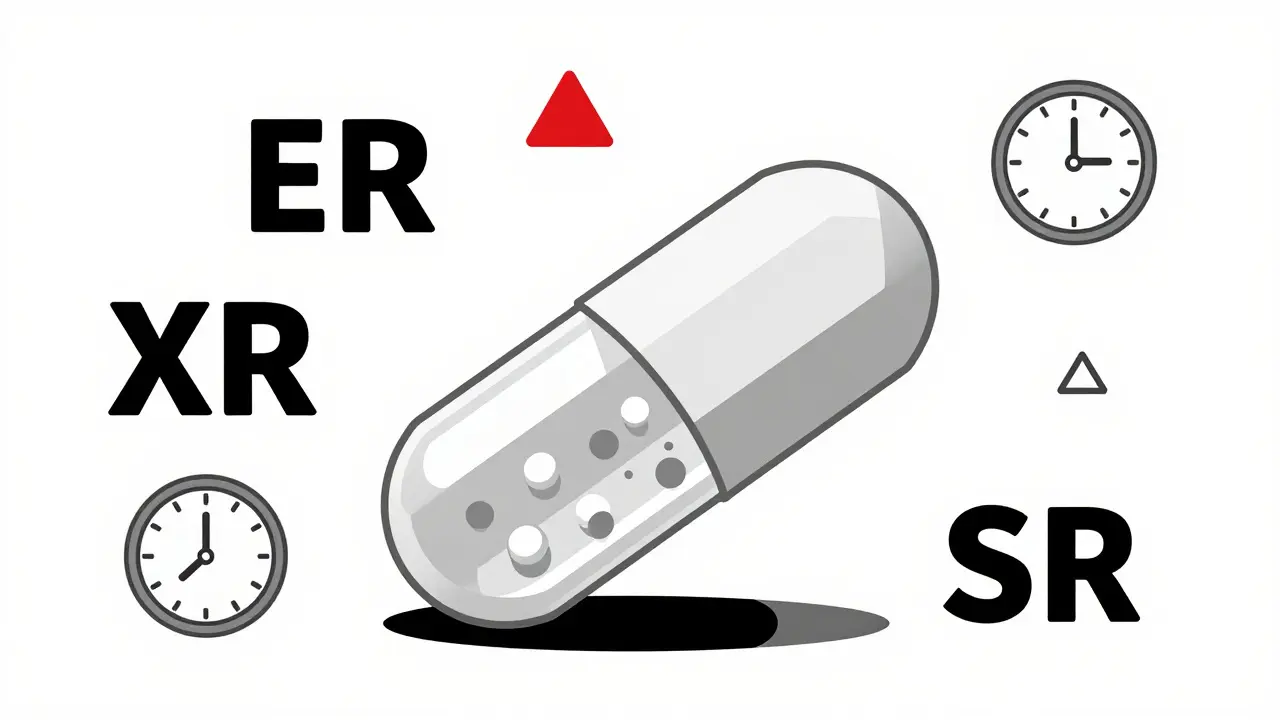
Extended-release medications - labeled as ER, XR, SR, CR, or CD - are designed to release medicine slowly over many hours, not all at once. Think of it like a slow drip instead of a splash. A regular painkiller might last 4 to 6 hours, so you take it three times a day. An extended-release version? One pill lasts 12 or even 24 hours. That’s why you see labels like “Take once daily” or “Take every 12 hours.”
These aren’t magic pills. They’re built with specific technology. Some use a polymer coating that dissolves slowly. Others are made with a matrix - the drug is mixed into a slow-dissolving material, like sugar in a hard candy. Some even have tiny capsules inside that open at different times. The goal? Keep the medicine steady in your bloodstream so you get consistent relief without spikes or crashes.
How to Spot Extended-Release on a Label
Look at the drug name. If you see “metoprolol succinate ER” or “oxycodone XR,” that’s your clue. The letters after the name tell you the release type:
- ER = Extended Release
- XR = eXtended Release
- SR = Sustained Release
- CR = Controlled Release
- CD = Continuous Delivery
Some brands use their own names - like Concerta (for ADHD) or Toprol XL (for high blood pressure). These are proprietary systems. Even if two pills say “extended-release,” they might work differently. One could be a coating, another a matrix. That’s why you can’t swap them without checking with your pharmacist.
Also check for time indicators. If it says “24-hour extended release,” that means it’s meant to last a full day. If it says “12-hour,” you’ll need to take it twice a day. Don’t assume - read it.
The Big Warning: Do Not Crush, Split, or Chew
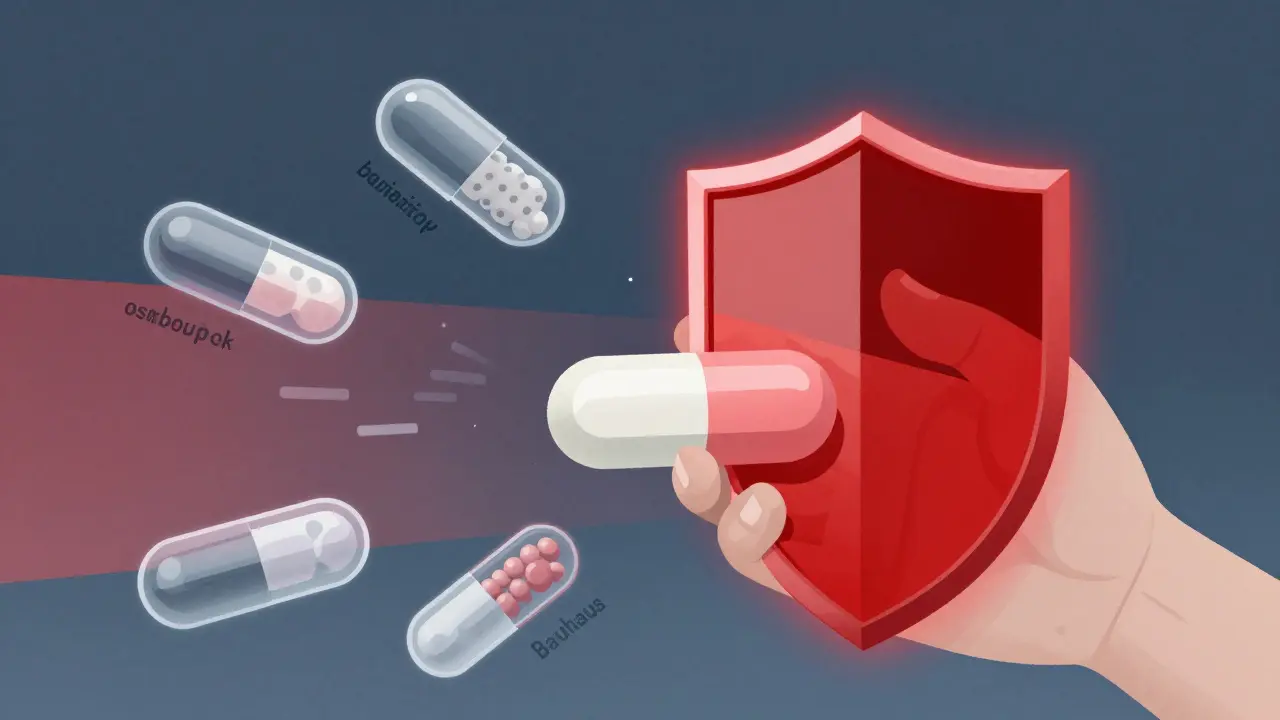
This is the most critical part. If you crush an extended-release pill, you’re basically turning a slow drip into a firehose. All the medicine floods into your system at once. That can be deadly.
In 2021, the FDA reported over 1,200 adverse events linked to people crushing or chewing extended-release opioids like OxyContin. One patient took a crushed 60mg tablet thinking it would help with pain faster - they ended up in intensive care. Another swallowed a crushed Adderall XR pill and stayed awake for 36 hours.
The warning isn’t just a suggestion. It’s written in bold on the label, often under “Warnings.” If you can’t swallow the pill whole, talk to your doctor. There might be a liquid version, a different formulation, or a non-extended-release alternative.
Timing Matters - When to Take It
Extended-release doesn’t just mean “lasts longer.” It means “works best at a certain time.”
Some, like Niaspan (niacin), are meant to be taken at night to reduce flushing side effects. Others, like metformin XR for diabetes, are taken with dinner to avoid stomach upset. Concerta for ADHD is usually taken in the morning - taking it at night can cause insomnia.
The label will say exactly when: “Take in the morning,” “Take with food,” or “Take at bedtime.” Don’t guess. If it doesn’t say, ask your pharmacist. Timing affects how well the medicine works - and whether you get side effects.
What’s in the Inactive Ingredients?
Most people skip the “Inactive Ingredients” section. But for extended-release meds, it matters. These aren’t just fillers. They’re the key to how the drug releases. For example, some extended-release tablets use ethylcellulose or hydroxypropyl methylcellulose as slow-dissolving coatings. If you have allergies or sensitivities to certain polymers, you might react - even if the active ingredient is safe.
Also, some extended-release formulations use different excipients than their immediate-release versions. That’s why a generic “metoprolol ER” might not work the same as the brand-name Toprol XL, even if both say “extended-release.” The FDA doesn’t require them to be interchangeable unless they’re rated “AB.” Always check with your pharmacist before switching generics.
Why You Can’t Trust Generic Swaps
Here’s a scary fact: There are three different 24-hour extended-release versions of diltiazem - a blood pressure drug - and none of them are interchangeable. One uses a matrix system. Another uses a coated bead system. A third uses a special osmotic pump. All are labeled “diltiazem ER.” But they release differently. Your body absorbs them at different rates.
If you switch from one to another without your doctor knowing, your blood pressure could spike or drop dangerously. The same goes for ADHD meds, antidepressants, and heart medications. The FDA calls these “non-interchangeable.” Your prescription must specify the exact product.
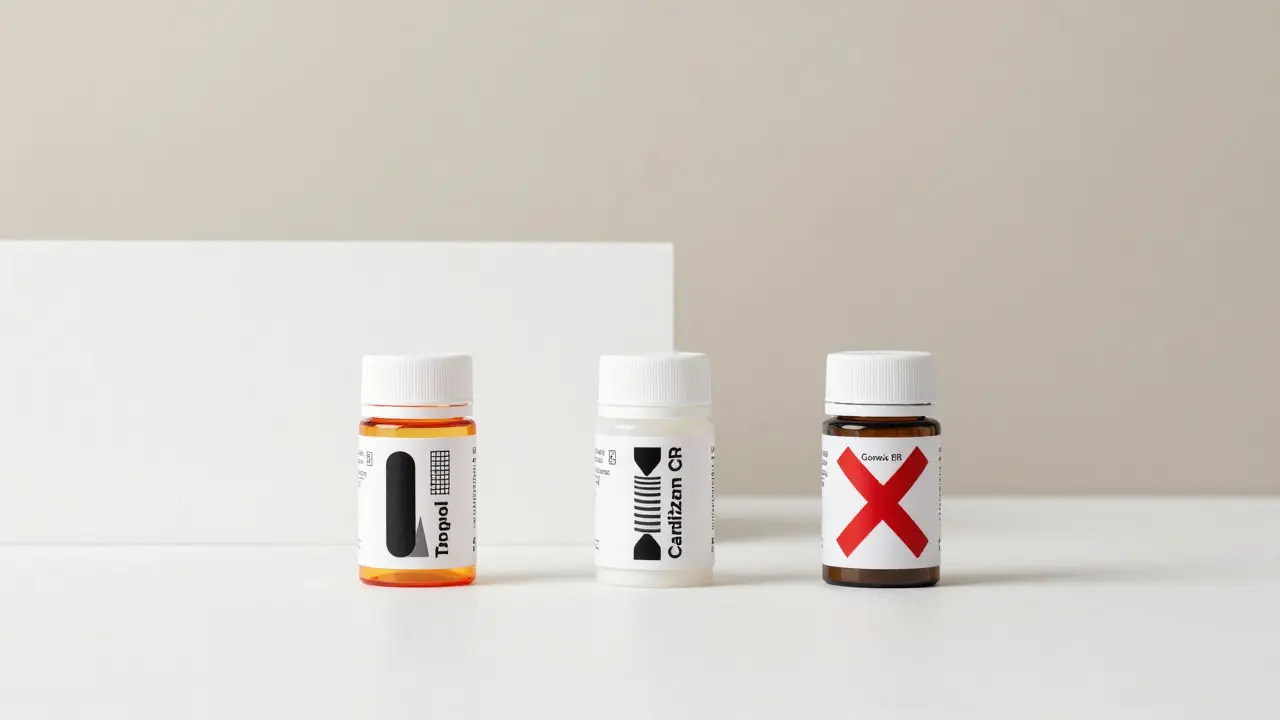
Always check the brand name on your prescription. If it says “Cardizem CD,” don’t accept “diltiazem ER” unless your doctor approves it. Ask your pharmacist: “Is this the same as what I was taking before?”
What to Do If You’re Confused
You’re not alone. A 2022 FDA study found that 42% of adults over 65 misunderstood “extended-release” to mean “longer-lasting effect” - but didn’t know they couldn’t crush the pill.
Here’s what to do:
- Read the label twice - once when you get it, and again before you take it.
- Look for the “Warnings” section - it will say “Do not crush, split, or chew.”
- Check the timing instructions - morning? night? with food?
- Ask your pharmacist - “Can you explain how this works?”
- Use the teach-back method - say back to them: “So this pill releases over 24 hours, I can’t crush it, and I take it at bedtime?”
Many pharmacies now include QR codes on labels. Scan it with your phone - you might get a short video showing how to swallow the pill or what happens if you break it.
What’s Changing in 2025?
The FDA is making changes. Starting in 2024, all new extended-release medications must have a high-contrast “DO NOT CRUSH” warning on the label. Digital prescriptions now require “24-hour extended release” instead of just “ER” to avoid confusion.
New technologies are coming too. Some pills in development use systems that can hold medicine for 48 to 72 hours - meaning you’d take one pill every two or three days. But that also means labels will get even more complex. The FDA admits current labels aren’t always clear to patients.
For now, the best protection is knowing what you’re taking - and never assuming.
What Happens If You Accidentally Crush One?
If you or someone you know accidentally crushed or chewed an extended-release pill:
- Don’t panic - but don’t wait either.
- Call your pharmacist or poison control immediately.
- Keep the pill packaging - it has the exact name and strength.
- Watch for signs of overdose: dizziness, rapid heartbeat, confusion, vomiting, fainting.
- If symptoms are severe, go to the ER.
It’s not always fatal - but it’s always risky. The body isn’t built to handle a full day’s dose all at once.
What does ER, XR, or SR mean on a medication label?
ER stands for Extended Release, XR for eXtended Release, and SR for Sustained Release. These mean the medication is designed to release slowly over several hours - often 12 or 24 hours - instead of all at once. This allows for fewer doses per day and more stable drug levels in your bloodstream.
Can I split or crush an extended-release pill if I have trouble swallowing it?
No. Crushing or splitting an extended-release pill can cause the entire dose to be released at once, which may lead to dangerous side effects or overdose. If you can’t swallow the pill whole, ask your doctor or pharmacist if there’s a liquid form, a different formulation, or an alternative medication that’s easier to take.
Why does the timing of my extended-release medication matter?
Extended-release medications are designed to work best at specific times of day. For example, Niaspan (niacin) is taken at bedtime to reduce flushing, while Concerta (ADHD medication) is taken in the morning to avoid sleep problems. Taking it at the wrong time can reduce effectiveness or cause unwanted side effects.
Are all generic extended-release medications the same as the brand name?
No. Even if two pills have the same active ingredient and say “extended-release,” they may use different release technologies. For example, there are three different 24-hour diltiazem products that are not interchangeable. Always check with your pharmacist before switching generics - and make sure your prescription specifies the exact product you need.
What should I do if I accidentally crushed my extended-release pill?
Call your pharmacist or poison control immediately. Watch for signs of overdose like rapid heartbeat, dizziness, confusion, or vomiting. Do not wait for symptoms to appear. Keep the packaging - it has the drug name and strength, which will help medical staff respond quickly.
Final Tip: When in Doubt, Ask
Medication labels are getting more complex. New formulations, new technologies, new warnings - it’s easy to feel overwhelmed. But you don’t have to figure it out alone. Pharmacists are trained to explain this stuff. Don’t be shy. Bring your pill bottle to the counter and say: “I’m not sure how this one works. Can you walk me through it?”
That one conversation could save your life.
amanda s
December 16, 2025 AT 19:07This is why America’s healthcare system is a joke. You need a PhD just to swallow a pill now. I took my grandma’s blood pressure med because I thought it was just a ‘longer-lasting’ version - turned out I almost killed her. No one told me not to crush it. No one. The label? Written in font smaller than my phone’s battery percentage.
Jigar shah
December 18, 2025 AT 07:02The distinction between ER, XR, SR, CR, and CD is not merely semantic - it is pharmacokinetic. The excipient matrix, polymer degradation kinetics, and osmotic pressure differentials dictate bioavailability profiles. Generic substitution without therapeutic equivalence (AB rating) introduces unquantifiable risk. The FDA’s 2024 labeling mandate is a necessary but insufficient step. We require standardized, machine-readable metadata on packaging - QR codes alone are performative.
Jonathan Morris
December 20, 2025 AT 04:53Did you know the FDA approved three different diltiazem ER formulations without requiring bioequivalence testing? That’s not oversight - it’s corporate collusion. Big Pharma doesn’t want you to know that your ‘generic’ is actually a different drug disguised as the same. They profit from confusion. The QR codes? A distraction. They’re tracking you. Your pill is listening. And they’re watching who reads this post.
Linda Caldwell
December 20, 2025 AT 22:36Y’all need to stop guessing and start asking. Seriously. Walk into the pharmacy like you own the place. Say ‘Explain this like I’m five.’ They’ll love you for it. I did. Got a free sticker and a 10-minute demo video. Life changed. 💪❤️
CAROL MUTISO
December 22, 2025 AT 19:21It’s almost poetic, isn’t it? We’ve engineered pills to mimic the rhythm of the body - slow, steady, patient - yet we treat them like fast food. Crushed. Chewed. Swallowed like a dare. We’ve outsourced our biology to corporations, then blame the label when things go wrong. The real tragedy isn’t the pill - it’s that we forgot how to listen to our own bodies. And the system? It’s designed to keep us confused. So we keep buying.
Virginia Seitz
December 23, 2025 AT 20:42My mom took her ER pill with grapefruit juice. Didn’t know it could kill her. 🥺 I cried for a week. Now I print the label and tape it to the pill bottle. 📝💊
Brooks Beveridge
December 25, 2025 AT 07:32Just had a 78-year-old patient ask me if ‘XR’ meant ‘extra strong.’ I didn’t laugh. I showed her the video on my phone. She cried. Then she hugged me. This isn’t just medicine - it’s trust. And we’re failing people every day. Don’t be silent. Ask. Share. Teach back. You’re not just a patient. You’re a partner.
Evelyn Vélez Mejía
December 27, 2025 AT 00:12It is an epistemological failure of the highest order that the dissemination of pharmaceutical knowledge has been outsourced to the consumer, who is simultaneously burdened with cognitive load, linguistic ambiguity, and institutional distrust. The regulatory apparatus, while ostensibly protective, functions as a labyrinth of obfuscation. One cannot reasonably expect a layperson to discern between ethylcellulose and hydroxypropyl methylcellulose - yet the legal liability rests squarely upon their shoulders. This is not healthcare. This is a contractual obligation disguised as consent.