
Health Literacy Strategies: How to Read Medication Labels and Avoid Dosing Mistakes
 Nov, 28 2025
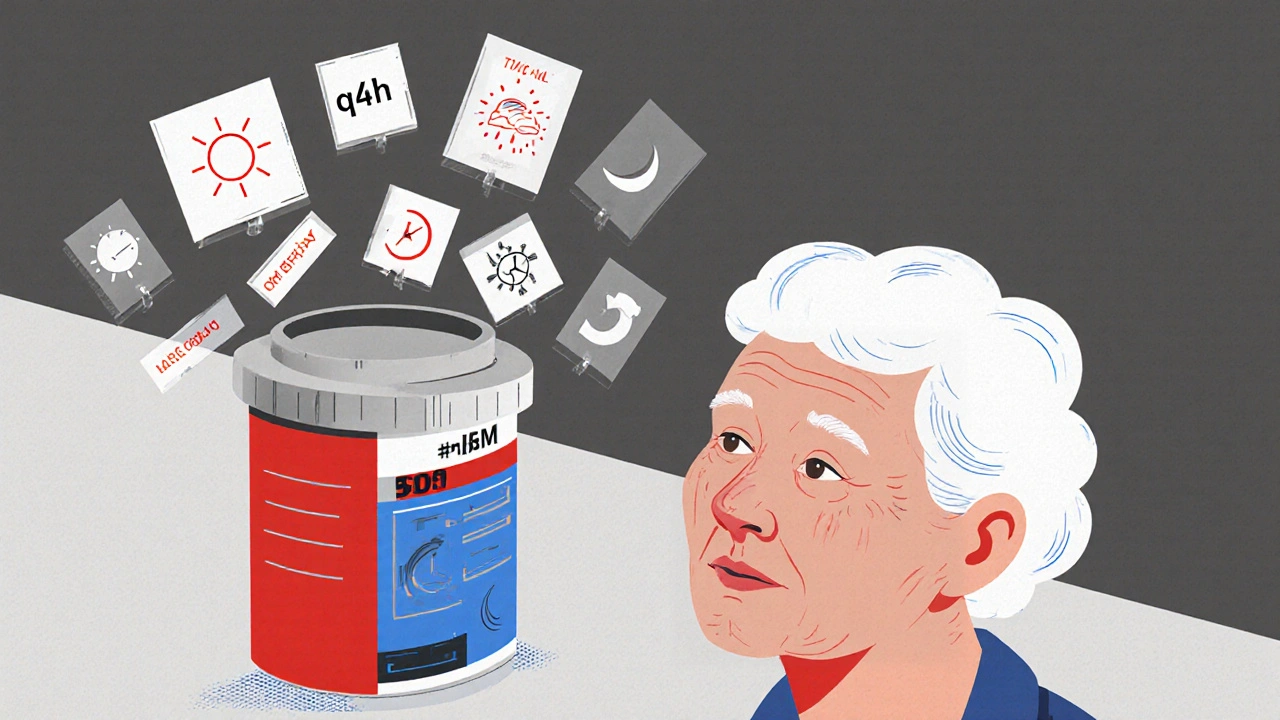
Every year, over 1.3 million medication errors happen in the U.S. - not because pills are wrong, but because people don’t understand what they’re supposed to do with them. You might think reading a label is simple: take one pill twice a day. But if you’re tired, stressed, or never learned to read well, that instruction can become a dangerous puzzle. One person took four pills instead of two because they thought "every 4-6 hours" meant "take 4 to 6 pills." Another drank liquid medicine from a plastic bottle, thinking it was a syringe. These aren’t rare mistakes. They’re common - and preventable.
Why Medication Labels Are Hard to Understand
Most prescription labels are written at a 10th-grade reading level. The average American reads at a 6th- to 8th-grade level. That gap isn’t just annoying - it’s deadly. A 2009 study found that 47% of patients misunderstood standard labels like "Take 1 tablet by mouth twice daily." But when the same instruction was rewritten as "Take 1 tablet in the morning and 1 tablet in the evening," misunderstanding dropped to 28%. It’s not just the words. Numbers confuse people too. "Take 5 mL twice daily" sounds clear - until you realize some parents think it means 5 mL total, not 5 mL each time. Units get mixed up: mg vs. ml, tsp vs. tbsp. And symbols? "q4h" means every 4 hours - but if you don’t know Latin abbreviations, you’re guessing. Even simple phrases like "take with food" leave people unsure. Does that mean before, during, or after eating? One patient in a CDC focus group said, "Every pharmacy uses different words for the same thing. I never know what they mean."The Universal Medication Schedule (UMS) That Actually Works
A simple fix has been quietly changing lives: the Universal Medication Schedule. Instead of "twice daily" or "every 12 hours," UMS uses four clear times: morning, noon, evening, bedtime. A 2022 study from Wisconsin Health Literacy found that when hospitals switched to UMS labels, dosing confusion among elderly patients dropped by 47%. One 72-year-old woman with five chronic conditions said, "I finally understood when to take my pills after they switched to morning/noon/evening/bedtime labels. I used to miss doses or double up. Now I know." This isn’t just about convenience. It’s about safety. When people know exactly when to take their pills, they’re less likely to skip doses or overdose. And it works for kids too. A 2023 trial at Children’s Hospital of Philadelphia showed that using UMS with caregivers reduced liquid medication errors by 34%.Visuals That Save Lives
Words aren’t enough. Pictures help - especially for people with low literacy or language barriers. A 2023 U.S. Pharmacopeia report showed that adding simple pictograms to labels increased correct interpretation by 28% among patients with limited health literacy. What kind of pictures? A sun for morning, a clock for noon, a moon for bedtime. A hand holding a pill. A glass of water. A crossed-out pill with a red line for "do not take if allergic." These aren’t decorations - they’re instructions. One heartbreaking case from the Institute for Safe Medication Practices involved a woman who took albuterol from a plastic container she thought was a syringe. She didn’t know it was medicine. She just saw a tube and assumed it was for measuring. That’s why standardization matters. Every label should use the same symbols. No guessing.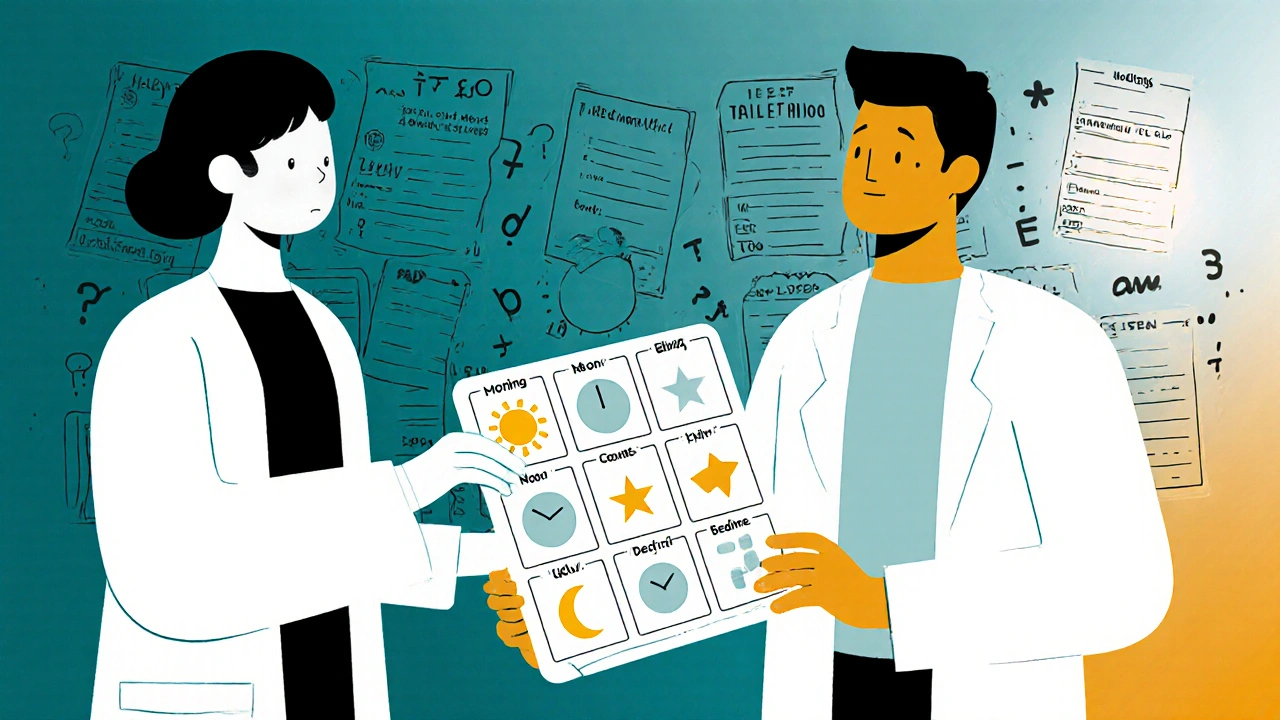
What Health Experts Say About Label Design
Dr. Ruth Parker from Emory University says, "Standard instructions are written for people who read well - but most people don’t." She points out that if labels were written at a 5th-grade level, with short sentences and active voice, comprehension jumps to over 90%. Dr. Michael Wolf, who led a key 2013 study on patient-centered labels, adds: "Simplified labels help - but they can’t fix everything. Many patients struggle with numbers. If you have to calculate how many milliliters to give, and you’re not good at math, you’ll get it wrong." That’s why the Institute for Safe Medication Practices (ISMP) recommends:- Write everything at a 5th-grade reading level or lower
- Use one-column layout - no clutter
- Avoid abbreviations like "q.d." or "b.i.d." - use "once daily" or "twice daily"
- Always list the active ingredient on the front of the package
- Use bold, large font for the dose and frequency
How to Check If You Understand Your Medication
You don’t have to wait for the system to change. You can protect yourself right now. Here’s how:- Ask for the UMS version. Say: "Can you write this in morning, noon, evening, bedtime?" Most pharmacies will do it.
- Use the teach-back method. After the pharmacist explains, say: "Just to make sure I got it - I take this at [say the time], right?" If you can explain it in your own words, you probably understand it.
- Check the active ingredient. Look at the front of the bottle or box. If it’s not listed, ask. Many over-the-counter medicines hide this on the side.
- Use a pill organizer. Fill it once a week with the times labeled: Morning, Noon, Evening, Bedtime. If you can’t remember, your pills will remind you.
- Take a photo of the label. Save it on your phone. When you’re confused, look at the picture. Don’t rely on memory.
What’s Changing - and When
The rules are finally catching up to the problem. In May 2023, the U.S. Pharmacopeia made new standards official: all prescription labels must follow clear design rules by May 2025. That means standardized fonts, pictograms, and plain language. The FDA is also pushing for changes. By 2024, they plan to require pictograms on all prescription labels. And Merck is developing an AI tool that will scan a label and tell you if you’re likely to misunderstand it - expected to launch in early 2024. Hospitals are already seeing results. UW Health cut medication-related readmissions by 22% in six months after training staff to use UMS and teach-back. Malpractice claims dropped 15%. Every dollar spent on health literacy saves $3.75 in avoided hospital visits.What You Can Do Today
You don’t need a perfect system to stay safe. Start with these steps:- Always ask: "What is this medicine for?" and "What happens if I miss a dose?"
- Keep a list of all your meds - including vitamins and OTC drugs - and show it to every doctor.
- Don’t be afraid to say: "I didn’t understand that. Can you show me?"
- If you’re caring for a child or elderly person, double-check every dose with a second adult.
- Use free apps like Medisafe or MyTherapy to set reminders and track doses.
Medication safety isn’t just about doctors and pharmacies. It’s about you. You have the right to understand what you’re taking. If a label feels confusing, it’s not your fault - it’s the system’s. But you can fix it, one question at a time.
What does "take every 4-6 hours" really mean?
It means you can take the medicine anytime between 4 and 6 hours apart - not that you should take 4 to 6 pills. For example, if you take your first dose at 8 a.m., you can take the next one anytime between 12 p.m. and 2 p.m. Most people misunderstand this and take too much. To avoid confusion, ask your pharmacist to write it as "Take 1 pill at 8 a.m., then every 4 to 6 hours as needed - but no more than 4 doses in 24 hours."
Why do some medicine bottles say "take with food" and others say "take after meals"?
They mean the same thing - but the wording isn’t standardized. "Take with food" usually means during or right after eating. "Take after meals" is clearer. If you’re unsure, ask your pharmacist: "Should I take it while eating, or wait 30 minutes after?" Some medicines need food to reduce stomach upset; others need an empty stomach to work properly. Don’t guess.
Can I trust the dosage instructions on over-the-counter medicine?
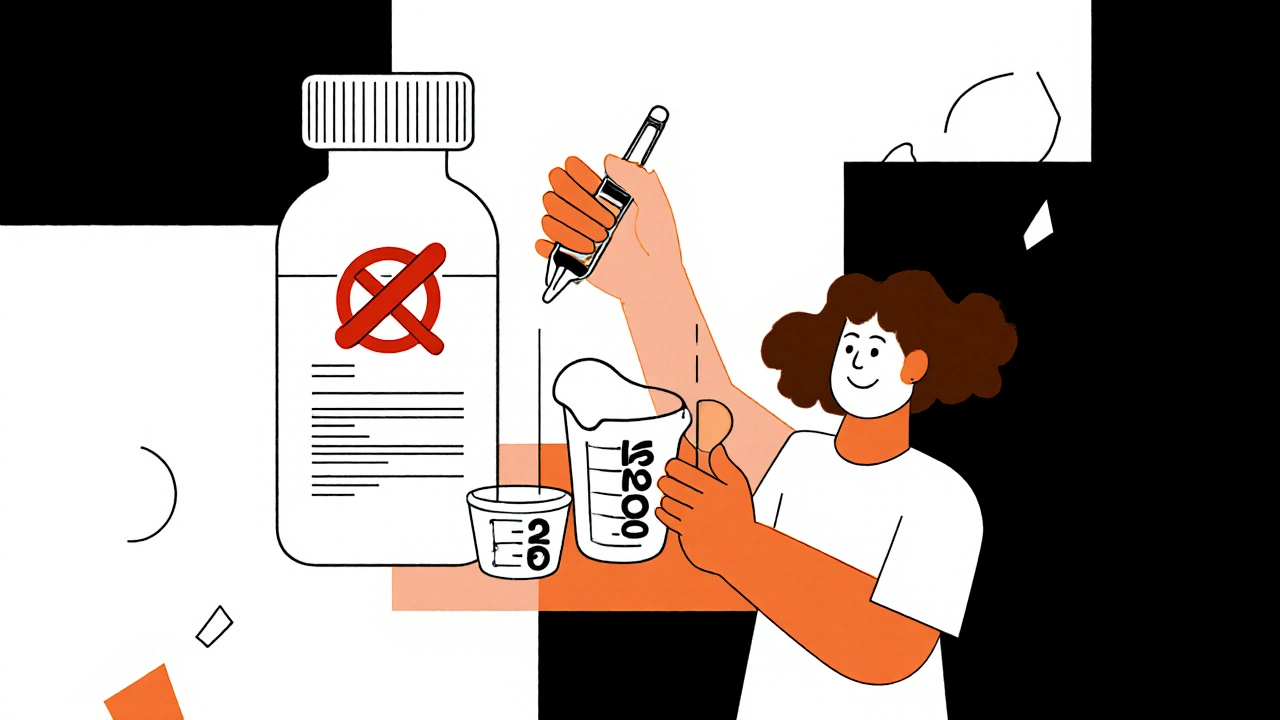
Not always. A 2012 study found that 63% of top-selling children’s liquid medicines used confusing chart-based dosing (like "for weight 20-24 lbs: 5 mL"). Parents often misread them. Always look for the active ingredient and check the milliliter (mL) amount. If it’s not clearly printed, call the manufacturer or ask your pharmacist. For kids, always use the measuring cup that comes with the bottle - never a kitchen spoon.
What’s the difference between "twice daily" and "every 12 hours"?
They sound the same, but they’re not. "Twice daily" usually means morning and evening - around 8 a.m. and 8 p.m. "Every 12 hours" means exactly 12 hours apart - like 8 a.m. and 8 p.m., or 2 a.m. and 2 p.m. If you’re supposed to take a medicine every 12 hours, skipping a dose because you’re asleep can reduce its effectiveness. Ask your doctor or pharmacist which one you need. If you’re unsure, go with morning and evening - it’s safer for most people.
How do I know if I have low health literacy?
You don’t need a test to know. If you avoid reading medical forms, feel embarrassed asking questions, or rely on family members to explain your prescriptions, you may struggle with health literacy. It’s not about intelligence - it’s about education and experience. The good news? Everyone can improve. Ask for simpler labels, use the teach-back method, and don’t be ashamed to say, "I need help with this." Your health depends on it.
What to Do If You’re Still Confused
If you’re still unsure after reading the label, asking questions, and using visuals:- Call your pharmacy. Pharmacists are trained to explain meds - they’re not just dispensers.
- Use a free telehealth service like Teladoc or Healthline to ask a nurse.
- Bring your pills to your next doctor visit and ask: "Can we go over each one?"
- Ask for a printed copy of your medication list in plain language - many clinics now offer this.
Medication errors don’t happen because people are careless. They happen because the system is designed for people who already know how to read it. You deserve better. And you have the power to demand it - one clear label at a time.
farhiya jama
November 29, 2025 AT 18:35Ugh, I just took my blood pressure pill at 3 a.m. because I misread 'every 12 hours' as 'every 12 minutes.' My cat now thinks I'm possessed. Why do they make this so hard? I’m not dumb, I’m just tired.
Also, why is the font smaller than my grandma’s handwriting? I need glasses to read the label AND to find my glasses.
Astro Service
December 1, 2025 AT 03:50Why are we even talking about this? In America, you just take the damn pill. If you can’t read, get someone to help you. Stop blaming the system. We got free pharmacies, free translators, free apps - if you still mess up, it’s on you.
Also, pictograms? Next they’ll be putting emojis on insulin pens. What’s next, a TikTok tutorial for aspirin?
DENIS GOLD
December 1, 2025 AT 09:54LMAO so now we’re designing medicine labels like they’re for toddlers? Next they’ll put a cartoon bear holding a pill with a speech bubble saying 'I feel better now!'
Meanwhile, my cousin overdosed on Tylenol because he thought 'maximum 4 doses' meant 4 pills per dose. Guess what? He didn’t need a sun icon. He needed a brain.
Stop coddling people. Accountability > aesthetics.
Ifeoma Ezeokoli
December 1, 2025 AT 18:39Oh my goodness, I cried reading this. I’m from Nigeria, and my mama took her diabetes meds wrong for 3 years because the label said 'take with food' - she thought it meant 'eat the pill with your food' like a snack! 🥲
When we switched to morning/noon/evening/bedtime, she started sleeping better, her sugar dropped, and she even started teaching her neighbors. This isn’t just design - it’s dignity.
Every time I see a pill bottle now, I whisper, 'I see you. I got you.' 💙
Someone needs to make this mandatory worldwide. Not just in the U.S. - in every village, every clinic, every language.
And yes, I’m sending this to WHO. I’m not waiting for permission to fix what’s broken.
Daniel Rod
December 2, 2025 AT 03:58This hits so deep. I’ve been a caregiver for my dad with dementia, and I swear, half the time I don’t know what’s what - is this the blue one for blood pressure or the white one for anxiety? They look the same.
I started using the UMS system with sticky notes on his fridge: ☀️💊, 🌞💊, 🌙💊, 🌙💤💊. He doesn’t read, but he remembers the pictures.
It’s not about dumbing things down - it’s about lifting people up. 🙏
And yes, I screenshot every label now. My phone is a pharmacy archive. 📸
Thank you for writing this. It feels like someone finally saw us.
gina rodriguez
December 3, 2025 AT 06:45I love that you included the teach-back method. I use it with my mom every time she gets a new script. She says it makes her feel less alone.
Also - pill organizers are a game changer. I got one with morning/noon/evening/bedtime slots and labeled them with washi tape. It’s cute, functional, and honestly? It makes me feel like I’m taking care of her - and myself - better.
Small changes, big impact. 💕
Sue Barnes
December 3, 2025 AT 21:02If you can’t read a label, you shouldn’t be managing your own meds. Period. This isn’t rocket science - it’s basic responsibility. Stop making excuses. The system isn’t broken, people are just lazy.
And pictograms? Are we turning healthcare into a kindergarten poster? Next they’ll be singing lullabies with the prescription.
Save the empathy for people who actually try.
jobin joshua
December 4, 2025 AT 13:57Bro I’m from India and we have 500+ languages here - half the labels are in English, half in Hindi, half in Tamil, and half in scribbles. 😅
My aunt took her heart pill at 4 a.m. because the label said 'q8h' - she thought it meant 'quarter to eight.'
So I made her a WhatsApp voice note saying 'morning, noon, night' in her dialect. She plays it every day. No app. No pictogram. Just love.
Technology helps - but connection heals. ❤️
Sachin Agnihotri
December 5, 2025 AT 16:38Wow, this is the most important thing I’ve read this year. I’ve been a pharmacist for 18 years, and I’ve seen people cry because they didn’t know if they were supposed to take their pill before or after coffee. I’ve watched grandmas give their grandkids the wrong dose because the bottle said 'teaspoon' - and they used a soup spoon.
It’s not about literacy. It’s about design. And design is a moral issue.
I started printing UMS labels by hand for elderly patients who can’t afford apps. I write it in big letters. I draw the sun, the clock, the moon.
One man told me, 'I’ve been taking this for 10 years. Today, for the first time, I know what I’m doing.'
I cried.
So yes - let’s make this mandatory. Let’s make it universal. Let’s make it human.
And if you think this is 'too soft' - ask yourself: who do you want to be the person who fixes this?
Be that person.
❤️