
Evening Primrose Oil and Seizure Risk: What You Need to Know About Antipsychotic Interactions
 Jan, 9 2026
Antipsychotic & EPO Safety Checker
Check Your Safety Risk
Based on clinical evidence and current guidelines, this tool helps you understand potential risks of combining evening primrose oil with your antipsychotic medication.
Safety Assessment
Your individual risk assessment based on current medical evidence:
If you’re taking antipsychotic medication and considering evening primrose oil (EPO) for PMS, eczema, or joint pain, you’re not alone. But here’s the problem: one doctor might tell you it’s safe. Another will say it could trigger a seizure. And both are citing real science. So who do you believe?
What Is Evening Primrose Oil, Really?
Evening primrose oil comes from the seeds of the Oenothera biennis plant. It’s rich in omega-6 fatty acids-mostly linoleic acid (74%) and gamma-linolenic acid (GLA, about 9%). GLA is the part people care about. Your body turns GLA into prostaglandin E1, a compound with anti-inflammatory effects. That’s why it’s used for conditions like breast pain, eczema, and rheumatoid arthritis.
It’s not a miracle cure. But for some people, it helps. The problem isn’t the oil itself-it’s what happens when it meets your brain chemistry, especially if you’re on antipsychotics or have a history of seizures.
The Seizure Controversy: Two Sides of the Same Coin
In the early 1980s, a few case reports linked evening primrose oil to seizures. That was enough for pharmacies and clinics to start warning people. By 2023, Mayo Clinic, Walgreens, and Familiprix all list epilepsy and seizure disorders as contraindications for EPO use. Their warning is clear: don’t take it if you have epilepsy or schizophrenia.
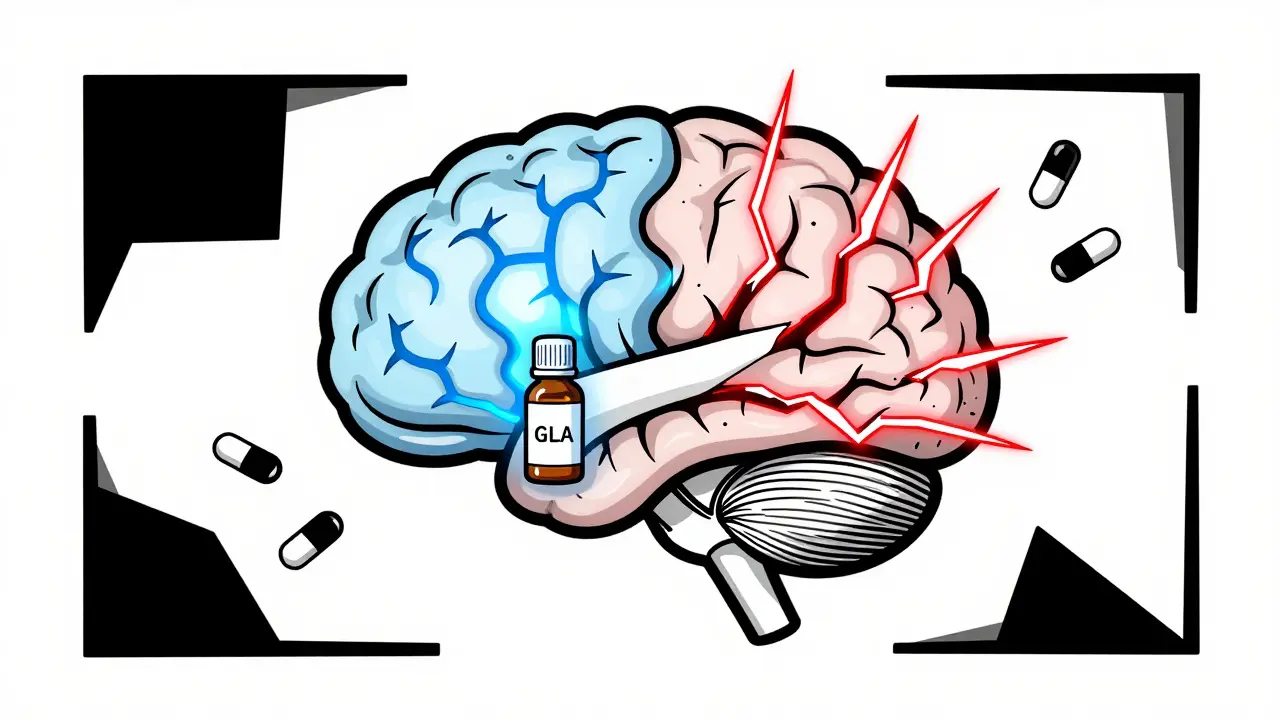
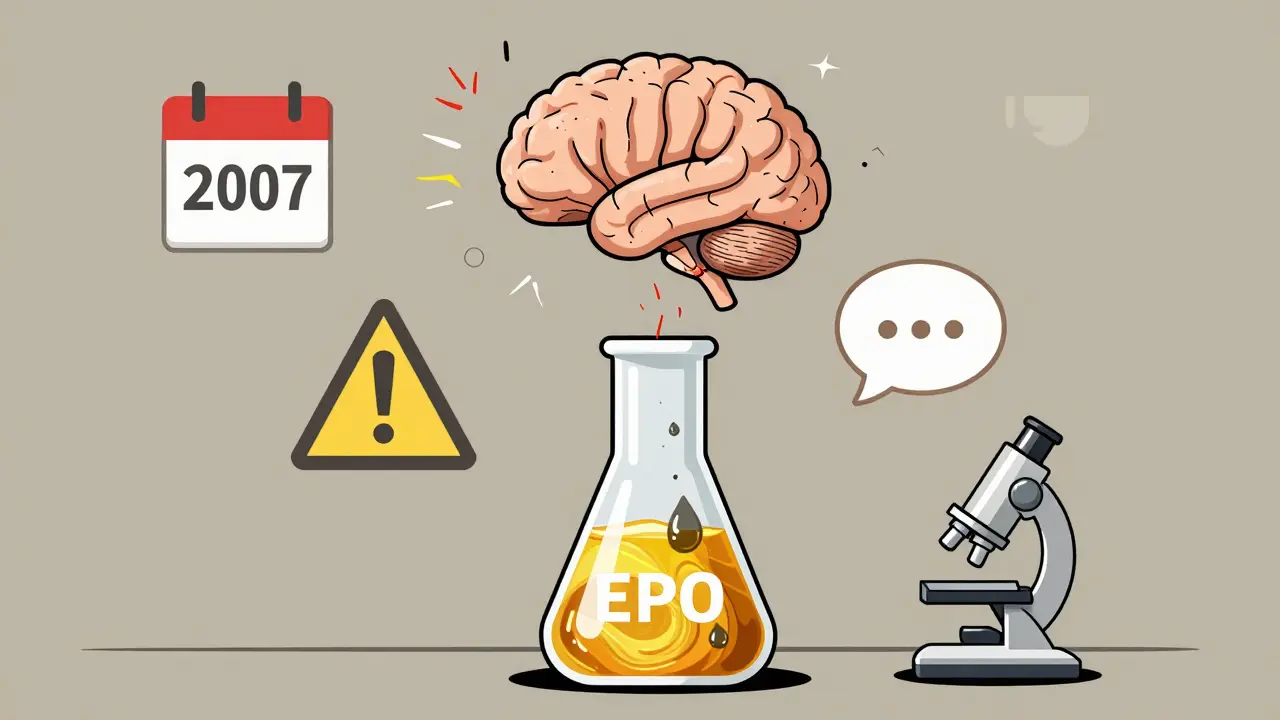
But here’s where it gets messy. In 2007, neuroscientist BK Puri from Imperial College London reviewed every study ever done on EPO and seizures. He found no solid evidence that EPO causes them. In fact, his research showed something surprising: in animal models, EPO’s fatty acids actually protected against seizures. How? By blocking sodium channels in brain cells and reducing abnormal electrical firing. Prostaglandin E1, the compound made from GLA, has documented anticonvulsant properties.
Puri’s conclusion? The seizure link is “spurious.” He argued that guidelines should remove EPO from seizure risk lists entirely.
So why do major institutions still warn against it?
Why the Conflict? Evidence vs. Caution
The American Academy of Neurology rated the evidence linking EPO to seizures as “Class IV”-the lowest level. That means there’s no strong clinical trial data proving harm. But they still recommend caution. Why? Because the mechanism is plausible.
Antipsychotics like chlorpromazine (Largactil), flupentixol (Fluanxol), and amifampridine are known to lower the seizure threshold. Add EPO to the mix, and some experts worry the combination could tip the balance. DrugBank’s 2025 update confirms interactions with these drugs. Familiprix’s 2023 documentation says EPO “increases the incidence of epileptic seizures when taken with antipsychotics.”
But here’s the catch: most of those warnings are based on single case reports. One patient had a seizure under anesthesia after taking EPO. Another reported more seizures after starting EPO with quetiapine. But in both cases, other medications, stress, sleep loss, or alcohol were also involved. Was EPO the cause-or just the last thing they added?
Meanwhile, real-world user data tells a different story. On Drugs.com, a woman with epilepsy took EPO for two years with no change in seizure frequency. On Reddit’s r/Epilepsy forum, 57% of 142 respondents said EPO didn’t affect their seizures. HealthUnlocked’s epilepsy community had nearly twice as many users reporting no issues as those reporting increased seizures.
So why do warnings persist?
The Risk Is Real-But Maybe Not for Everyone
Let’s be clear: seizures are dangerous. A single uncontrolled seizure can lead to injury, hospitalization, or even death. That’s why doctors err on the side of caution.
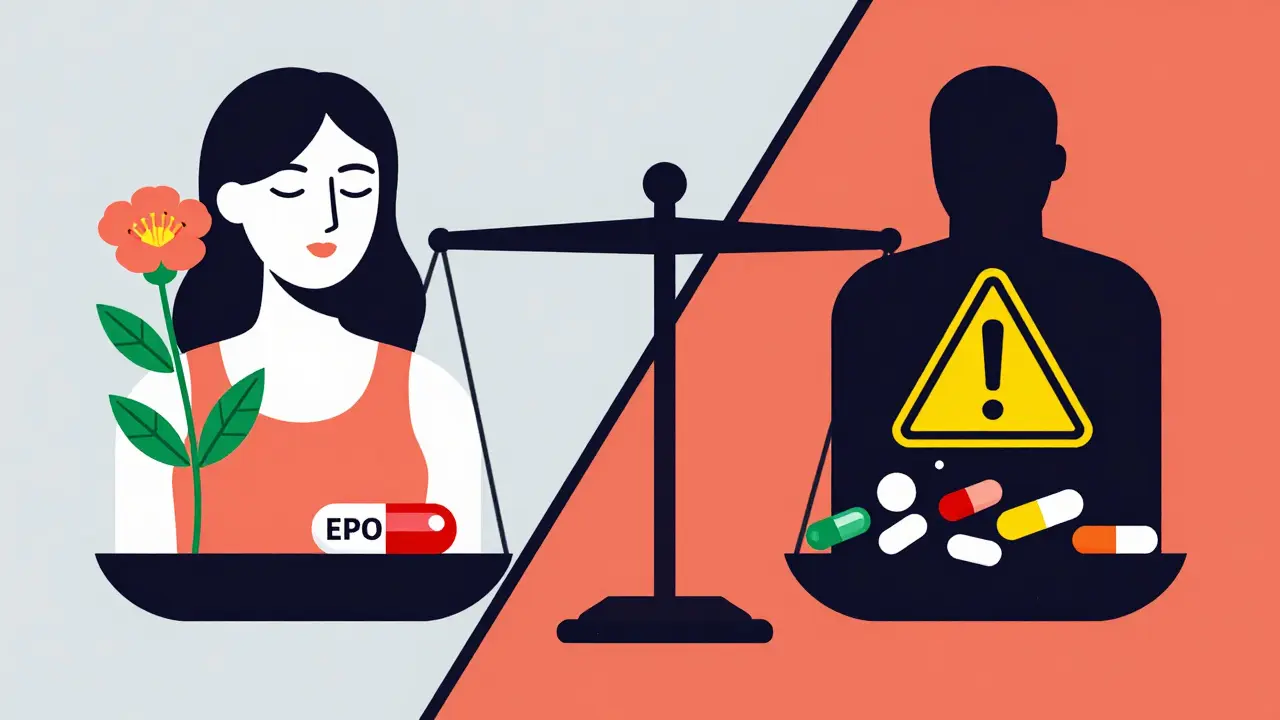
But blanket warnings don’t help. If you’re stable on your antipsychotic, have no history of seizures, and are using EPO for mild PMS, your risk is likely very low. But if you’ve had even one seizure in the past, or if you’re on a high-risk antipsychotic like amifampridine or chlorpromazine, the potential for interaction is real.
Here’s what we know for sure:
- GLA in EPO can affect brain cell signaling-both in ways that might help and ways that might harm.
- Some antipsychotics are more likely to interact with EPO than others. Flupentixol, chlorpromazine, and amifampridine are flagged in multiple databases.
- There’s no large-scale human trial proving EPO causes seizures in people on antipsychotics.
- There’s also no large-scale trial proving it’s completely safe.
That’s the gray zone.
What Do the Experts Actually Say?
Let’s break it down by source:
- Mayo Clinic (2023): “Don’t take it if you have epilepsy or schizophrenia.” No nuance. No qualifiers.
- BK Puri, Imperial College London (2007): “The association is spurious. EPO may be protective.”
- Epilpepsy Foundation (2022): “Theoretical concerns exist. Clinical evidence is limited.”
- DrugBank (2025): Lists 5 specific antipsychotics with documented interaction risk, including newer ones like brexpiprazole and lumateperone.
- Walgreens (2024): “May interact with seizure and antipsychotic meds, increasing seizure risk.”
- European Medicines Agency (March 2024): “No causal link proven, but more research needed on specific drug combinations.”
The divide isn’t just between institutions-it’s between clinical practice and research. Doctors treating patients see rare but serious events. Researchers see weak data and conflicting mechanisms.
What Should You Do?
If you’re on an antipsychotic and thinking about EPO, here’s what to do:
- Check your medication. Are you on flupentixol, chlorpromazine, amifampridine, brexpiprazole, lumateperone, or pimavanserin? If yes, avoid EPO unless your doctor says otherwise.
- Know your seizure history. Have you ever had a seizure-even one years ago? If yes, don’t take EPO.
- Don’t self-prescribe. Talk to your psychiatrist or neurologist. Bring the supplement bottle. Ask: “Is this safe with my current meds?”
- Watch for changes. If you start EPO and notice more twitching, confusion, unusual sensations, or muscle jerks-stop immediately and call your doctor.
- Consider alternatives. For PMS or eczema, there are other supplements with better safety profiles-like vitamin B6, magnesium, or fish oil.
And if you’re already taking EPO without issues? Don’t assume it’s safe forever. Your body changes. Your meds change. A new drug, a sleepless night, or an infection could lower your seizure threshold. What was fine last year might not be safe this year.
The Bigger Picture: Supplements Aren’t Regulated Like Drugs
Evening primrose oil is sold as a supplement. That means the FDA doesn’t require proof of safety before it hits the shelf. Labels vary wildly. One bottle says “500mg per capsule.” Another says “1,300mg.” The dose matters. Higher doses mean more GLA. More GLA means more potential for brain effects.
And here’s something most people don’t realize: 15% of EPO users have a neurological condition, according to Nielsen Health IQ data. That’s a huge number. And the supplement market is growing-EPO sales jumped 8.7% in 2023. People are taking it. Without clear guidance.
That’s why a new 18-month study is underway. Led by Imperial College London and Johns Hopkins, it’s tracking 300 epilepsy patients taking EPO. Results won’t be out until 2026. Until then, we’re stuck in limbo.
Final Thoughts: Trust, But Verify
There’s no easy answer. The science is messy. The warnings are contradictory. The stakes are high.
But here’s what’s clear: if you’re on antipsychotics, you’re already managing complex brain chemistry. Adding an unregulated supplement with unclear neurological effects is risky-even if it’s “natural.”
Don’t rely on Reddit reviews or a friend’s story. Don’t assume “it’s just a supplement” means it’s harmless. Talk to your doctor. Show them the bottle. Ask for the evidence. And if they say “avoid it,” listen. Your brain isn’t worth gambling with.
The truth? Most people won’t have a problem. But for the ones who do? One seizure is one too many.
Mario Bros
January 10, 2026 AT 18:00Christine Milne
January 11, 2026 AT 20:45Bradford Beardall
January 12, 2026 AT 22:24McCarthy Halverson
January 13, 2026 AT 13:00Michael Marchio
January 13, 2026 AT 22:14Jake Kelly
January 15, 2026 AT 02:10Ashlee Montgomery
January 15, 2026 AT 19:54neeraj maor
January 16, 2026 AT 06:59anthony martinez
January 17, 2026 AT 12:37Jake Nunez
January 18, 2026 AT 08:54Ritwik Bose
January 19, 2026 AT 14:58Paul Bear
January 20, 2026 AT 08:16lisa Bajram
January 21, 2026 AT 14:15Jaqueline santos bau
January 22, 2026 AT 14:27