
Dry Eye Syndrome: How to Manage Tear Deficiency and Choose Artificial Tears
 Apr, 17 2026
Imagine waking up with the feeling that there is a piece of sand stuck in your eye, only for that grit to persist all day. For millions of people, this isn't a one-time annoyance-it's a daily reality. Dry Eye Syndrome is a condition where your eyes don't produce enough tears or the tears they do produce evaporate too quickly, leaving the ocular surface vulnerable to inflammation and damage. While it might sound like a simple nuisance, ignoring chronic dryness can lead to corneal scarring or permanent vision loss in about 4.3% of severe cases. The good news? You can manage it, but the secret lies in knowing exactly why your eyes are dry before you reach for the eye drops.
The Two Faces of Dry Eye
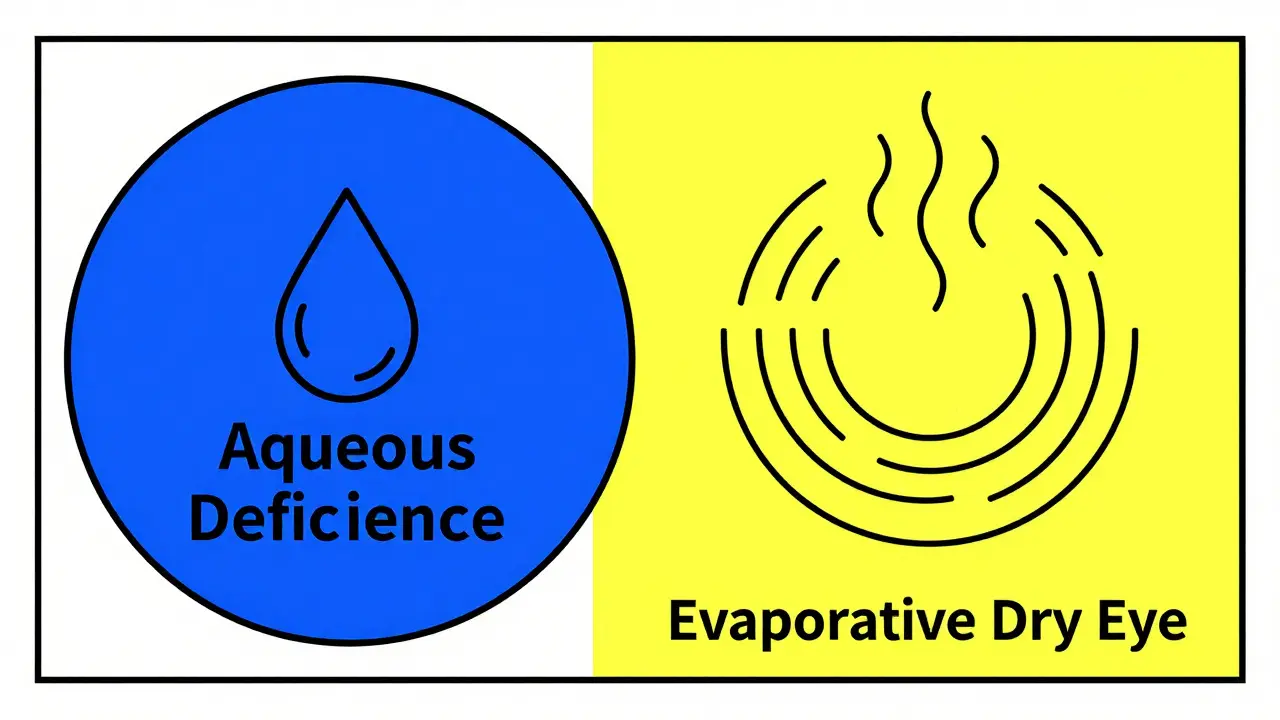
Not all dry eyes are created equal. If you're just buying any bottle of drops from the pharmacy, you might be treating the wrong problem. Experts generally split the condition into two main types: aqueous deficiency and evaporative dry eye.
Aqueous Tear-Deficient Dry Eye (ADDE) happens when your lacrimal glands simply don't pump out enough water. This is the "true" deficiency, affecting about 10-15% of patients. It's often linked to Sjogren's syndrome, an autoimmune disorder, or simply the natural aging process. For instance, the prevalence of this type jumps from around 7% in people in their 20s to nearly 19% for those over 70.
On the other hand, Evaporative Dry Eye (EDE) is far more common, making up roughly 86% of cases. In this scenario, you might be producing plenty of water, but it vanishes almost instantly. This usually happens because of Meibomian Gland Dysfunction (MGD), where the oil glands in your eyelids get clogged. Without that oily top layer, your tears evaporate at rates exceeding 16 nanoliters per minute-way above the healthy 4-8 nL/min range.
| Feature | Aqueous Deficiency (ADDE) | Evaporative Dry Eye (EDE) |
|---|---|---|
| Primary Cause | Low water production (Lacrimal Gland) | Fast evaporation (MGD/Oil Gland) |
| Prevalence | ~10-15% of cases | ~85-90% of cases |
| Common Link | Sjogren's syndrome, aging | Screen time, blepharitis, environment |
| Primary Need | Water replacement | Lipid/Oil supplementation |
Decoding Artificial Tears: Which One Actually Works?
Artificial Tears are the first line of defense for mild to moderate dryness, but the chemistry inside the bottle matters. Most contain electrolytes like sodium and potassium to mimic natural tears, but the "magic" is in the viscosity agents.
If you see hyaluronic acid or carboxymethylcellulose on the label, these are polymers that help the drop stick to your eye longer. For example, a 0.15% sodium hyaluronate formulation can provide relief for up to 4.2 hours, whereas a standard saline drop might only last 2.5 hours. This is a huge difference when you're trying to get through a workday without your vision blurring every twenty minutes.
The biggest debate in the eye-drop aisle is preservatives. Many bottles use benzalkonium chloride (BAK) to keep the solution sterile. However, if you're using drops more than four times a day, BAK can actually irritate the surface of the eye and cause further epithelial damage. This is why doctors strongly recommend preservative-free single-dose vials for heavy users. In fact, people with severe cases often see a 37% greater improvement in symptoms when they ditch the preservatives.
The Vicious Cycle of Inflammation
Dry eye isn't just about a lack of moisture; it's an inflammatory battle. When your tears aren't stable, the salt concentration in your tears increases-a state called hyperosmolarity. This triggers a cascade of inflammatory markers like IL-1 and TNF-α, which can increase by up to 4.7 times the normal level.
This creates a loop: dryness leads to inflammation, and inflammation damages the very glands that produce the tears. This is why artificial tears sometimes feel like a "band-aid" solution. They fix the moisture level for an hour, but they don't stop the underlying fire. For those who find that drops aren't cutting it, prescription options like cyclosporine or lifitegrast are designed to target the inflammation directly, rather than just adding more water to the mix.

Practical Tips for Better Relief
Applying eye drops seems simple, but most people do it wrong. If you're just blinking rapidly after a drop, most of the liquid ends up on your cheek or draining instantly. To get the most out of your drops, try this technique:
- Tilt your head back at a 45-degree angle.
- Gently pull your lower eyelid down to create a small pocket.
- Apply a single drop about 1cm away from the eye-don't touch the tip to your eye, as this can introduce bacteria.
- Close your eyes gently for a moment to let the fluid spread.
If you're dealing with a "gritty" feeling despite using drops, try refrigerating them. Cooling the drops can increase their residence time on the eye by about 22% and provides a soothing sensation that reduces the urge to rub your eyes. For those who wake up with extremely dry eyes, a nighttime ointment (usually Vaseline-based) provides a thick barrier that lasts 6-8 hours, protecting the cornea while you sleep.
When to Stop Self-Treating
While OTC drops are great for occasional dryness, there are red flags that mean you need to see an optometrist or ophthalmologist immediately. If you notice your vision fluctuating by more than 0.5D (significant blurring that doesn't clear with a blink) or if you have severe pain that doesn't respond to moisture, you might have Oxford Grade 3 or 4 corneal staining-essentially, your cornea is becoming "raw."
Additionally, if you've used artificial tears consistently for 4-6 weeks and you're still struggling, it's time for a professional check. You might need a punctal plug (a tiny device that blocks the tear drainage duct) or a neurostimulator to kickstart your natural tear production. Modern diagnostics, like the TearLab system, can now measure your tear osmolarity to pinpoint exactly whether you have an aqueous or evaporative problem, removing the guesswork from your treatment.
Can artificial tears damage my eyes if used too often?
The drops themselves aren't damaging, but the preservatives in multi-dose bottles can be. Benzalkonium chloride (BAK) can cause epithelial damage if used more than 11 times a day. If you need frequent dosing, always switch to preservative-free, single-use vials.
Why do my eyes water more when they are actually dry?
This is the paradox of evaporative dry eye. When the ocular surface becomes irritated and dry, it sends a distress signal to the brain. The brain responds by triggering a flood of "reflex tears." These are mostly water and lack the necessary oils to stay on the eye, so they simply run down your face without actually hydrating the surface.
Do artificial tears work with contact lenses?
Yes, but you must check the label. Some drops can cause the lens to cloud or feel gritty. Look for formulations specifically labeled "for contacts" or those containing HPMC (hydroxypropyl methylcellulose), which typically integrate better with lens materials.
How long does it take for artificial tears to work?
Symptom relief is usually immediate. However, the duration of that relief depends on the viscosity. Standard saline drops last a short time, while those with hyaluronic acid can provide relief for several hours.
Can screen time really cause dry eye?
Yes. When we stare at screens, our blink rate drops significantly-sometimes by 50% or more. Since blinking is what spreads the oil layer across the eye, staring at a monitor leads to faster tear evaporation and an increased risk of developing dry eye syndrome.
william wang
April 17, 2026 AT 12:34I've had the best luck with the preservative-free vials. It really makes a difference if you're using them all day long. Also, the tip about refrigerating them is a total game changer for the morning inflammation ❄️