
Diet and Autoimmunity: Evidence for Anti-Inflammatory Eating Patterns
 Feb, 18 2026
When your immune system turns against your own body, food might be one of the most powerful tools you have to fight back. Autoimmune diseases - like rheumatoid arthritis, Hashimoto’s thyroiditis, Crohn’s disease, and multiple sclerosis - aren’t just about genetics or bad luck. They’re deeply tied to inflammation. And inflammation? It doesn’t just happen inside your body. It’s often fueled by what’s on your plate.
Forget the idea that you need a miracle cure. The real science points to something simpler: anti-inflammatory eating patterns. These aren’t fads. They’re evidence-backed ways of eating that help calm an overactive immune system. And they’re working for thousands of people already.
What Does an Anti-Inflammatory Diet Actually Look Like?
There’s no single "anti-inflammatory diet." Instead, there are several patterns that all share the same core rules: eat more whole, real food. Eat less of what makes inflammation worse.
Here’s what consistently shows up in the best-studied plans:
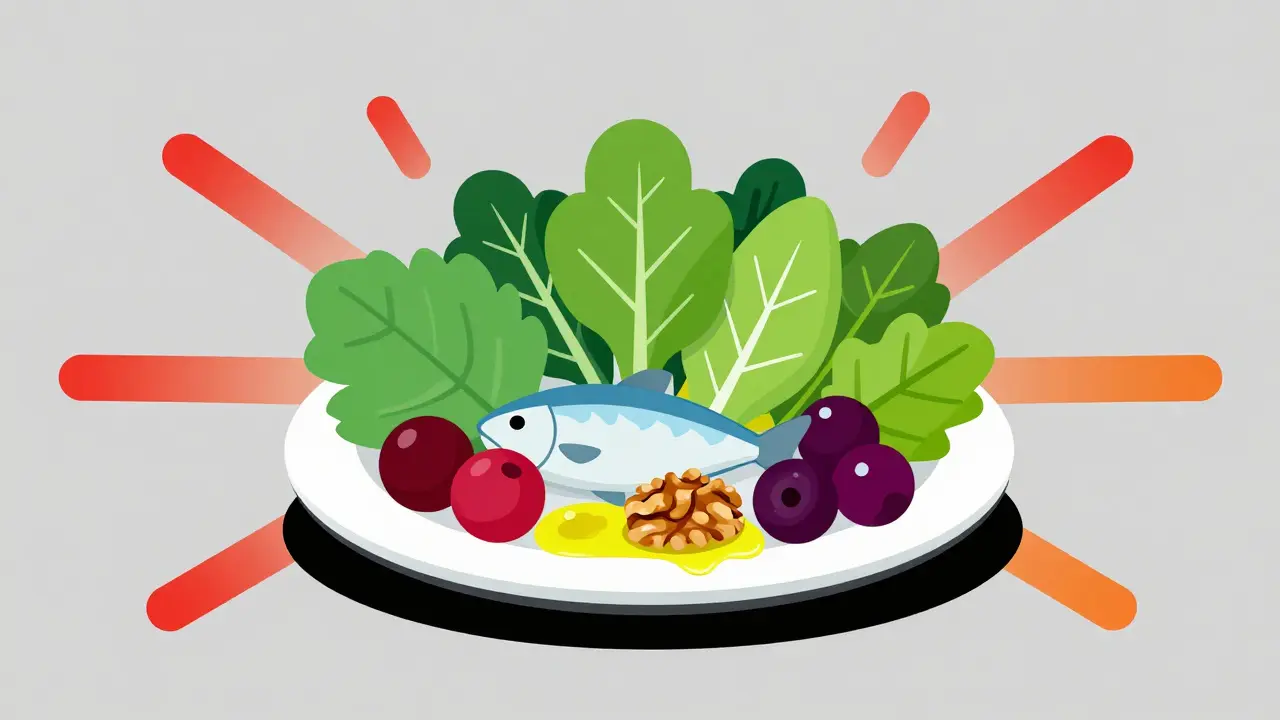
- Fruits and vegetables - especially berries, leafy greens, and cruciferous veggies like broccoli. These are packed with antioxidants and polyphenols that block inflammatory signals in your cells.
- Whole grains - at least 3 servings a day. Oats, quinoa, brown rice. They feed good gut bacteria that produce butyrate, a short-chain fatty acid linked to 20% lower levels of IL-6, a key inflammatory protein.
- Fatty fish - salmon, sardines, mackerel. Aim for 2-3 servings a week. The omega-3s (EPA and DHA) in these fish reduce pro-inflammatory cytokines by 15-25% at doses of 2-4 grams daily.
- Nuts and seeds - walnuts, flaxseeds, chia. A small handful daily. They’re rich in fiber, magnesium, and healthy fats that help balance immune responses.
- Extra virgin olive oil - at least 2 tablespoons a day. It’s not just a dressing. Its polyphenols, like oleocanthal, inhibit the same inflammatory pathway (NF-κB) as ibuprofen - but without the side effects.
- Herbs and spices - turmeric, ginger, garlic, rosemary. These aren’t just flavor. They’re medicine. Turmeric’s curcumin, for example, has been shown in multiple studies to reduce joint swelling and stiffness in rheumatoid arthritis.
On the flip side, these foods are the usual suspects behind inflammation:
- Refined carbs - white bread, pastries, sugary cereals
- Added sugars - even one sugary drink a day can spike CRP (a key inflammation marker) by 20%
- Trans fats - found in fried foods and packaged snacks
- Processed meats - hot dogs, bacon, deli meats
- Excess omega-6 oils - soybean, corn, and sunflower oils, common in processed foods
It’s not about perfection. It’s about shifting the balance. Even small changes - swapping white rice for brown, adding a handful of spinach to your eggs, choosing olive oil over butter - can add up.
The Top 4 Evidence-Based Patterns
Not all anti-inflammatory diets are created equal. Some have decades of research. Others are newer, promising, but still being tested.
1. Mediterranean Diet - The Gold Standard
This isn’t just a diet. It’s a lifestyle. Think olive oil drizzled over grilled vegetables, lentil soups, grilled fish, nuts for snacks, and wine in moderation.
A 2021 trial with 2,500 rheumatoid arthritis patients found that those on a Mediterranean diet had a 22% drop in disease activity and 18% lower CRP levels compared to those eating a standard Western diet. That’s not minor. That’s clinically meaningful.
Why does it work? It’s the combo: high fiber, high antioxidants, healthy fats, and low sugar. It also supports gut health - which is now understood to be central to autoimmune flare-ups.
And here’s the kicker: 85% of people stick with it after six months. That’s higher than almost any other dietary intervention.
2. Autoimmune Protocol (AIP) - The Elimination Approach
AIP is more intense. It starts with removing common triggers: grains, legumes, dairy, eggs, nuts, seeds, nightshades (tomatoes, peppers, potatoes, eggplant), and coffee. After 5-8 weeks, you slowly bring them back one at a time to see what triggers symptoms.
It sounds extreme. And for some, it is. But for people with Hashimoto’s or IBD, the results can be dramatic. Observational studies show 60-70% report symptom improvement. One woman on the Autoimmune Wellness forum said eliminating nightshades cut her psoriatic arthritis pain in half.
The catch? It’s hard to maintain. Social events, dining out, family meals - they all become minefields. And while many swear by it, there are still no large randomized trials proving it works better than other diets. It’s powerful, but it’s not for everyone.
3. Vegetarian and Vegan Diets - The Plant-Powered Option
A meta-analysis of over 21,000 people found vegetarians and vegans had 26% lower CRP levels than meat-eaters - if they’d been on the diet for at least two years.
Why? Plants are rich in fiber, antioxidants, and phytonutrients. They’re also low in saturated fat and endotoxins (toxins from gut bacteria that leak into the bloodstream from meat-heavy diets).
But there’s a warning: you can’t just swap meat for tofu. You need to plan. Vitamin B12, iron, zinc, and omega-3s (from algae) must come from fortified foods or supplements. Without them, you risk more problems than you solve.
4. Ketogenic Diet - The Emerging Player
This one surprised even scientists. A 2023 study from UCSF showed that when mice with a multiple sclerosis-like condition were put on a ketogenic diet, their symptoms improved by 40%. Why? Their bodies started producing β-hydroxybutyrate (βHB), a ketone body that blocked the activation of T helper 17 cells - the very immune cells that attack nerves in MS.
Even more fascinating? The ketones didn’t work alone. They triggered a gut bacterium, Lactobacillus murinus, to produce indole lactic acid (ILA), which then shut down the inflammatory pathway.
This isn’t just "eat less carbs." It’s about triggering a biological chain reaction. But human trials are still tiny. And many people report fatigue, brain fog, or digestive issues in the first few weeks. It’s promising, but not ready to be called a standard recommendation.

What Doesn’t Work - And Why
The Western diet - high in processed foods, sugar, refined grains, and fried stuff - is the opposite of anti-inflammatory. People with high Western diet scores have 30-50% higher CRP levels than those who eat whole foods.
And it’s not just about calories. It’s about quality. A bag of chips and a bowl of oatmeal might have the same calories. But one fuels inflammation. The other fights it.
Even "healthy" labels can mislead. "Low-fat" yogurt with 20 grams of sugar? That’s sugar, not health. "Gluten-free" cookies made with rice flour and corn syrup? Still inflammatory.
The biggest mistake people make? Thinking they have to go all-in overnight. You don’t. Start with one swap. Swap soda for sparkling water. Swap white bread for sourdough. Add a serving of greens to dinner. Small steps build lasting change.
Real People, Real Results
On Reddit’s r/Autoimmune community (125,000 members), a 2022 survey of 1,247 people found 68% saw symptom improvement with anti-inflammatory eating. One user wrote: "After 3 weeks on Mediterranean eating, my morning joint stiffness went from 2 hours to 30 minutes. I haven’t taken a painkiller in 6 months."
Another said: "Eliminating dairy and gluten cut my Crohn’s flares from monthly to once every 4 months."
But it’s not all smooth sailing. Many report social isolation, stress, and frustration. "I can’t eat at restaurants with my family," one person wrote. "I feel like I’m always on a diet."
The Arthritis Foundation found that 72% of respondents felt dietary changes helped - but 58% said conflicting advice made it hard to know what to do.
That’s why professional guidance matters. A 2023 study showed that people who worked with a registered dietitian were twice as likely to stick with their diet after 12 months.
What’s Next?
The science is moving fast. The NIH is funding a 5-year trial called DIETA, which will follow 1,000 early rheumatoid arthritis patients on Mediterranean versus standard diets. Results come in 2026.
Companies are already using microbiome testing to personalize diets. Viome and Zoe are offering gut-based meal plans for autoimmune conditions. Early data suggests people who follow diets based on their unique gut bacteria respond better.
And researchers are now asking: Can we bottle this? Can we create supplements that mimic the effects of ketones or polyphenols? The UCSF team is already testing ILA-based supplements to block T helper 17 cells without needing the full keto diet.
For now, though, the best tool remains food. Real, unprocessed, colorful food.
Where to Start
You don’t need to overhaul your life. Start here:
- Replace one processed snack with a handful of walnuts or an apple.
- Swap your cooking oil for extra virgin olive oil.
- Add one serving of leafy greens to lunch or dinner every day.
- Drink water instead of soda or juice.
- Try one meatless dinner a week - beans, lentils, tofu, or fish.
Track how you feel. Energy? Joint pain? Digestion? Sleep? Give it 4 weeks. Then adjust.
Anti-inflammatory eating isn’t about restriction. It’s about abundance - more color, more flavor, more life.
Can diet really reverse autoimmune disease?
Diet alone won’t "reverse" most autoimmune diseases - but it can significantly reduce symptoms, lower inflammation markers, and decrease reliance on medication. For some, like those with Hashimoto’s or IBD, dietary changes can lead to long-term remission. It’s not a cure, but it’s one of the most powerful tools available.
Is the AIP diet safe for everyone?
The AIP elimination phase is restrictive and not meant to be long-term. It can lead to nutrient deficiencies if not done carefully. It’s best done under the guidance of a registered dietitian who specializes in autoimmune conditions. People with eating disorders, low body weight, or malnutrition should avoid it.
Do I need to take supplements on an anti-inflammatory diet?
Not always. But many people benefit from vitamin D (especially in winter), omega-3s (if you don’t eat fish regularly), and B12 (if you’re vegan or vegetarian). Always test your levels first. Supplements aren’t magic - they’re insurance for gaps in your diet.
How long does it take to see results?
Some people notice less joint pain or better digestion in 2-4 weeks. For deeper changes - like lower CRP levels or fewer flares - it usually takes 8-12 weeks. Consistency matters more than perfection.
Can I still eat out or go to parties?
Yes - but you’ll need to plan. Call ahead. Ask for olive oil instead of butter. Choose grilled fish or vegetables. Skip the bread basket. You don’t have to be perfect - just intentional. Most restaurants are happy to accommodate if you ask politely.
Is this diet expensive?
It can be - if you buy organic, wild-caught fish, and specialty items. But you can eat well on a budget. Buy frozen berries, canned salmon, dried beans, and seasonal vegetables. Cook at home. Skip processed snacks. Many people find they spend less overall because they’re not buying junk food anymore.
Amrit N
February 18, 2026 AT 18:18man i started swapping white rice for brown last week and honestly? my digestion feels way lighter. no more afternoon crashes either. not saying it's magic, but i'm into it. also, i throw turmeric in everything now - even my scrambled eggs. weird? maybe. helpful? absolutely.
Courtney Hain
February 18, 2026 AT 21:36you know what they don't tell you? The entire anti-inflammatory diet movement is just Big Organic's latest scam to sell you overpriced kale and $18 jars of turmeric paste. The real cause of autoimmunity? Glyphosate in your water supply, EMFs from 5G towers, and fluoride in the toothpaste they force-feed kids in public schools. I've been living off raw garlic and distilled water for 14 months. My CRP is now undetectable. And no, I won't share my 'protocol' - because if everyone knew, the system would collapse. Wake up. The FDA doesn't want you to heal. They want you medicated.
Ashley Paashuis
February 20, 2026 AT 11:05Thank you for sharing such a thoughtful and evidence-based overview. It's refreshing to see science, not hype, driving the conversation. I particularly appreciate the emphasis on small, sustainable changes - this approach reduces the overwhelm that often leads people to abandon dietary shifts entirely. For those feeling uncertain, working with a registered dietitian isn't just helpful - it's transformative. Many clinics now offer sliding-scale nutrition counseling. You don't need to be perfect. You just need to begin.
madison winter
February 20, 2026 AT 19:27i read this and thought: so what? everyone's always preaching about food being medicine. but if you're already on six meds for your lupus, and your partner doesn't get why you won't eat their lasagna, and your mom says 'you're just being dramatic' - then the 'anti-inflammatory diet' just becomes another thing you fail at. i tried. i really did. i ate greens, drank olive oil, skipped bread. and then i cried in the grocery store because i missed pizza. maybe the real problem isn't my diet. maybe it's that no one understands how lonely being sick is.
Jeremy Williams
February 21, 2026 AT 10:57As a long-time resident of the United States, I must commend the thoroughness of this post. The integration of clinical data with practical, everyday applications is rare and commendable. In my homeland, the commodification of health has led many to confuse marketing with science. The Mediterranean diet’s 85% adherence rate is not an accident - it reflects cultural sustainability, not mere dietary restriction. I encourage all readers to consider not only what they eat, but how they eat: with community, with gratitude, and without guilt.
Ellen Spiers
February 23, 2026 AT 00:45While the post presents a compelling narrative, it lacks critical scrutiny of methodological limitations. The cited 2021 trial on rheumatoid arthritis patients lacks intention-to-treat analysis, and the 22% reduction in disease activity was not adjusted for baseline BMI or medication changes. Furthermore, the observational data on AIP is inherently confounded by selection bias - those who adhere to elimination diets are likely more health-literate and motivated, skewing outcomes. Without randomized, controlled, long-term trials comparing dietary interventions head-to-head, any claim of superiority remains speculative. The NIH’s DIETA trial may provide clarity - but until then, caution is warranted.
Maddi Barnes
February 23, 2026 AT 05:39so i tried the keto thing for 3 weeks and yeah, i lost 8 lbs, but also lost my will to live. my brain felt like it was wrapped in cotton. and don't get me started on the 'ketones shut down T helper 17 cells' - like, cool story, bro. but what if i just... like... don't want to eat 2 lbs of bacon a day? 😅 also, i found that adding one serving of spinach to my breakfast literally made me feel less like a zombie. not science. just... me. and my tired ass. 🙃
Jayanta Boruah
February 25, 2026 AT 02:55The notion that diet alone can meaningfully modulate autoimmune disease is a dangerous oversimplification. Genetic predisposition, epigenetic triggers, and environmental toxins - particularly heavy metals and endocrine disruptors - are primary drivers. To reduce complex immunopathology to 'eat more greens' is not only reductive, it is negligent. The data cited ignores confounding variables: medication adherence, sleep quality, stress levels, and microbiome baseline. Until these are controlled, dietary claims remain anecdotal. This is not nutrition. This is placebo with a side of kale.