
Coping Strategies for Long-Term Chronic Medication Use: How to Stay on Track
 Jan, 22 2026
Taking a pill every day for years isn’t just a habit-it’s a lifeline. For people managing conditions like high blood pressure, diabetes, rheumatoid arthritis, or heart failure, medication isn’t optional. But here’s the hard truth: chronic medication adherence drops off sharply over time. Studies show that after one year, nearly half of people stop taking their meds exactly as prescribed. Not because they’re lazy. Not because they don’t care. But because it’s exhausting. Overwhelming. Emotionally draining.
Why Long-Term Medication Use Feels Like a Full-Time Job
Imagine waking up every morning to a tray of pills: one for cholesterol, another for thyroid, a third for pain, maybe a fourth for depression. Then again at night. Some need to be taken on an empty stomach. Others with food. Some you can’t crush. Some you can’t skip. And if you miss one, you’re not sure what happens. You start second-guessing: Is this even working? Why do I still feel tired? You see the cost on your pharmacy receipt. You feel guilty when you forget. You avoid talking about it because no one else gets it. This isn’t just about forgetting. It’s about burnout. It’s about losing the sense that you’re in control. And that’s where coping strategies come in-not as a quick fix, but as a daily toolkit to keep you grounded.The Five Coping Strategies That Actually Work
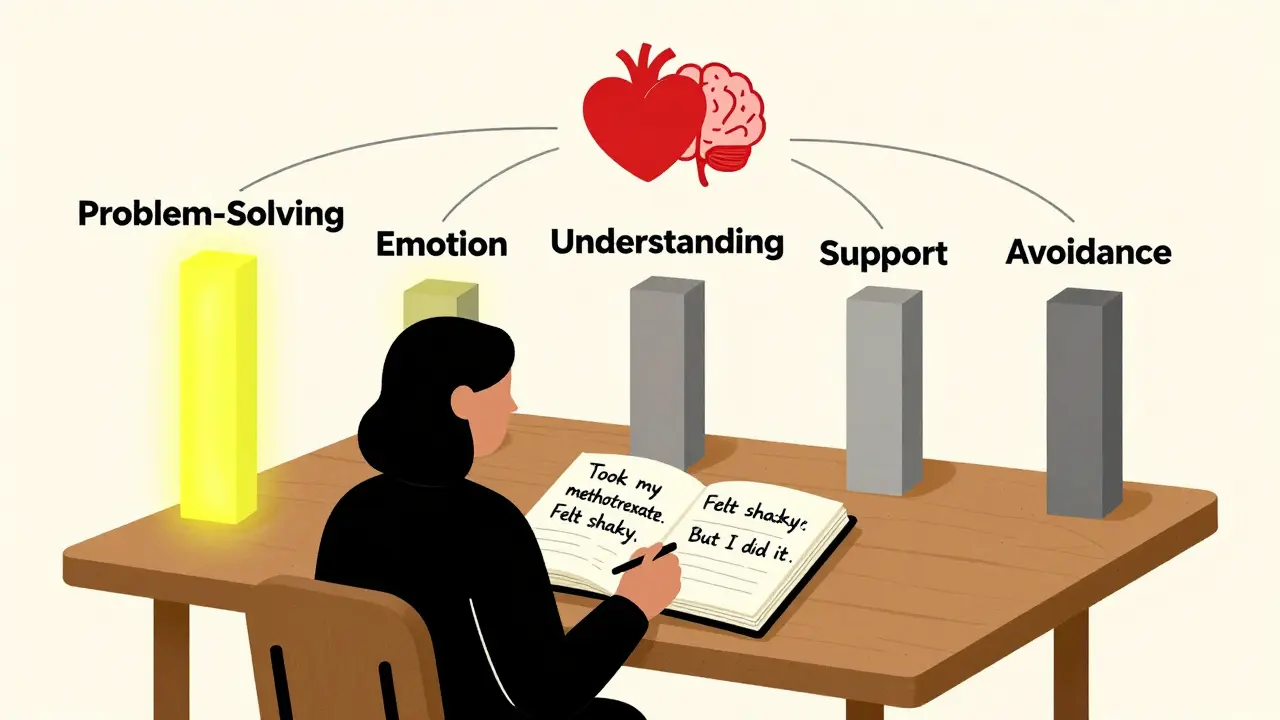
Research from a 2022 review of 15 studies across chronic conditions shows five main ways people cope with long-term medication use. Not all of them help. Some actually hurt. Here’s what the data says about each:- Problem-solving / Active coping - This is the most effective strategy. People who actively figure out solutions-like setting phone alarms, using pill organizers, calling their pharmacist when side effects hit, or asking their doctor about cheaper alternatives-were 78% more likely to stay on track. This isn’t about willpower. It’s about building systems. One woman in Melbourne with type 2 diabetes started using a Bluetooth pill box that texts her when she misses a dose. Her HbA1c dropped by 1.8% in six months.
- Emotion-focused coping - This includes journaling, meditation, talking to a counselor, or even just letting yourself cry about how unfair it all feels. It doesn’t fix the pills, but it stops them from consuming your mental space. Studies found this helped 69% of people improve adherence. One man with rheumatoid arthritis started writing in a notebook every night: “Took my methotrexate. Felt shaky. But I did it.” That small act made him feel like he was still the person in charge.
- Seeking understanding - Knowing why you’re taking a drug changes everything. When patients understand how their medication works-not just “it lowers blood pressure,” but “it stops the artery narrowing that could cause a stroke”-they’re more likely to stick with it. Ask your doctor: “What happens if I don’t take this?” Write it down. Keep that note in your phone.
- Support-seeking - Talking to someone who gets it. That could be a support group, a friend who also takes daily meds, or even a pharmacist who remembers your name. One study found patients who joined a community group for heart failure patients were 30% more likely to refill their prescriptions on time. You don’t have to do this alone.
- Problem avoidance - This is the trap. Skipping doses because you’re “too tired,” hiding pills from your partner, pretending you’re fine. It feels easier in the moment. But research shows this strategy backfires. Half the studies found it led to worse adherence. The other half? Those were people who used avoidance as a short-term break-not a long-term plan. The difference matters.
What Doesn’t Work (And Why)
A lot of advice out there sounds good but doesn’t hold up. Don’t rely on:- Just “trying harder.” Motivation fades. Systems last.
- Shaming yourself for forgetting. Guilt makes you avoid the topic even more.
- Waiting for your doctor to ask. Most doctors don’t bring it up unless you do.
- Assuming you’re the only one struggling. You’re not. Up to 70% of people with chronic conditions have trouble with adherence at some point.
Team-Based Care: The Secret Weapon
The CDC found that patients who got team-based care-where a pharmacist, nurse, and doctor work together-had an 89% adherence rate after 12 months. That’s compared to 74% for those who just saw their GP. What made the difference?- Pharmacists reviewed every medication and cut out duplicates or unnecessary ones.
- Patients got personalized refill reminders via phone call, not just a text.
- They were shown how to access low-cost or free medication programs like RxAssist.org.
- They were encouraged to ask questions without fear.
Practical Tips You Can Start Today
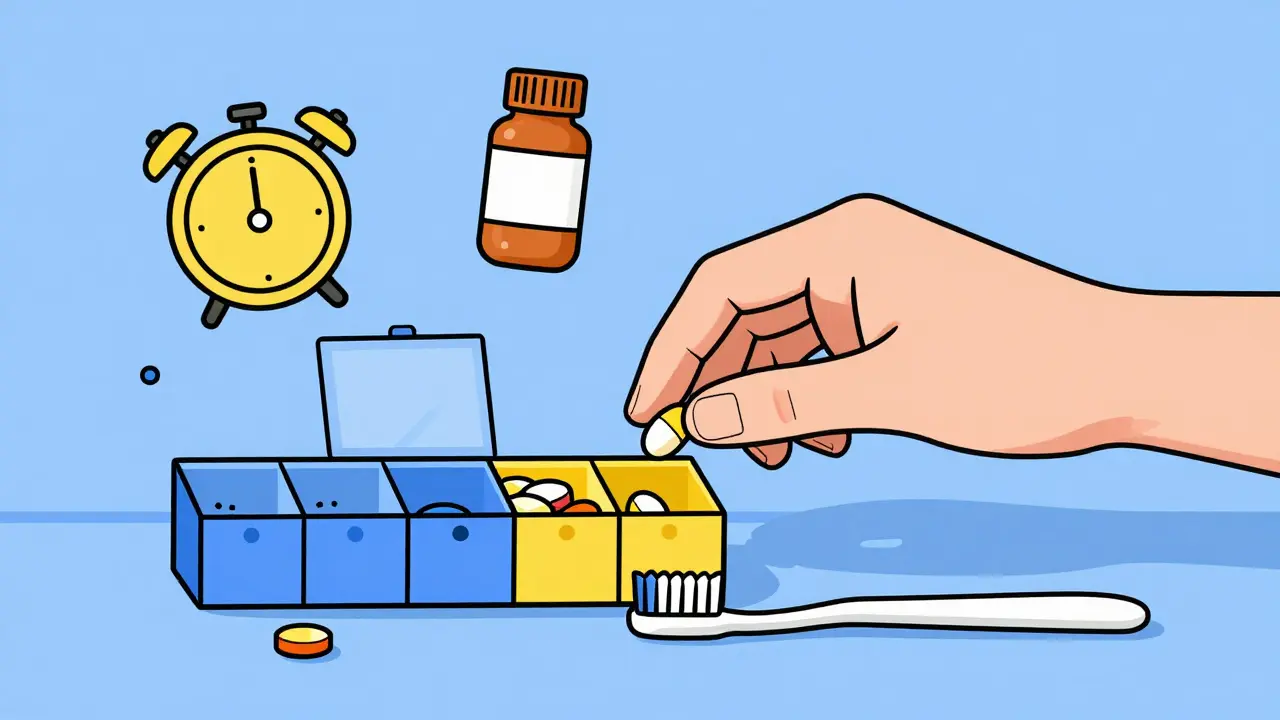
You don’t need to overhaul your life. Start small:- Use one pill organizer with morning and night compartments. Buy it at any pharmacy. Put it next to your toothbrush.
- Set two alarms: one for when you take your meds, one for when you should refill them. Label them: “Take BP pill” and “Call pharmacy.”
- Write down one side effect you’ve noticed. Bring it to your next appointment. Don’t say “I feel weird.” Say: “Since starting lisinopril, I’ve had a dry cough every night. Is that normal?”
- Find one person you trust-friend, sibling, neighbor-and say: “I’m trying to stay on my meds. Can you check in on me once a week?”
- Check your formulary. If you’re paying over $50 a month for a generic, ask your doctor: “Is there another option?” Often, there’s a $4 version.
When Coping Strategies Aren’t Enough
Sometimes, the problem isn’t coping. It’s cost. Or complexity. Or side effects that feel unbearable. If you’re skipping doses because:- You can’t afford your meds → Ask about RxAssist.org, patient assistance programs, or generic alternatives.
- You’re taking 8 pills a day → Ask your doctor if any can be combined. Many blood pressure meds now come in one pill.
- Side effects are ruining your life → Don’t quit. Talk. There are often other drugs in the same class that won’t cause the same issue.

What the Data Doesn’t Tell You
The studies show that women are more likely to stick with their meds than men. Older people do better than younger ones. People with shorter disease duration are more consistent. Why? It’s not just willpower. It’s social support. It’s access. It’s how safe they feel asking for help. If you’re a man, younger, or feeling isolated-your risk is higher. That doesn’t mean you’re failing. It means you need different tools. Maybe more support. Maybe simpler routines. Maybe a different kind of conversation with your doctor.You’re Not Broken. You’re Human.
Chronic illness isn’t a test of character. It’s a marathon with no finish line. Some days you’ll nail it. Other days, you’ll miss a dose. That’s okay. What matters is that you keep showing up. That you keep trying. That you reach out when you’re stuck. The most effective coping strategy isn’t a trick. It’s this: “I’m still here. And I’m still taking care of myself.” That’s enough.Why do I keep forgetting my pills even though I know they’re important?
Forgetting isn’t laziness-it’s cognitive overload. When you’re managing a chronic condition, your brain is juggling symptoms, appointments, diet, exercise, and meds. Over time, your brain starts treating meds as background noise. The solution isn’t to try harder. It’s to make taking pills automatic: link them to something you already do every day, like brushing your teeth or eating breakfast. Use alarms, pill boxes, or apps. Make it a habit, not a choice.
Can I stop my meds if I feel fine?
No. Many chronic meds work silently. Blood pressure pills, cholesterol drugs, and thyroid hormones don’t make you feel better-they prevent damage you can’t see. Stopping them-even for a few days-can raise your risk of stroke, heart attack, or organ damage. Feeling fine means the meds are working. That’s not a reason to quit. It’s a reason to keep going.
What if my side effects are worse than my condition?
Talk to your doctor before stopping. Many side effects fade after a few weeks. Others can be fixed by switching to a different drug in the same class. For example, if a blood pressure pill gives you a dry cough, there are others that won’t. If you’re gaining weight or feeling depressed, there are alternatives. Your doctor can’t help if you don’t speak up. Write down the side effect, when it happens, and how bad it is. Bring that list to your next visit.
Are there free or low-cost options for expensive meds?
Yes. Many drug manufacturers offer patient assistance programs. Websites like RxAssist.org list free or discounted medications based on your income. Pharmacists can also help you find generics or substitute drugs that cost less. In Australia, the PBS (Pharmaceutical Benefits Scheme) caps prescription costs at $31.60 for concession card holders and $31.60 for others in 2026. Ask your pharmacist: “Is there a cheaper version?” They’re trained to help with this.
How do I know if my coping strategy is working?
Track your refills. If you’re running out of pills on time, you’re doing well. Also, notice your stress levels. If you feel less anxious about your meds, if you’re not hiding bottles, if you’re talking about them without shame-that’s progress. You don’t need to be perfect. You just need to be consistent. After three months, ask yourself: “Do I feel more in control?” If yes, you’ve found something that works.
Stacy Thomes
January 22, 2026 AT 13:52You ever just stare at your pill organizer like it’s a villain from a horror movie? I do. Every. Single. Morning. But I started putting it next to my coffee maker-and now, I can’t skip it without feeling like I betrayed myself. It’s not about willpower. It’s about tying it to something you already love. Coffee + pills = my new morning ritual. And guess what? I haven’t missed one in 87 days. You got this.
Dawson Taylor
January 22, 2026 AT 21:14The data is clear. Adherence is not a moral failure but a systems problem. Human cognition is not optimized for repetitive, non-rewarding tasks over extended durations. The solution lies not in increased personal discipline, but in environmental design: external cues, automated reminders, and reduced cognitive load. The individual is not broken. The system is misaligned.
Oladeji Omobolaji
January 23, 2026 AT 17:53Man, this hit home. I take like six pills every day for my BP and diabetes. Sometimes I just... forget. Not because I don’t care, but because life got loud. I started using a cheap pill box from the dollar store and now I leave it on my phone charger. When I plug in at night, I see it. Simple. Works. You ain’t alone.
dana torgersen
January 23, 2026 AT 19:01Okay so like… I’ve been taking my meds for 7 years… and I still cry sometimes… like… why does my body have to be this… broken… thing… that needs… so… many… little… pills… to… even… work…? And I’m tired… I’m so tired… but I still take them… because… I’m still here… and… that… counts… right??
Sallie Jane Barnes
January 25, 2026 AT 03:45Thank you for writing this with such dignity and clarity. I’ve worked in chronic care for over a decade, and I’ve never seen a piece that so accurately captures the emotional labor of daily medication management. The emphasis on system-building over willpower is critical. Most clinical advice ignores the psychological toll. You’ve given people permission to be human-and that’s revolutionary.
Susannah Green
January 26, 2026 AT 07:21Just a quick tip: if you’re on insulin or anything that requires refrigeration, get a small cooler bag with a gel pack and keep it in your work bag or car. I used to leave mine in the sun and it went bad-twice. Now I have a little label on it that says ‘DO NOT ABANDON’ and it makes me laugh. Laughter helps. Also, call your pharmacy and ask for a 90-day supply. Saves trips, saves stress, saves money. You’re doing better than you think.
Kerry Moore
January 26, 2026 AT 07:45I appreciate the emphasis on team-based care. As a clinician, I’ve seen patients who are diligent but overwhelmed. Often, they don’t realize that pharmacists can perform comprehensive medication reviews at no cost. Many patients assume their doctor is the only person who can help. But pharmacists are medication specialists-trained to spot interactions, redundancies, and cost-saving opportunities. If you’re on five or more medications, request a review. It’s one of the most underutilized tools in chronic care.
Sue Stone
January 26, 2026 AT 12:41I forgot my meds yesterday. Didn’t feel like a monster. Just a tired human. Took them this morning. Still here. Still trying. That’s enough.