
Common Medication Errors and How to Avoid Drug Mistakes at Home
 Mar, 11 2026
Every year, hundreds of thousands of people in the U.S. end up in emergency rooms because of mistakes made at home with their medications. It’s not always because someone was careless. Often, it’s because the system is confusing, labels are unclear, or instructions were never fully understood. The truth? Medication errors at home are more common than most people think - and almost all of them are preventable.
What Are the Most Common Medication Mistakes?
When you’re managing meds at home, even small slips can have big consequences. The most frequent errors include:
- Giving the wrong dose - too much or too little
- Missing doses or stopping meds early
- Taking the wrong medicine (like confusing ibuprofen with acetaminophen)
- Taking medicine at the wrong time (e.g., with food when it should be on an empty stomach)
- Double-dosing because you forgot you already took it
- Keeping and using expired or discontinued drugs
- Mixing over-the-counter meds with prescriptions without realizing they contain the same active ingredient
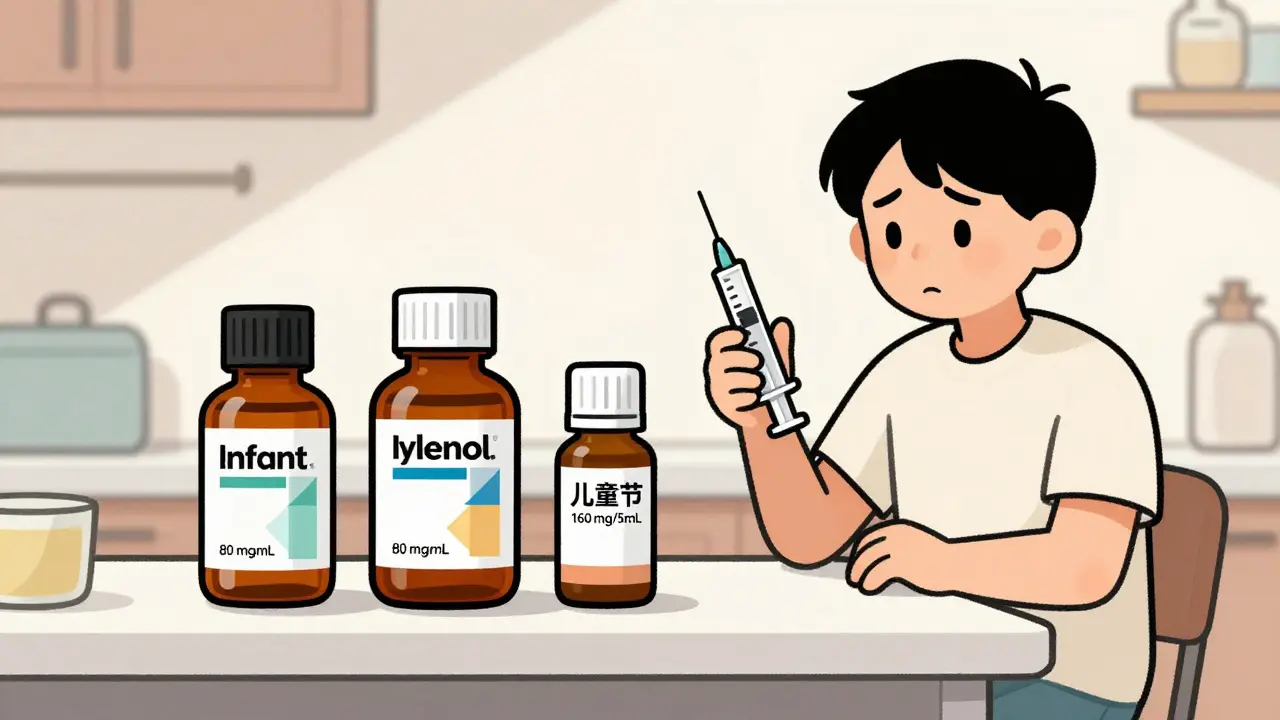
For kids, the risks are even sharper. A child experiences a medication error at home every 8 minutes, according to UC Davis Health. Why? Because parents often mix up infant and children’s strengths of Tylenol or Advil. Infant Tylenol is twice as concentrated as the children’s version. Pouring the wrong one - even by accident - can lead to liver damage. And when parents alternate acetaminophen and ibuprofen to fight fever, they increase the chance of dosing errors by nearly half.
Who’s Most at Risk?
It’s not just seniors or people with complex conditions. Anyone taking multiple drugs is vulnerable. But certain groups face higher risks:
- People over 75 - 38% more likely to make a medication error than younger adults.
- Those on five or more medications - 30% higher chance of mistakes.
- Parents of young children - especially under age 6, where dosing confusion is common.
- People with low health literacy - nearly 80% of patients forget or misunderstand what they’re told at the doctor’s office.
- Those with language barriers - instructions given in English may not be fully understood.
Even caregivers with medical training aren’t immune. One study found that 41.6% of home-care nurses admitted to making a medication error in the past year. If trained professionals slip up, imagine how easy it is for families without medical background to make mistakes.
Why Do These Errors Keep Happening?
It’s not just forgetfulness. The root causes are deeper:
- Confusing labels - Many drug bottles look alike. One pill might say "Lisinopril," another "Lisinopril-HCTZ." If you’re not trained, it’s easy to mix them up.
- Discharge confusion - When you leave the hospital, you’re handed a stack of papers. You’re tired. You’re overwhelmed. You don’t remember half of what the nurse said. A 2023 study found that nearly 93% of parents of kids with ear infections gave fewer antibiotic doses than prescribed.
- Brand vs. generic confusion - Your doctor prescribes "ibuprofen," but the pharmacy gives you "Advil." You think they’re different. They’re not. But if you take both, you’re doubling your dose.
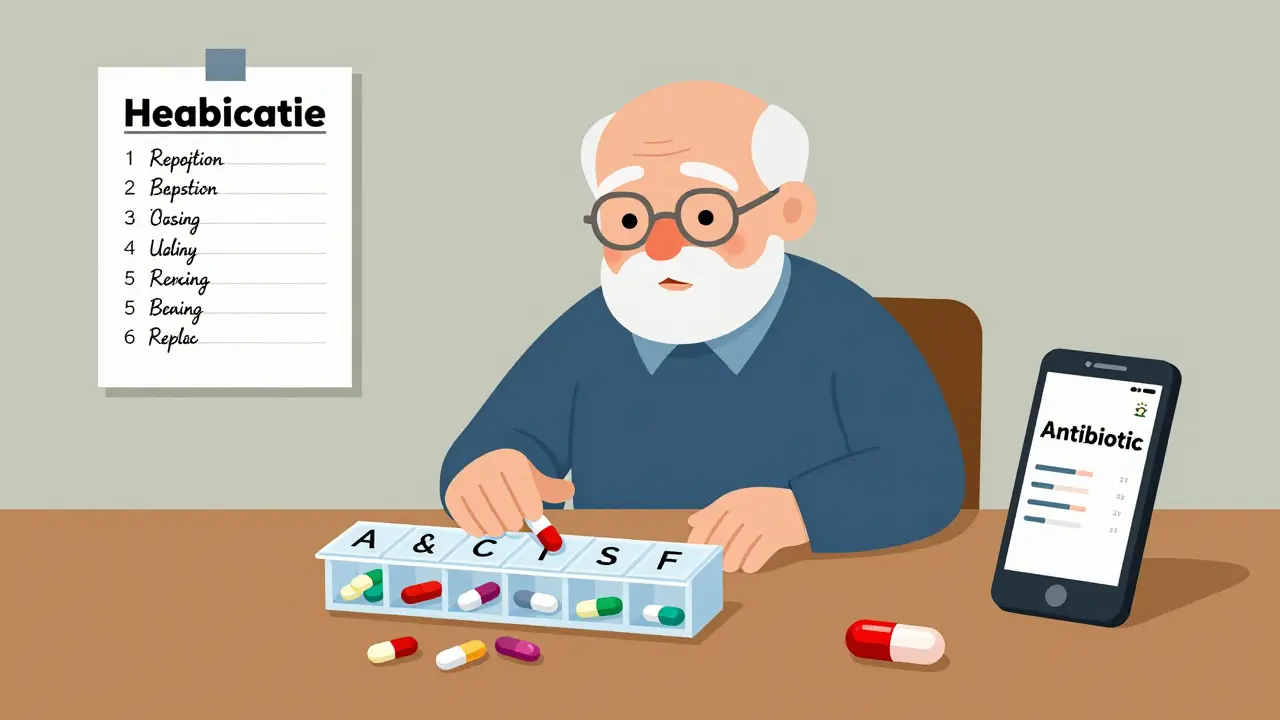
- Medication organizers - Pill boxes help, but only if they’re labeled correctly. If you fill them without double-checking, you could end up with antibiotics in your morning slot and blood pressure pills at night.
- Cost fears - Some people skip doses because they can’t afford the full prescription. Others take extra pills thinking more will help faster.
And then there’s the problem of overlapping ingredients. Cold medicine often contains acetaminophen. So does Tylenol. If you give your child a cold syrup and then give Tylenol for fever - without checking the label - you’re giving them too much acetaminophen. That’s a leading cause of accidental poisoning in kids.
How to Prevent Medication Errors at Home
Here’s what actually works - backed by research and real-world use:
- Keep an up-to-date medication list - Write down every pill, patch, liquid, or injection you take. Include the dose, why you take it, and when. Bring this list to every doctor visit. Update it every time something changes.
- Use one pharmacy - When all your prescriptions come from one place, the pharmacist can check for dangerous interactions. They’ll flag if you’re getting two drugs that shouldn’t be mixed.
- Ask for the "teach-back" method - When your doctor or nurse explains your meds, say: "Can you please explain it to me like I’m going to give this to my child?" Then repeat it back in your own words. This simple trick cuts errors by 40%.
- Read every label - every time - Don’t assume the bottle is the same as last time. Check the name, strength, and instructions. Look for active ingredients. If you’re giving medicine to a child, always match the dose to their weight, not their age.
- Use a pill organizer with clear labels - Buy one with large print and separate compartments for morning, afternoon, evening, and night. Fill it once a week. Double-check each pill against your list.
- Never mix OTC and prescription meds without checking - Always ask: "Does this have the same ingredient as something else I’m taking?"
- Dispose of old meds properly - Expired or unused pills? Take them to a pharmacy drop-off. Don’t keep them in the cabinet. Don’t flush them. Just get rid of them.
- Set phone reminders - Use alarms for doses. Even if you think you’ll remember, your brain gets overloaded. A beep at 8 a.m. and 8 p.m. saves lives.
Special Tips for Parents and Caregivers
If you’re caring for a child under 6:
- Always check the concentration on the bottle. Infant Tylenol is 160 mg/5 mL. Children’s is 160 mg/5 mL - wait, no. That’s the same. Actually, infant drops are 80 mg/1 mL. Children’s liquid is 160 mg/5 mL. Confusing? Yes. That’s why you must read the label.
- Use the syringe that comes with the medicine. Never use a kitchen spoon. A teaspoon isn’t accurate. A syringe is.
- Don’t alternate acetaminophen and ibuprofen unless your doctor says so. It’s tempting to switch to "keep the fever down," but it increases error risk by 47%.
- Keep all meds out of reach. Even if you think the child is too young to grab, toddlers are faster than you think.

What About Seniors?
For older adults:
- Ask for a medication review every six months. Ask: "Are all these still needed?" Many seniors take drugs that were prescribed years ago and no longer help.
- Use a pill dispenser with alarms. Some even call a family member if a dose is missed.
- Have someone else check your pill box once a week. A second set of eyes catches mistakes you might miss.
- Don’t be afraid to say: "I don’t understand this."
When to Call for Help
If you suspect a mistake - even if the person seems fine - don’t wait. Call your pharmacist or poison control. In Australia, dial 13 11 26. In the U.S., call 1-800-222-1222. You don’t need proof of harm. If you’re unsure, it’s better to call.
Also, if you notice someone taking the same medicine twice a day when it’s supposed to be once - or if they’re using an old prescription bottle - speak up. These are red flags.
Final Thought: You’re Not Alone
Medication errors aren’t about being dumb or careless. They’re about systems that are too complex, labels that are too similar, and instructions that are too fast. The good news? You don’t need to be a nurse to prevent them. You just need to be careful - and a little stubborn.
Ask questions. Write things down. Double-check. Keep your list updated. Use alarms. Talk to your pharmacist. These small habits don’t just prevent mistakes - they save lives.
What are the most common medication errors at home?
The most common errors include giving the wrong dose (too much or too little), missing doses, taking the wrong medication, doubling up because you forgot you already took it, mixing over-the-counter drugs with prescriptions, and continuing to take medications after they’ve been discontinued. For children, confusing infant and children’s strengths of acetaminophen or ibuprofen is a leading cause of accidental overdose.
Why are medication errors more common at home than in hospitals?
In hospitals, trained staff use double-check systems, barcodes, and electronic records. At home, there’s no one to verify doses, no one to catch mix-ups, and patients often don’t fully understand their instructions. Studies show 80% of people forget or misremember what their doctor tells them about their meds, making home environments far riskier.
Can using a pill organizer prevent medication errors?
Yes - but only if used correctly. A pill organizer helps you remember when to take your meds, but if you fill it without checking each pill against your prescription list, you could be putting the wrong drugs in the wrong slots. Always cross-reference the label on the bottle with what you’re putting in the box. Use organizers with large print and clear time labels.
How do I know if I’m giving my child the right dose?
Always check the label for weight-based dosing, not age. Use the syringe or dosing cup that came with the medicine - never a kitchen spoon. For acetaminophen and ibuprofen, confirm the concentration (e.g., 80 mg/1 mL for infants, 160 mg/5 mL for children). Never give more than one product containing the same active ingredient at the same time. If you’re unsure, call your pharmacist.
Is it safe to take leftover antibiotics from a previous illness?
No. Antibiotics are prescribed for specific infections and specific durations. Taking leftover ones can lead to underdosing, which encourages antibiotic resistance. It can also cause side effects or allergic reactions if the medicine isn’t right for the current illness. Always dispose of unused antibiotics at a pharmacy drop-off. Never keep them for "next time."
What should I do if I think I gave the wrong medication?
Call poison control immediately - even if the person seems fine. In Australia, dial 13 11 26. In the U.S., call 1-800-222-1222. Have the medication bottle ready. Don’t wait for symptoms to appear. Many drug reactions take hours to show up. Quick action can prevent serious harm.
Emma Deasy
March 12, 2026 AT 17:49Let me just say this: medication errors are not just "mistakes"-they’re systemic failures wrapped in a veneer of "personal responsibility." I’ve seen a 78-year-old woman take her husband’s blood pressure pills because the bottles looked identical-and she didn’t have glasses. No one held the pharmacy accountable. No one even apologized. Just a shrug and a, "Well, it happens." That’s not negligence. That’s institutional abandonment.
And don’t get me started on OTC meds. Tylenol? Advil? Cold syrup? They’re all Trojan horses. The labels are deliberately confusing. The FDA doesn’t regulate font size. The active ingredients are buried in tiny print. It’s not an accident. It’s designed this way to keep you buying more.
I’ve filed complaints. I’ve written letters. I’ve called the manufacturers. Nobody listens. Until someone dies. Then there’s a press release. Then a recall. Then silence again. This isn’t healthcare. It’s a lottery. And we’re all playing with our children’s lives.
Rosemary Chude-Sokei
March 14, 2026 AT 04:48While I appreciate the thoroughness of this piece, I must emphasize the importance of structured medication reconciliation during transitions of care. Research consistently demonstrates that formalized handoffs-especially from hospital to home-reduce adverse drug events by up to 52% when implemented with interdisciplinary oversight.
Furthermore, the use of standardized medication lists in EHR systems, synchronized with pharmacy dispensing records, has proven to be a critical intervention in high-risk populations. The absence of such protocols in outpatient settings is not merely an oversight-it is a systemic vulnerability that demands policy-level attention.
I urge clinicians and caregivers alike to adopt the Beers Criteria and STOPP/START guidelines as foundational tools in home medication management. These are not suggestions. They are evidence-based imperatives.
Noluthando Devour Mamabolo
March 14, 2026 AT 13:36OMG this is so real 😭 I work in a clinic in Cape Town and I’ve seen so many mamas give their babies the wrong dose because the bottle says "160mg/5mL" but the syringe is marked in mL and they think it’s teaspoons 🥲
Also-why do pharmacies still not have color-coded caps? Like, if it’s a high-risk med, make it purple. If it’s an antibiotic, make it red. Simple. Visual. Universal.
And pls stop saying "just read the label"-what if you’re blind? What if you’re illiterate? What if English isn’t your first language? We need better systems, not more blame.
Also-pill organizers? They’re useless if you don’t have someone to fill them. And who has time? We’re working two jobs and raising kids. This isn’t a personal failure. It’s a social one.
Leah Dobbin
March 14, 2026 AT 16:42How ironic that we live in a society obsessed with precision-quantified self, Fitbits, biohacking-yet we entrust our lives to pharmaceutical labeling that looks like it was designed by a toddler with a crayon.
It’s not incompetence. It’s negligence. The pharmaceutical industry profits from confusion. They don’t want you to know that Advil and ibuprofen are the same. They want you to buy both. They want you to think you’re being "smart" by alternating Tylenol and Motrin. They profit from your anxiety.
And don’t even get me started on the fact that the FDA allows "inactive ingredients" to be listed as "other ingredients"-a loophole that lets them hide allergens, dyes, and preservatives. This isn’t healthcare. It’s a corporate game. And we’re the pawns.
Ali Hughey
March 15, 2026 AT 05:30Okay, but have you ever wondered who’s really behind this? 🤔
Think about it: every time someone overdoses on acetaminophen, the hospitals get paid. The ERs get funded. The drug manufacturers get more sales. The pharmacists get more work. The FDA gets more "data" to justify more regulations. It’s a feedback loop.
And the real kicker? The government doesn’t want you to know that the same companies that make the meds also design the labels. There’s a patent. A patent on confusing bottle shapes. A patent on near-identical font sizes. This isn’t accidental. This is engineered.
Who benefits? The system. And we’re all just walking into it, blindfolded, trusting the labels. Wake up.
P.S. I’ve been monitoring my meds since 2018. I use a QR code scanner app. I log every pill. I cross-reference with the NIH database. I’m not paranoid. I’m PREPARED.
Alex MC
March 15, 2026 AT 10:51Thank you for writing this. It’s rare to see a piece that doesn’t just blame the patient.
I’ve been a caregiver for my mom for 5 years. She’s on 11 meds. Some days, I forget which one is which. I use a spreadsheet. I take pictures of the bottles. I call the pharmacy every time something changes.
It shouldn’t be this hard. But since it is, I’m glad someone finally said: "Here’s what actually works."
One thing I’d add: talk to your pharmacist. Not your doctor. Not your nurse. The pharmacist. They’re the ones who catch the interactions. They’re the ones who know the labels inside out. And they’re usually happy to help. Just ask.
rakesh sabharwal
March 17, 2026 AT 06:21These "tips" are elementary. Anyone with a high school education should know not to mix medications. The fact that people need a 2,000-word guide to avoid poisoning themselves is a reflection of societal decay.
And why are we still using paper pill organizers? We live in the age of AI. There are smart pill dispensers with facial recognition and cloud sync. Why aren’t these mandated? Why aren’t they covered by insurance?
It’s not about education. It’s about laziness. And the system rewards it. The system thrives on incompetence. The solution? Stop enabling it. Stop coddling. Start holding people accountable.
Dylan Patrick
March 18, 2026 AT 14:38My grandma took her blood pressure med twice because she forgot she already took it. We started using a pill box with alarms. Now she’s fine. Simple. No drama. Just action.
Also: never use a spoon. Ever. Not even a tablespoon. Use the damn syringe. I don’t care if you think it’s "messy." Your kid’s liver doesn’t care either.
Kathy Leslie
March 20, 2026 AT 13:18This is the most helpful thing I’ve read all year. I’m not a nurse. I’m not a doctor. I’m just a mom who Googles everything. But now I know to check the concentration. And to call poison control. No shame. Just safety.
Thank you.
Amisha Patel
March 22, 2026 AT 05:39Just one question: do you have a template for the medication list? I’d love to use one.
Elsa Rodriguez
March 23, 2026 AT 05:59I can’t believe people still don’t get this. I had a cousin die because her daughter got the wrong dose of Tylenol. They used a measuring cup. They thought "children’s" meant "safe."
It wasn’t an accident. It was a tragedy waiting to happen. And now I have to watch my niece grow up without her sister. And no one even apologized.
Stop being passive. Stop trusting labels. Stop assuming. Double-check. Every. Single. Time.
Serena Petrie
March 23, 2026 AT 14:41Too long. Didn’t read.
mir yasir
March 24, 2026 AT 07:37While the article presents a superficially compelling narrative, it fundamentally misrepresents the root cause of medication errors as systemic rather than epistemological. The failure lies not in labeling or institutional design, but in the erosion of pharmacological literacy among the general populace.
One cannot rely on external systems to compensate for a lack of foundational knowledge. The onus must return to the individual-specifically, to those who elect to self-administer complex pharmacological regimens without first achieving a baseline comprehension of pharmacokinetics, pharmacodynamics, and drug interactions.
It is not the pharmacy’s fault if one cannot differentiate between ibuprofen and acetaminophen. It is, rather, a failure of personal intellectual responsibility.