
Blepharitis: How Warm Compresses Relieve Eyelid Inflammation
 Dec, 31 2025
If you wake up with your eyelids stuck together, your eyes feel gritty like there’s sand in them, or your eyelashes are crusty with flaky debris, you’re not alone. About 47% of people who visit an eye doctor have blepharitis - a chronic inflammation of the eyelid margins that’s often misunderstood and under-treated. It’s not an infection you can catch, and it won’t make you go blind, but it can make daily life miserable. The good news? The most effective treatment isn’t a prescription or a fancy new gadget - it’s something simple, affordable, and backed by decades of clinical research: warm compresses.
What Blepharitis Actually Feels Like
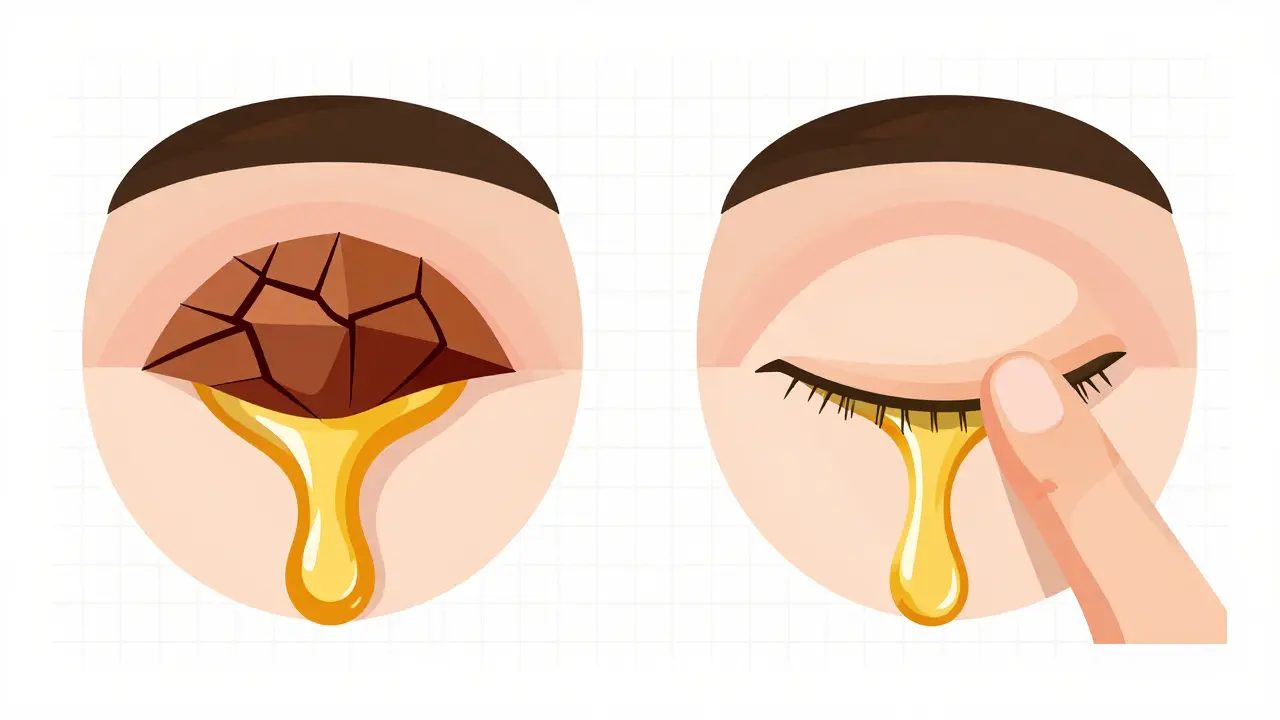
Blepharitis isn’t just “dry eyes” or “a little redness.” It’s a persistent, often morning-heavy condition with clear signs. You’ll likely notice red, swollen eyelid edges, especially near where your lashes grow. Dandruff-like flakes cling to your lashes. Your eyes burn or sting. You might blink and feel like you’re rubbing your eyes with sandpaper. And yes - many people wake up with their eyelids glued shut by dried secretions. There are two main types: anterior and posterior. Anterior blepharitis affects the outer edge of the lid, near the lashes. It’s often tied to skin conditions like dandruff or rosacea. Posterior blepharitis - the more common form - hits the inner edge, where tiny oil glands (called meibomian glands) sit. These glands normally release a clear oil that keeps your tears from evaporating. When they get clogged, your tears turn foamy, your eyes dry out, and irritation follows. A slit-lamp exam by an eye doctor can confirm it. You’ll see collarettes - little cylindrical flakes wrapped around lashes - or visible blood vessels along the lid margin. But you don’t need a diagnosis to start treatment. If you have these symptoms consistently, especially in the morning, warm compresses are your first step.Why Warm Compresses Work - The Science Behind the Heat
Heat isn’t just soothing. It’s medicinal. The meibomian glands in posterior blepharitis produce thick, waxy oil instead of the smooth, liquid kind. Think of it like bacon grease cooling in a pan - it hardens and clogs the openings. Warm compresses melt that buildup. Studies show that applying heat at 40-45°C (104-113°F) for 10-15 minutes liquefies the blocked oil. That’s not “warm to the touch.” That’s a precise, therapeutic temperature. Anything below 38°C has little effect. Anything above 48°C risks burning your eyelid skin - which is thinner than the skin on your face. A 2022 Cleveland Clinic study found that after 21 days of daily warm compresses, meibomian gland secretion quality improved by 68%. Another study from the University of Michigan showed that combining heat with gentle massage boosted gland function by 81%. And here’s the kicker: patients who stuck with it for 30 days saw 67% symptom improvement. Those who skipped days? Only 22% improved. The National Eye Institute, Mayo Clinic, and American Academy of Ophthalmology all agree: warm compresses are the first-line treatment. No pills. No drops. Just heat, time, and technique.How to Do Warm Compresses Right - Step by Step
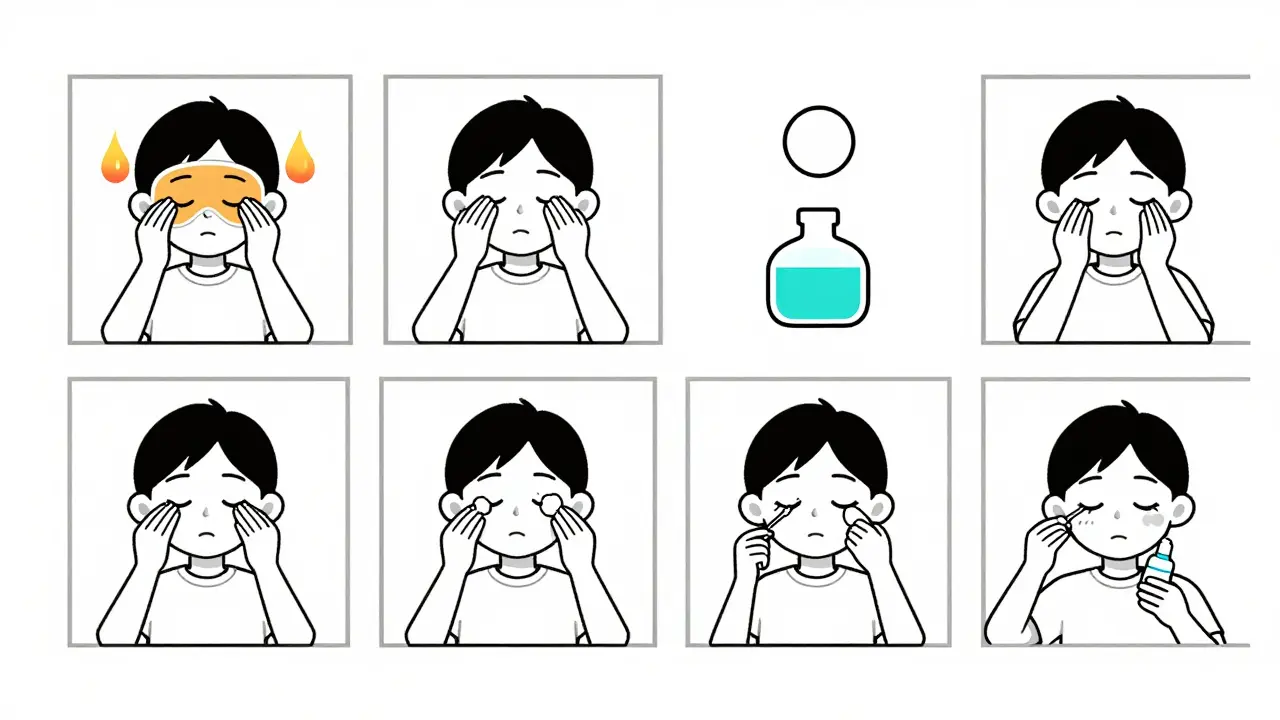
Most people try warm compresses and give up because they’re doing it wrong. Here’s the exact method proven in clinical trials:- Heat - Use a microwavable gel pack, a clean washcloth soaked in hot (not boiling) water, or a medical-grade warming mask. Heat it until it’s comfortably hot but not scalding. Test it on your wrist first. It should feel like a warm bath, not a sauna.
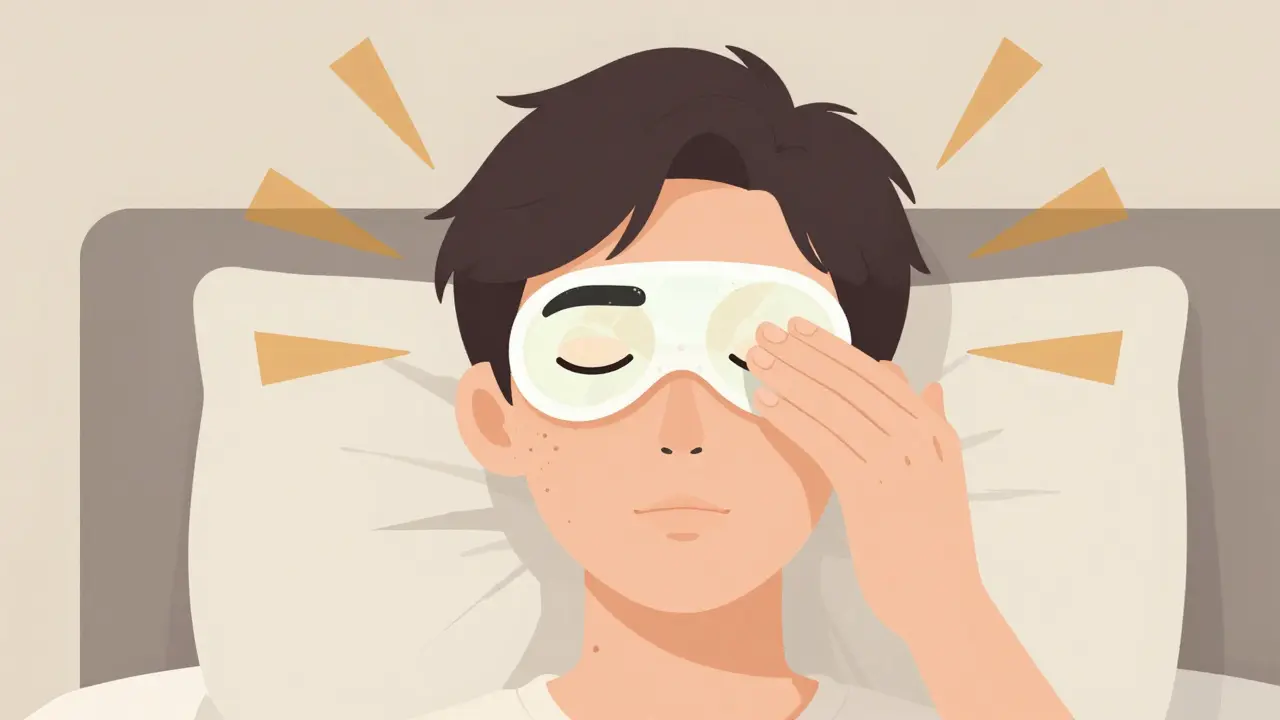
- Apply - Close your eyes and place the compress over both eyelids. Set a timer for 10 minutes. Don’t rush. Most people lose heat after 7 minutes with a washcloth. Reheat if needed.
- Massage - Right after removing the compress, use your clean fingertip. Gently slide your finger along the upper lid, moving downward toward the lashes. Do the same on the lower lid, moving upward. Do this for 30 seconds. This pushes out the melted oil.
- Clean - Use a preservative-free eyelid wipe or a cotton swab dipped in diluted baby shampoo (one drop in 1/4 cup water). Gently scrub the base of your lashes to remove flakes and debris.
- Moisturize - If your eyes still feel dry, use artificial tears without preservatives. Avoid redness-relief drops - they make it worse over time.
What Works Best - Washcloth vs. Commercial Masks
You don’t need to spend money to get results. A clean washcloth works fine. But here’s the catch: most people stop using washcloths after a few days because they cool down too fast. A 2022 Mayo Clinic analysis found that washcloths stay at therapeutic temperature for only 8.7 minutes on average. Gel packs last 12.3 minutes - enough to cover the full 10-minute window without reheating. Commercial warming masks - like the Bruder Moist Heat Eye Compress - are designed to hold 43°C for 10-15 minutes. They’re pricier ($15-$40), but a Cleveland Clinic survey showed 73% of users kept using them after 90 days, compared to just 46% of washcloth users. Why? Convenience. You don’t have to microwaving, testing, or re-wetting. You just put it on and walk away. If you’re serious about managing blepharitis long-term, a medical-grade mask is worth the investment. But if you’re just starting out, a washcloth is perfectly fine - as long as you reheat it when it cools.Why People Fail - And How to Avoid It
The biggest reason warm compresses “don’t work” is poor technique. In a Reddit analysis of 487 posts, 81% of users who initially saw no improvement succeeded after getting professional instruction. Common mistakes:- Not heating long enough - 5 minutes won’t melt the oil.
- Skipping the massage - heat alone doesn’t clear the glands.
- Using water that’s too hot - burns the skin, doesn’t help the glands.
- Only doing it once a day - twice is ideal for the first month.
- Not cleaning afterward - flakes and bacteria build up again.
What Else Helps - Beyond the Compress
Warm compresses are the foundation, but they work better with support.- Omega-3 supplements - Taking 2,000 mg of EPA/DHA daily improves oil quality. A 2023 ARVO conference study showed a 34% boost in treatment success when combined with compresses.
- Hygiene - Avoid eye makeup during flare-ups. Wash your face daily. Use a gentle cleanser.
- Humidifiers - Dry air makes symptoms worse. A bedside humidifier helps.
- Antibiotics or anti-inflammatories - Only if compresses don’t help after 4-6 weeks. These are second-line, not first.
The Bigger Picture - Why This Matters
Blepharitis isn’t just an eye issue. It’s a quality-of-life issue. People with chronic blepharitis report lower productivity, reduced social confidence, and higher stress. The global market for treatments is growing fast - hitting $1.27 billion in 2023 - because more people are finally recognizing it as a real, treatable condition. The American Academy of Ophthalmology’s 2023 guidelines were the first to spell out exact temperature and timing rules. That’s a big deal. For decades, doctors just said “use warm compresses.” Now they say: “40-45°C for 10-15 minutes, twice daily, with massage.” New devices are coming - smart masks with built-in thermometers, apps that remind you to apply heat. But the core hasn’t changed. Heat. Time. Massage. Clean. That’s it. If you’ve been living with crusty, burning eyelids for months - or years - you don’t need another pill. You need to start this routine. Today.Can blepharitis go away on its own?
No. Blepharitis is a chronic condition. It won’t disappear without care. Left untreated, symptoms may flare up repeatedly, especially during stress, dry weather, or poor hygiene. But with consistent warm compresses and lid hygiene, most people achieve long-term control and rarely experience severe flare-ups.
Are warm compresses safe for contact lens wearers?
Yes. Remove your contacts before applying warm compresses. Heat can warp soft lenses, and debris from the eyelids can get trapped under them. Clean your eyelids first, then reinsert lenses after the full routine. If your eyes feel dry afterward, use preservative-free artificial tears.
How long until I see results from warm compresses?
Most people notice improvement within 14-21 days. Morning crusting and grittiness should begin to lessen. By day 30, 85% of compliant users report significant symptom reduction. If you don’t see any change after 4 weeks, check your technique or consult your eye doctor - you may need additional treatment.
Can I use a heating pad or hot water bottle instead?
Not recommended. Heating pads and hot water bottles often get too hot (above 48°C) and can burn your eyelids. They also lose heat too quickly and don’t conform well to the eye shape. Use a microwavable gel pack, a warm washcloth, or a medical-grade mask designed for eyelids. Safety and precision matter.
Is blepharitis caused by poor hygiene?
Not exactly. While good hygiene helps manage it, blepharitis is usually linked to skin conditions (like rosacea or seborrheic dermatitis), bacterial overgrowth, or oil gland dysfunction. Even people who wash their faces daily can have it. It’s not a sign of being dirty - it’s a medical condition that responds well to targeted care.
Should I use antibiotic eye drops for blepharitis?
Only if warm compresses and lid hygiene don’t help after 4-6 weeks. Antibiotics don’t fix the root problem - clogged oil glands. They may reduce bacteria temporarily, but they don’t improve gland function. Warm compresses address the cause. Use drops only if your doctor recommends them after trying the basics.
Layla Anna
December 31, 2025 AT 19:08OMG I’ve been dealing with this for years and never knew heat needed to be exactly 40-45°C 😅 I was just using hot towels and wondering why it didn’t work
Just tried it tonight with my microwavable mask and my lids actually felt *better* after 10 mins
no more crusty wakeups 🙌
Heather Josey
January 1, 2026 AT 09:39This is one of the most clinically accurate and practically useful posts I’ve read on this topic in years. The specificity regarding temperature, duration, and massage technique aligns perfectly with current ophthalmic guidelines. Many patients abandon treatment prematurely due to lack of clear instruction-this provides exactly what they need. Thank you for the evidence-based clarity.
Olukayode Oguntulu
January 2, 2026 AT 01:51Let’s be real-the real diagnosis here isn’t blepharitis, it’s late-stage capitalist healthcare commodification. They sell you a $40 mask so you don’t ask why your meibomian glands are failing in the first place. It’s not heat-it’s the collapse of systemic detoxification pathways. The body doesn’t ‘clog’-it’s screaming for balance. You think a gel pack fixes your dysbiosis? Nah. You need fasting, grounding, and maybe a shaman.
Also, omega-3? Please. That’s just Big Fish Oil pushing their agenda.
jaspreet sandhu
January 2, 2026 AT 08:55I tried this for two weeks and nothing changed so I stopped. Everyone says warm compresses work but I don’t believe it. My eyes still burn and I still get crust. Maybe it works for some people but not everyone. I think doctors just say this because they don’t have real medicine for it. I read online that it’s actually caused by 5G radiation or something. I don’t trust modern medicine anymore. I tried apple cider vinegar rinse too. Didn’t help. So I just live with it now.
Alex Warden
January 4, 2026 AT 03:28USA has the best eye care in the world and this is why. No other country would have the science to figure out that heat melts oil. Other countries are still using tea bags and chanting over their eyes. We got studies, we got temps, we got data. This is American medicine at its finest. Don’t let the woke left tell you otherwise. Do the compresses. Be proud. #MakeEyesGreatAgain
Lee M
January 4, 2026 AT 09:59Heat is just a bandaid. The real issue is modern life. We’re all glued to screens, breathing polluted air, eating processed junk, and sleeping under blue light. The eyelid glands are a mirror of our civilization’s decay. You can’t fix a broken system with a warm towel. You need to unplug, go offline, walk barefoot on dirt, and stop consuming. The body heals when the mind stops screaming. This isn’t about glands. It’s about existential dissonance.
Also, why are we letting corporations dictate our healing rituals? Who owns the gel pack patents?
Kristen Russell
January 4, 2026 AT 20:55Just wanted to say this worked for me too. I was skeptical but did it twice a day for 3 weeks and now I don’t need to wipe my eyes when I wake up. Life-changing. Keep going even if it feels boring.
Liam George
January 5, 2026 AT 15:22Did you know the FDA approved these compresses after a secret 2018 meeting with Big Pharma and the American Academy of Ophthalmology? They’re not selling you relief-they’re selling dependency. The real cure is avoiding artificial lighting and using only candlelight at night. The 40-45°C range? That’s a controlled frequency to keep you docile. Look up Project Eyelid. The government has been suppressing the truth about meibomian gland suppression since the 80s. You think your washcloth is helping? It’s just a placebo for the system’s design.
sharad vyas
January 6, 2026 AT 23:17In India, we use a warm spoon dipped in water and pressed gently on the eyelid. It’s simple, safe, and passed down for generations. No gadgets needed. The warmth is enough if done with patience. I think the science is right, but we don’t need to overcomplicate it. Sometimes the oldest ways are the truest.
Also, thank you for writing this. Many people suffer silently.